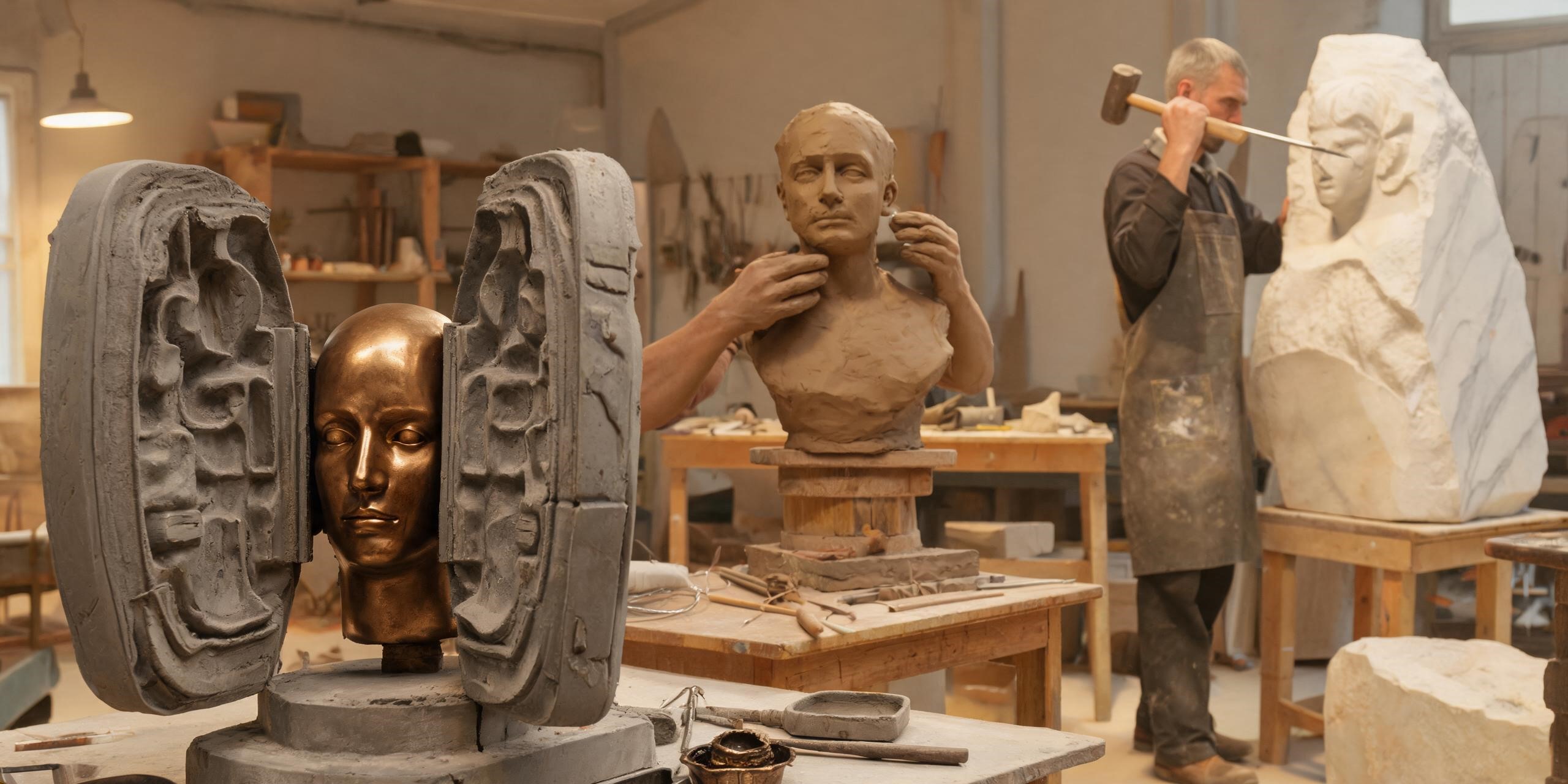
Three doors lead into sculpture. One cuts the material away, one builds it up, and one pours it into a mould. Every sculpted object on earth came through one of them.
The classification is older than any national tradition. A Greek marble torso, a Chinese bronze ritual vessel and a Jingdezhen porcelain figure all belong to one of three families: the sculptor either removes material (diao, u96d5), adds it (su, u5851), or reproduces a model through a mould (zhu, u94f8). Everything else u2014 welding, 3D printing, assemblage u2014 is a modern extension of one of these three.
This article sets out the three methods, the spatial forms they produce, and the working principles that apply regardless of material. It is a general map. For how the three methods play out in porcelain specifically, the Jingdezhen series covers building with clay, cutting into the body and casting through a mould in separate articles.
Carving, Modelling, Casting: The Three Core Methods
The three methods differ in one fundamental respect: what the sculptor does to the material.
| Method | Chinese | What the sculptor does | Typical materials | Key property |
|---|---|---|---|---|
| Carving | u96d5 | Removes material, keeping the form that remains | Stone, wood, ivory, jade | Irreversible; the classical tradition |
| Modelling | u5851 | Adds material, building the form up gradually | Clay, wax, plaster, oil-based modelling clay | Freely correctable; the most open method |
| Casting | u94f8 | Makes a model, takes a mould, pours a liquid material | Bronze, iron, resin, porcelain slip | Reproducible; the same model yields many copies |
Each method produces a different relationship between the sculptor and the finished object. The carver commits to every stroke, because material can only be removed and never replaced. The modeller can keep changing their mind until the material dries, and the same clay can be reworked many times. The caster thinks in two stages: first the model, which can be corrected freely, then the casting, which cannot be corrected at all.
The three methods also produce three different working rhythms. Carving is slowest at the start, because the whole figure must be planned before the first stroke, and fastest at the finish, because there is nothing left to add. Modelling is slowest in the middle, where the form is still open and every decision can still be unmade. Casting is slowest at the mould stage, which is where the edition is fixed, and fastest in the pouring, which is mechanical.
The methods are not exclusive. A figure can be modelled in clay, cast in bronze, and finished by carving the surface; a stone can be carved and then have cast elements attached. But every part of every sculpted object still came through one of the three doors, and the character of the finished work is set by which door it came through.
Spatial Forms: Round, Relief, Pierced, Incised
Whichever method is used, the finished work occupies space in one of four ways.
Round sculpture (u5706u96d5) stands free, is complete in three dimensions and can be viewed from any angle. Michelangelo’s David, Rodin’s Thinker and the temple Buddha are all round sculpture.
Relief (u6d6eu96d5) is attached to a ground and meant to be seen from one side. It is divided by how far the forms project: high relief approaches round sculpture, low relief stays close to the surface, and pierced relief cuts the ground away behind the design.
Pierced carving (u900fu96d5/u9542u7a7au96d5) removes the background entirely, so that light passes through and the design reads against empty space. It combines the freedom of round sculpture with the fragility of relief.
Incised line (u7ebfu523b) cuts or engraves a line into a flat surface, the most economical form of all. It is closer to drawing than to modelling, and it is the method used for inscriptions, rubbings and the finest surface decoration.
The Working Principles of Representational Sculpture
For work that represents something u2014 a figure, an animal, a face u2014 a set of rules has accumulated across traditions. They are less a style than a way of seeing.
Whole before parts. The large outline, the large movement and the large volume come first. Detail is added only after the whole is convincing, because a correct detail in the wrong place will still read as wrong.
Proportion. The traditional Chinese canon uses the rule of standing seven, sitting five, kneeling three and a half u2014 the head is the unit, and the standing figure is seven heads tall. The face divides into three equal zones (hairline to brow, brow to nose base, nose base to chin) and five eye-widths across.
Mass. Sculpture lives in volume, not outline. A form that reads as thin or flat will fail no matter how accurate the profile is. Mass is what gives a figure its presence.
Balance. Every standing figure has a centre of gravity, and the first rule is that it must stay within the base. The Greeks discovered that shifting the weight to one leg u2014 contrapposto u2014 releases the whole body into a natural S-curve, and that discovery travelled through Rome, the Renaissance and every figurative tradition since.
Light and texture. Raised areas catch light, recessed areas hold shadow. The sculptor uses this before any colour is applied, and the choice of surface u2014 smooth, rough, dragged, polished, aged u2014 decides the character of the work.
How East and West Read Sculpture Differently
The methods are shared, but the ends have diverged. The two traditions can be set side by side.
| Greek and Renaissance | Chinese tradition | |
|---|---|---|
| Highest aim | Imitation of nature; the ideal human body | Spirit and vitality; likeness of character rather than surface |
| Standard | Golden ratio, anatomical accuracy | Qiyun (u6c14u97f5, spirited resonance); form as a vehicle for presence |
| Method | Measured observation, dissection | Conventional forms, exaggeration and simplification for effect |
| Surface | Flesh polished to ideal smoothness | Colour and texture integral; clay and bronze often left visible |
The twentieth century broke the frame on both sides. Sculpture moved from representing things to presenting ideas: Cubism disassembled the figure, Surrealism mined the unconscious, Minimalism reduced the object to a block, and conceptual work treated the idea as the work itself. The three methods survived intact, because an idea still has to be made in a material.
A Common Grammar
Across every period and tradition, four rules of composition recur: balance and stability, contrast and harmony, rhythm and repetition, and variety within unity. The process also converges: conception, small sketch, enlarged study, finished work. The judgement of quality converges too: accurate structure, coherent proportion, natural movement, vivid expression, a distinctive style and a clear subject.
Frequently Asked Questions
Which of the three methods is the oldest?
Carving and modelling are both prehistoric: carved stone and bone figures and modelled clay figurines appear in the archaeological record long before any metal is cast. Casting arrives with metallurgy, in China with the bronze tradition of the second millennium BC, and in the Mediterranean at roughly the same period.
Why is carving described as irreversible?
Because material can only be removed, never replaced. A cut that goes too deep destroys the form beneath it, and the carver must plan the whole figure before the first stroke. Modelling allows the same clay to be reworked indefinitely, and casting allows the model to be corrected before the mould is made.
What is the difference between high relief and low relief?
High relief projects far enough from the ground that parts of it are fully in the round; low relief stays close to the surface and reads almost as drawing. The choice controls how the work is lit and from how far away it can be read.
Do modern sculptors still use these categories?
Yes. Even work that rejects representation still has to be made, and the making still runs through one of the three doors: cut, built or cast. Welding and 3D printing are new tools for adding or reproducing material, not new categories.
Related Reading
For the porcelain branch of this grammar, see the four core sculpture techniques of Jingdezhen and ceramic sculpture art, forms and kilns. The three methods in porcelain are treated in detail in the articles on pinched flowers, carved porcelain and slip casting.
Jingdezhen Heritage works with sculptors in all three methods. If you have a figure, an animal or an ornamental form in mind u2014 whether to be built by hand, carved or cast u2014 write to service@jingdezhenheritage.com or message us on WhatsApp with the subject, the size and the material you are considering.
Published 31 October 2026 by Jingdezhen Heritage, a porcelain studio in Jingdezhen, Jiangxi, China.