
By Lucyan, ceramic artist at Jingdezhen Heritage.
A plaster mould does not fail the day it cracks. It fails much earlier, quietly, at the cast where the piece it produces stops being the same piece it produced the first time. For an artist making one object, that distinction is academic. For an edition — fifty pieces that have to match within a tolerance a gallery will physically check — it is the entire problem, and it is why two studios can quote the same edition at prices that differ by a factor of three.
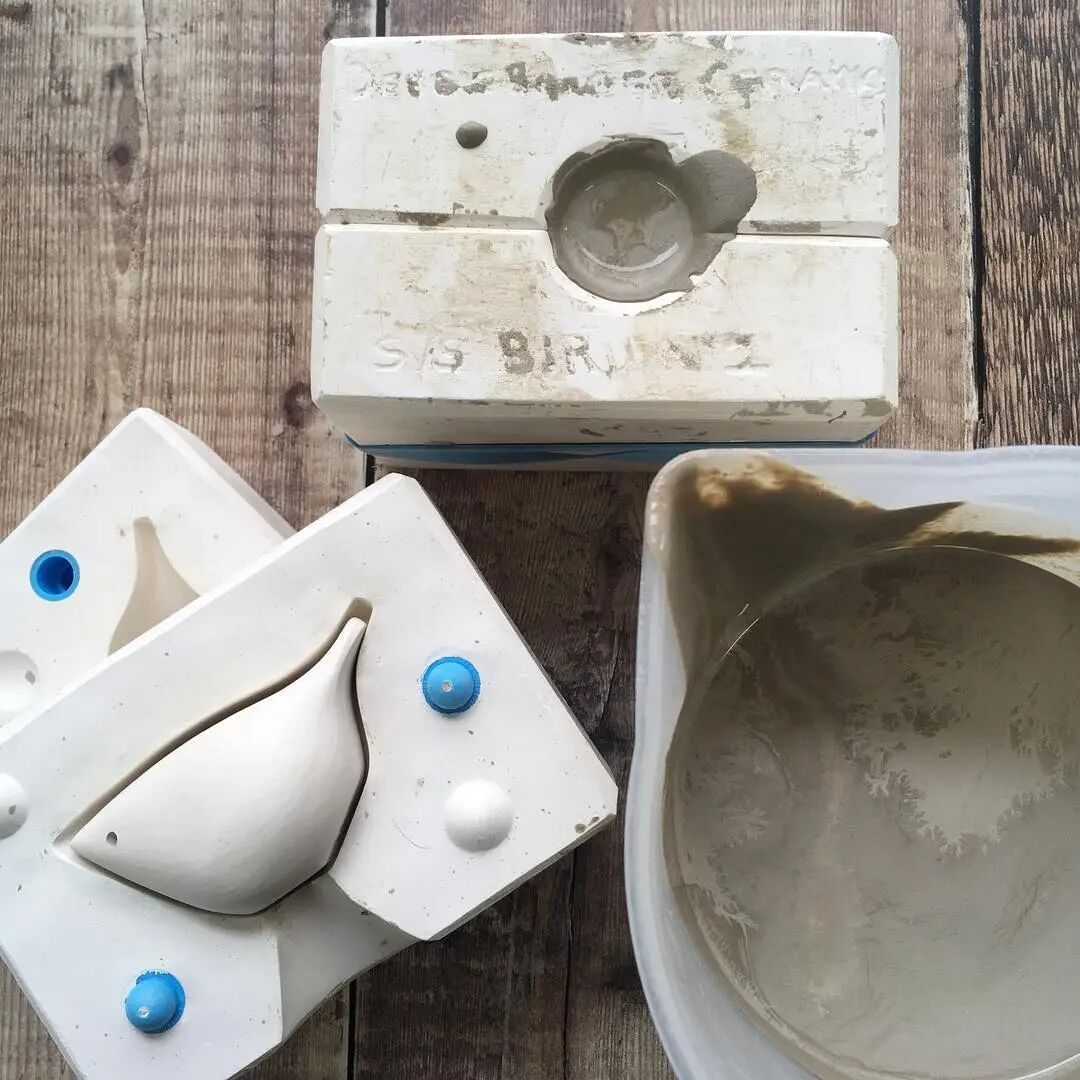
A plaster mould has two lifespans
A plaster mould has a production life and an edition life. Production life is how long it keeps yielding castable pieces, and it runs into the hundreds of casts. Edition life is how long it keeps yielding interchangeable pieces, and it ends far sooner — when fine detail softens and cavity dimensions drift by tenths of a millimetre. Editions must be planned on the second number.
Almost every disappointing edition traces back to a studio quoting the first number and a client needing the second. The mould did not lie. It kept casting. It simply stopped casting the same thing.
Why plaster wears out at all
A plaster mould is not a hollow. It is a sponge with millions of interconnected capillaries, and casting works because those capillaries pull water out of the slip. Water leaves, clay platelets pack against the mould face, and a wall builds at roughly a millimetre every few minutes of dwell. Everything about the mould’s life follows from that one mechanism.
Each cast pushes something into the capillaries. The finest fraction of the slip — clay platelets, deflocculants, soluble salts — lodges at the surface and slowly seals the pores that were doing the work. A sealed surface absorbs more slowly, so the same dwell time produces a thinner wall, and to get the wall back you leave the slip in longer. That creeping dwell time is the first measurable symptom, and it appears long before anything looks wrong.
Gypsum is also mildly soluble, around two grams per litre of water. Repeated contact with wet slip dissolves plaster at the face and re-precipitates it, which is why a worn mould feels slick and glassy under the finger instead of chalky. The chalky texture is the porosity. Once it is gone, no amount of cleaning brings it back.
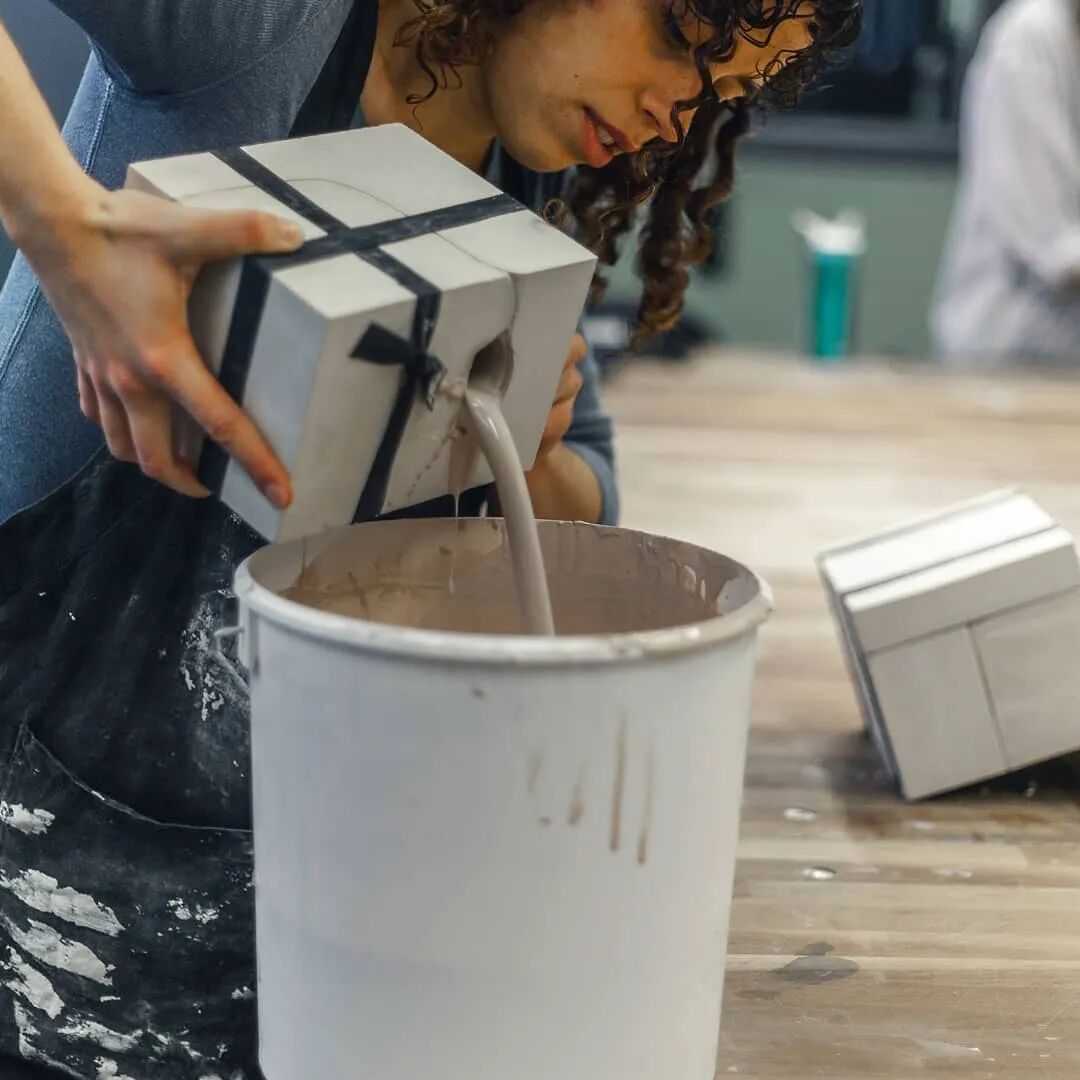
Published figures, and the gap they leave
Ceramics-education studios publish mould-life figures in the hundreds: small, simple moulds are quoted at five hundred casts or more, and large, complex moulds at two to three hundred before noticeable ageing. Those figures describe a mould that still closes, still releases, and still yields a piece recognisable as the design.
They do not describe a mould that still yields a piece a curator would accept as identical to the first. The difference between those two conditions is where editions are won and lost, and it is invisible in any single number a supplier gives you.
| What the form asks of the mould | What ends its useful life | Order of magnitude |
|---|---|---|
| Simple vessel, glazed overall, no applied detail | Release and mould structure | 300–500+ casts |
| Form with incised or applied decoration | Legibility of the detail | 100–200 casts |
| Sculpture with crisp tool marks, thin edges, undercuts | Sharpness of an edge | Tens of casts |
Those ranges are orders of magnitude, not a specification. The number that governs your edition is the one a studio can state for your specific form, in your slip, in its plaster — and any studio that answers with a single figure for all work has not measured anything.
Five signs a mould has left its edition life
Wear is measurable, and measuring it is the difference between planning an edition and hoping one turns out. Check the same three points on every tenth cast and record them; the record is worth more than any rule of thumb.
1. Detail softens at the sharpest feature first. Incised lines, the edge of a relief, a tool mark, the crease of a fold. Sight along the surface with a single light source at a low angle — raking light makes a rounded edge obvious in a way that diffuse room light never will. The line that was a knife edge becomes a groove with a soft shoulder, and it does so while the rest of the surface still looks perfect.
2. The cavity drifts. Measure the same three dimensions with digital calipers, on the fired or the dry green piece, always at the same points. Drift accumulates slowly and then matters suddenly: three tenths of a millimetre across a two-hundred-millimetre form is 0.15 percent, invisible on a single piece, and fatal to a matched pair, a fitted lid, or a stack that was designed to sit flush.
3. Dwell time creeps up. If you needed eight minutes to build a four-millimetre wall at the start and need eleven minutes now, the mould is telling you its absorption rate has fallen. This is the cheapest early warning available, and it costs nothing but a note on the wall.
4. The face goes glassy. A working mould should feel faintly chalky and drink a drop of water on contact. A worn one beads water and feels slick. That slickness is the sealed layer, and it is permanent.
5. Release becomes reluctant. The cast clings, you tap harder, then you pry, and prying destroys the register between shells. A mould that needs force to open is already costing you pieces, whether or not it has cost you one yet.
Two failures sit outside this list because they end a mould outright rather than gradually: cracks running through the plaster wall, usually at its thinnest section, and chipped or rounded keys and flanges. Both are structural. Neither is repairable in a way you can rely on for an edition, and a mould repaired with fresh plaster will not match the casts made before the repair.
The edition arithmetic
An edition is a division problem. Usable identical casts per mould, multiplied by the number of moulds, must cover the edition plus test casts plus fired loss. Miss any of those three terms and the last pieces of the edition are made on a mould that is no longer the mould the first pieces came from.
Take an edition of fifty with a fine-detail form, where thirty identical casts per working mould is the honest budget. Fifty pieces at a fired loss of twelve percent needs about fifty-seven casts before the kiln. Thirty per mould means two working moulds, plus tests and the inevitable rejects, which means a third. Three moulds for an edition of fifty is not extravagance; it is what the arithmetic returns, and a quote that assumes one mould is a quote that will be renegotiated at piece thirty-one.
There is a second-order problem inside that arithmetic. Working moulds made from the same master are not identical to each other. Plaster expands as it sets — typically by a few parts in a thousand — so a mould cast from a master is not the same size as the master was, and two moulds poured from that master on different days can differ by a measurable amount. The practical consequence is a decision the artist has to make before production, not after: either every piece in the edition comes from one mould, which caps the edition at what one mould can honestly carry, or the edition is split across moulds and the groups differ by a fraction of a millimetre. Both are defensible. Only one of them is defensible after the fact.
This is the conversation a studio should be having with an artist at the quoting stage. If the answer to “can I have an edition of a hundred” is delivered without asking about the form, the studio is selling a production life, not an edition.
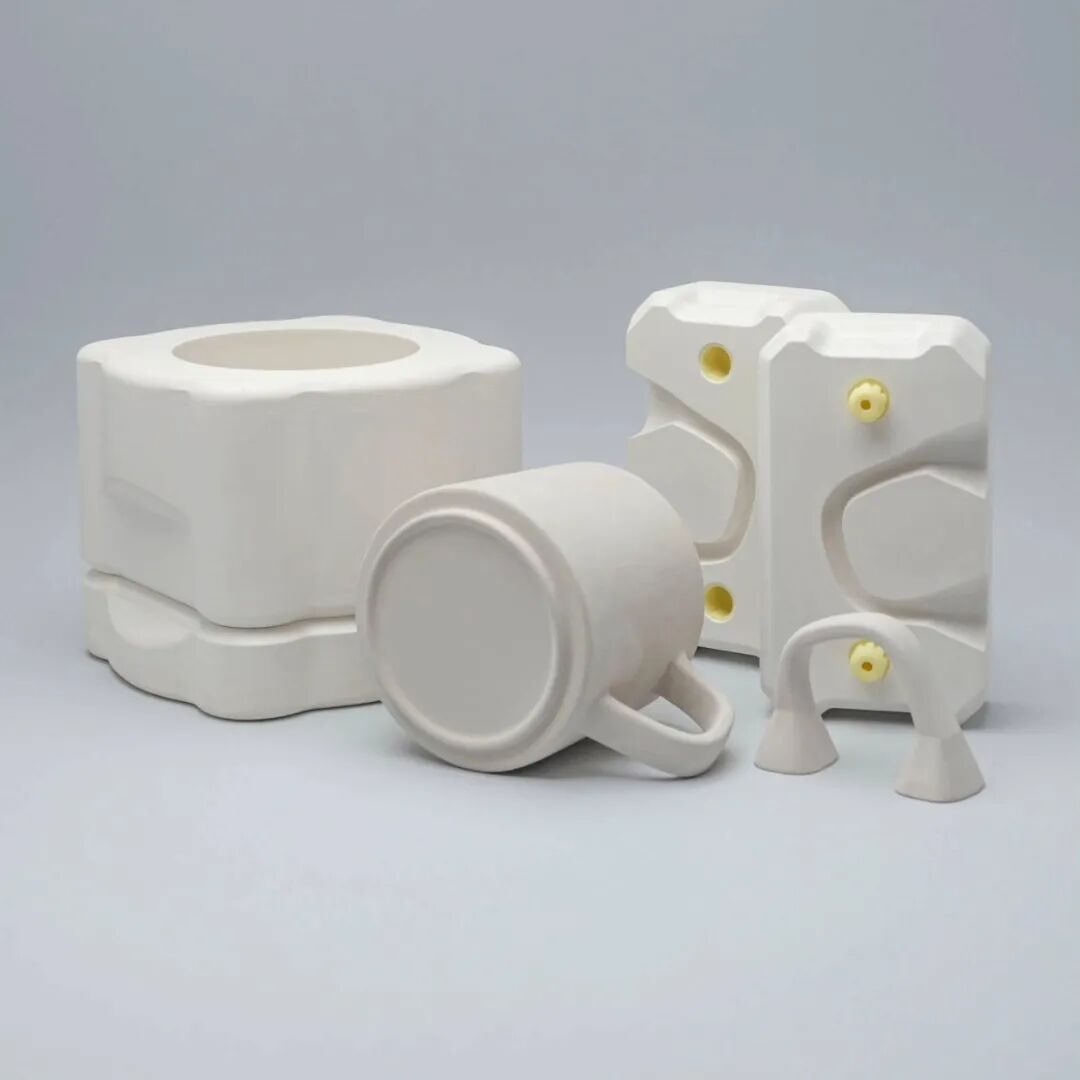
Mixing, drying and storage decide most of the life
Before wear even begins, the first fortnight of a mould’s life is decided by how it was poured, dried and stored. Most of the avoidable losses happen here, and almost all of them are cheap to prevent.
Ratio, by weight, not by eye. Pottery plaster is mixed at roughly one hundred parts plaster to seventy parts water by weight; the manufacturer’s figure for your plaster overrides any general rule. Weigh both. Sprinkle the plaster into the water rather than dumping it, let it slake for a minute or two, then mix for two minutes until it is smooth. A wetter mix gives a softer, more porous, shorter-lived mould; a thicker mix sets too fast to pour a complex form.
Water quality counts. Hard water and dirty containers change the set and the surface. Clean water, clean bucket, and never the residue of a previous batch.
Dry it properly, then wait longer than you want to. A new mould needs at least forty-eight to seventy-two hours before its first cast, and a full week is better. A mould that is still chemically setting cannot draw water properly, and casting into it produces weak, soft walls that slump or tear. Support it flat while it dries; a mould drying unsupported can distort under its own weight.
Never force the drying. A heat gun, an oven, or a radiator dries the outside before the core, sets up a moisture gradient, and cracks the mould along the thinnest wall. Air movement in a dry room does the job in a day or two longer and does not destroy anything.
Cast dry, clean damp. A damp mould cannot absorb, so the wall you get is the wall that was already there plus a soft skin. Between casting sessions, rinse the face with a soft sponge and clean water, then dry it fully. No abrasives, no wire wool, no scouring pad — each of those removes the porous skin you spent a week creating.
Store it dry, flat and face-up. A mould kept in a damp workshop grows surface mould and loses absorption within weeks. Stack nothing on a face. Dust is removable with a soft brush; moisture damage is not.
Rest and rotate. Two moulds worked alternately will out-produce one mould hammered continuously, and both will live longer. A mould that never dries between casts is being asked to do something it cannot do.
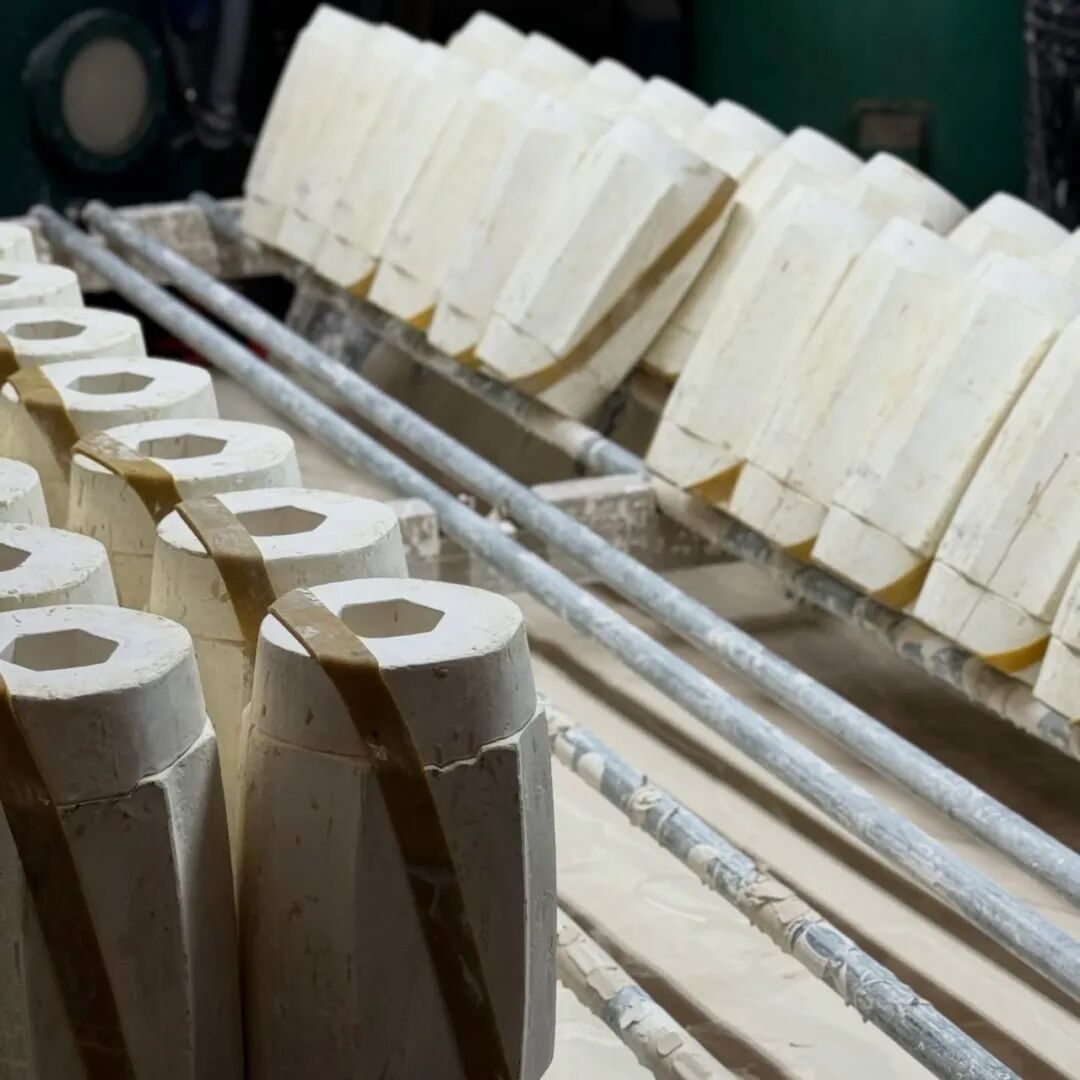
The parting agent mistake that ends a mould in one pour
Gypsum bonds to gypsum. Without a barrier between an existing shell and the next pour, the two fuse, and what comes out of the box is not a mould with a difficult seam — it is a single solid block of plaster with your master sealed inside it. It is the most expensive five-minute omission in the workshop.
Soap is the traditional answer: brush a thin coat over every surface that will meet new plaster, and let it dry to a faint sheen. Soap that is still wet dilutes into the fresh plaster and provides no barrier at all, which is worse than none, because it feels like you did it.
Vaseline works immediately and needs no drying time, but over-application prints a faint texture into the mould face that shows up on every cast for the life of the mould. Commercial release spray is fast and consistent and costs more per mould. Cooking spray is an emergency measure: the residue contaminates the surface and the release is unreliable.
Coverage is where most failures happen, and the flange is where coverage is most often missed, along with the keys and the parting lines. Those are the surfaces doing the locating, and the surfaces most likely to be forgotten because they are small. Fitting a parting-agent check into the routine — one line on the bench list, ticked before the plaster is weighed — prevents an entire class of loss.
When the plaster itself is the fault
Plaster has a shelf life, and expired plaster fails in ways that look like bad technique. Fresh pottery plaster is a smooth, lump-free powder that feels cool to the touch and gives fifteen to twenty minutes of working time once mixed.
If it arrives hardened into lumps, feels warm in the bag, or sets in under ten minutes, it has taken on moisture and is no longer reliable. The failure is not always dramatic: expired plaster can set, cast, and then produce a mould that crumbles at the face after twenty casts. Buying fresh plaster costs less than the edition it ruins.
It also has to be the right plaster. Pottery plaster is formulated for porosity — the interconnected capillaries that make casting work. Building plaster and repair plaster are denser, and a mould made from them will not draw water at all. Set plaster warming as it cures is normal; a hot spot where the pour streamed into one place is not, and it means the mould set unevenly and will wear unevenly too.
What to ask a studio before commissioning an edition
The answers separate studios that run editions from studios that can cast. Ask for numbers, and treat a confident general figure as a warning rather than an answer.
How many identical casts do you budget per working mould for this form? Not how many casts a mould survives. A studio that runs editions has a number, per form, and can tell you what it is based on.
At which cast do you expect detail loss, and how do you check for it? The good answer involves raking light, calipers, and a written record. The bad answer involves the phrase “we would notice”.
How many working moulds will my edition use, and will every piece come from the same mould? The second half of that question matters more than the first. You are entitled to know whether your edition is one group or three.
What is your fired loss rate, and is it inside my edition number or charged on top? An edition of fifty that is delivered as forty-six is either a breach or an agreed allowance, and the only difference is whether it was written down.
What happens if a mould fails at piece thirty-five? The answer will tell you whether remakes are matched to the existing pieces or simply made, and whether the master still exists to make a new working mould from.
How are moulds stored between casting runs, and how long do yours rest? A studio that rotates and dries moulds is protecting the surface you are paying for. A studio that casts continuously into the same mould is spending it.
Questions artists ask before planning an edition
How many casts can a plaster mould survive?
Ceramics-education studios quote 500 or more casts for small, simple moulds and 200 to 300 for large, complex ones before noticeable ageing. Those figures describe a mould that still releases a piece, not a mould that still produces a piece identical to the first. For fine-detail editions the usable window is far shorter, in the tens to low hundreds of casts.
What is the difference between production life and edition life?
Production life is how long a mould keeps yielding castable pieces, which runs into the hundreds of casts. Edition life is how long it keeps yielding interchangeable pieces, which ends when fine detail softens and cavity dimensions drift by tenths of a millimetre. Editions must be budgeted on edition life, not production life.
How can I tell a plaster mould is worn out?
Five measurable signs: detail softening at the sharpest feature under raking light, dimensional drift measured with calipers at the same three points, dwell time creeping upward as absorption falls, the mould face becoming slick and glassy instead of chalky, and release requiring force. Cracks through the plaster wall and rounded keys end a mould outright.
How long must a new plaster mould dry before casting?
At least 48 to 72 hours after pouring, and a full week is better. A mould that is still chemically setting cannot absorb water properly and produces weak, soft walls. Never accelerate drying with a heat gun or oven: uneven drying sets up a moisture gradient and cracks the mould at its thinnest wall.
How many moulds does an edition of 50 need?
Divide the edition by the number of identical casts a working mould can honestly produce. An edition of 50 with a fired loss of 12 percent needs about 57 casts before the kiln; at 30 identical casts per mould that is two working moulds, plus a third for test casts and rejects. Moulds made from the same master are not dimensionally identical, so the artist must also decide whether all pieces come from one mould.
Can a damaged plaster mould be repaired?
Small chips and edge damage can be filled with fresh plaster, but the repair never has the absorption or the strength of the original surface, and casts made after a repair will not match casts made before it. Cracks through the wall or damaged keys mean a new working mould, which requires the master to still exist.
How this applies to commissioned work
In an edition that is planned properly, the mould budget sits in the production plan rather than in the footnote: the form is assessed for detail depth and wall thickness, a working-mould count is set against the edition the artist wants, and the artist is told which parts of the edition will come from which mould before anything is poured. Where a form cannot carry the edition size honestly, that should surface at the quoting stage, when it is a design conversation, rather than at piece thirty-five, when it is a dispute.
The slip casting workflow covers the sequence from master to finished cast and where each check falls. For how mould life interacts with the rest of a commission, the custom ceramic sculpture commissioning process sets out what a studio needs to know before it can put a number on an edition, and shipping covers what happens to the finished set.
Limits of this guidance
The cast counts above are published figures from ceramics-education studios and general workshop practice, not measurements from any single workshop on your form. Real mould life moves with the plaster brand and its age, water hardness, the slip recipe, mould wall thickness, the depth of the detail and how the mould is treated between casts. Two studios using the same plaster on the same design can differ by a factor of two. The only number that means anything for your edition is the one a studio can state for that specific form, and a studio that cannot state one has not been counting.