Ten ways of cutting define the whole of Chinese carving. Some work in three dimensions, some on a surface, and one builds a moving chain from a single block of stone.
The Chinese tradition classifies carving by what the knife does, not by what it depicts. The standard list runs to ten: miniature carving, round carving, relief, openwork, chain carving, pierced relief, recessed carving, line engraving, the thin-as-painting cut known as boyi, and the seal-cutting arts of zhuanke and niudiao. They are applied to wood, stone, jade and ivory, and several of them transfer directly to porcelain. This article goes through them one by one, with the technical requirement that defines each.
Miniature Carving: The Test of Absolute Control
Miniature carving (weidiao, u5faeu96d5) is defined by size, but its difficulty is not size alone. The stone must be flawless: a single grain of sand the size of a pinhead can cover the space of ten carved characters, and a hairline crack will split under the point. The knives are specially ground to a needle edge. The carver must already be a calligrapher and painter, because at this scale the cut is made by intention rather than by measurement.
The tradition is ancient. Oracle-bone inscriptions of the Shang dynasty contain characters a millimetre high; Warring States seal stamps no larger than a grain of millet carry both raised and recessed characters. The Carved Boat of Wang Shuyuan u2014 a peach-stone boat with opening windows and legible figures u2014 is the standard citation for the art.
Round Carving: The Complete Object
Round carving (yuandiao, u5706u96d5) produces a fully three-dimensional object that can be walked around. The carver works from every direction at once, because the finished piece must read from the front, the back, the sides and above. The method is demanding in material: the block must be sound throughout, and the carver’s first responsibility is the roughing-out stage (dapi, u6253u576f), which fixes the proportions of every part before any detail is cut.
Shoushan stone is the material most associated with round carving in the Chinese tradition. The sequence runs: rough out, refine the blank, cut the detail, polish. Each stage depends on the one before it, and a mistake at roughing-out cannot be recovered later.
Relief: The Compressed Image
Relief (fudiao, u6d6eu96d5) carves an image that stands out from a flat ground. It is half sculpture and half drawing: the forms are compressed into a shallow space, and perspective rather than volume does the work of depth. Relief divides into high relief, where the forms approach the round, and low relief, where they stay close to the surface.
The best material for relief is a stone with distinct colour layers, so that the carver can use the outer colour for the design and the inner colour for the ground. The Six Steeds of the Zhao Mausoleum and the imperial carriage way of the Forbidden City are the standard historical examples. Relief is the carving of architecture and vessels, because it decorates without demanding its own space.
Openwork and Chain Carving: The Empty Space as Material
Openwork (loudiao, u9542u96d5) removes everything that is not the design, leaving the form standing against empty space. It is the most demanding of the surface techniques because the stone must be flawless throughout u2014 a crack in the pierced area means the piece fails. Specialised tools are required: long-armed chisels, hook knives and fine saws, because the interior can only be reached through the openings.
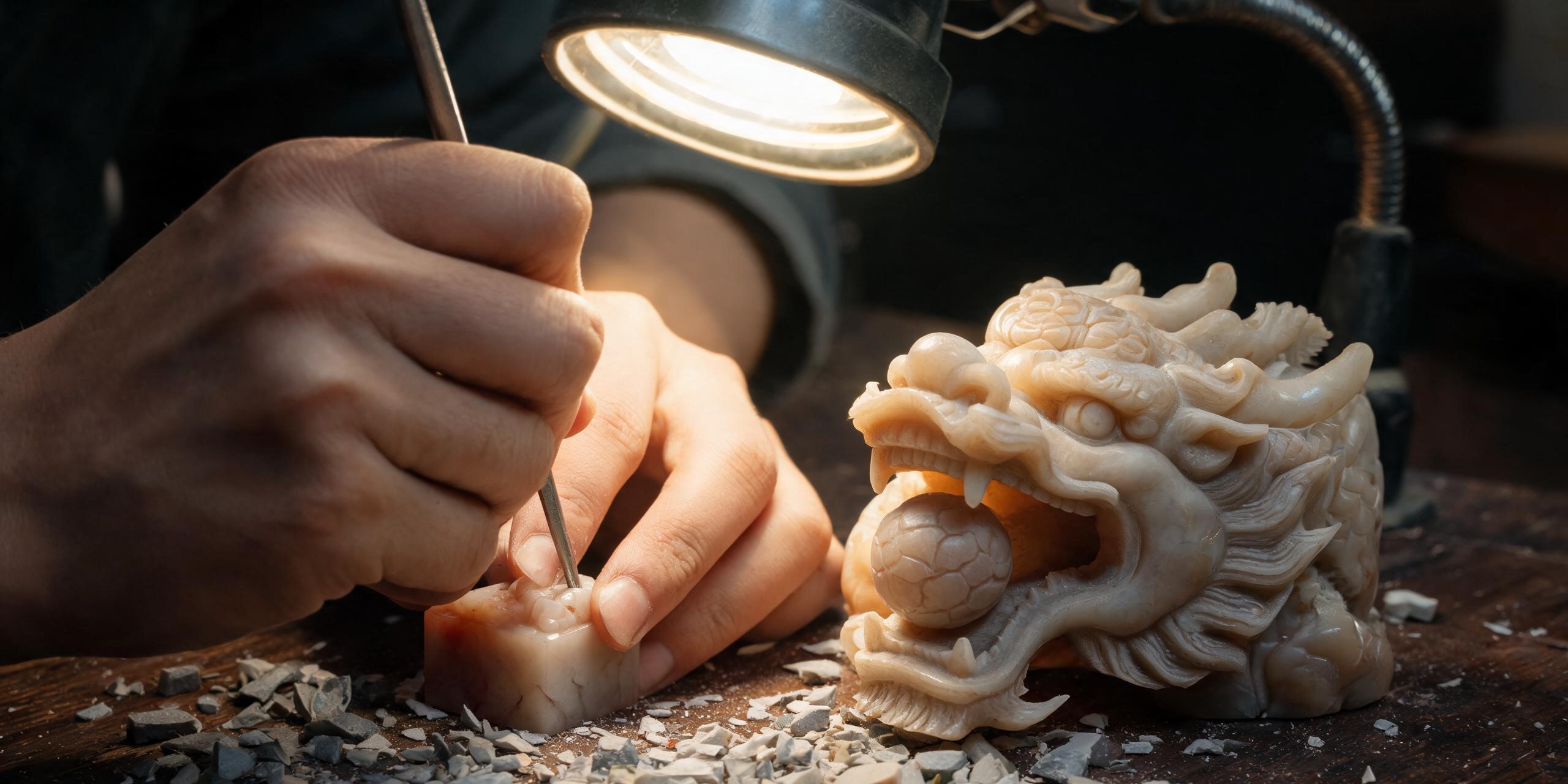
Chain carving (liandiao, u94feu96d5) goes further: a continuous chain is carved from a single block, link by link, with no join and no added material. Each link is drilled, cut free and then secured with a reversible modelling paste while the next is carved. The chain is finished by soaking the paste away in warm water. The simplest form is the ball carved inside a dragon’s mouth u2014 larger than the opening, cut from the solid stone, and free to roll but unable to escape.
Pierced Relief: Between Relief and Openwork
Pierced relief (toudiao, u900fu96d5) keeps the raised design of relief but cuts the background away behind it, so the piece reads against light. It differs from openwork in that it is still one-sided or two-sided, not a fully round carving; the back is often treated as a separate face, and a framed pierced panel is known as a loukong huaban (u9542u7a7au82b1u677f). The distinction matters because openwork and chain carving belong to the round-carving family, while pierced relief is an extension of relief.
Recessed Carving and Line Engraving
Recessed carving (chendiao, u6c89u96d5), also called water-polished sunken blossom, cuts the design into a smooth stone surface so that shadow rather than projection creates the image. It is the technique of cliff inscriptions, steles and architectural lettering.
Line engraving (xiandiao, u7ebfu96d5) draws with the point of the knife on a polished surface. It borrows the methods of Chinese painting u2014 the freehand line, the layered composition, the scattered perspective u2014 and builds the image from the weight and depth of the line alone. A stone engraving that is then rubbed onto paper occupies the space between carving and printmaking.
Boyi: The Thinnest Relief
Boyi (u8584u610f) is relief reduced to its minimum u2014 a cut so shallow it reads as a painting. The name means thin intention, and the technique is also called knife-painting. It developed in the late Ming and early Qing from the brocade borders of Shoushan seal stones, and it is defined by the same qualities as literati painting: elegant, exact, and close to the logic of the drawn line. Boyi sits between calligraphy, seal-cutting and painting, and it is the most literary of the ten methods.
Seal Cutting and Knob Carving
Seal cutting (zhuanke, u7bc6u523b) carves characters into the face of a seal. Raised characters on a red ground are yang-cut; recessed characters that print white on red are yin-cut. The script is always seal script, in one of its twenty-odd historical forms, chosen to fit the layout of the face. The art begins with the Qin unification of the script and has remained the companion of calligraphy and painting ever since u2014 no classical work is complete without its seal.
Knob carving (niudiao, u94aeu96d5) carves the animal finial on the top of a seal. The creature u2014 a dragon, lion, phoenix, tiger, tortoise or mythical beast u2014 is confined to a few cubic centimetres and shown only from above, so the carver must compress the whole presence of a round sculpture into a form that sits comfortably in the hand. The sequence is fixed: level the platform, file the shape, rough the form, finish the surface.
Which of the Ten Apply to Porcelain
Porcelain accepts some of the ten and refuses others. The unfired body can be incised, carved in relief, pierced and built up; the fired glaze can be cut with a steel point. But the body is too brittle for chain carving, too thick for true miniature work, and the seal-cutting tradition belongs to stone.
| Technique | Works on porcelain? | Where it appears |
|---|---|---|
| Miniature carving | No | Peach stone, ivory, Shoushan stone |
| Round carving | Yes | Porcelain figures, built and fired hollow |
| Relief | Yes | Vessels, plaques, architectural ceramics |
| Openwork | Yes | Lanterns, censers, rice-grain ware |
| Chain carving | No | Stone only; the body is too brittle |
| Pierced relief | Yes | Porcelain panels and screens |
| Recessed carving | Yes | Inscriptions on steles and plaques |
| Line engraving | Yes | Incised decoration on unfired bodies |
| Boyi | Partially | The thinnest carved decoration on plates |
| Seal cutting | No | Stone seals; porcelain seals are moulded |
| Knob carving | Partially | Porcelain seal finials, moulded then refined |
Frequently Asked Questions
What is the difference between openwork and pierced relief?
Openwork is carved in the round, so the design can be seen from every side and the empty space is part of the form. Pierced relief is still a relief: the design projects from a ground, and the background is cut away behind it. Openwork belongs to the round-carving family, pierced relief to the relief family.
How is a chain carved from one piece of stone?
Each link is drilled, cut free with a fine hooked knife, and then locked in place with a reversible modelling paste before the next link is cut. When the whole chain is finished the paste is soaked away in warm water. The chain has no join and no added material u2014 it is one piece of stone, cut so that the links move.
Why does miniature carving require a flawless stone?
Because the characters are so small that a single grain of sand can cover several of them, and a hairline crack will split under the point of the knife. The stone must be uniform throughout, the knife must be ground to a needle edge, and the carver must already be a calligrapher, because at this scale the cut is made by intention, not by measurement.
Which of the ten techniques are used on porcelain?
Round carving, relief, openwork, pierced relief, recessed carving and line engraving all transfer directly. Boyi appears as the thinnest carved decoration. Chain carving and true miniature carving are impossible in porcelain because the body is too brittle, and seal cutting belongs to stone, though porcelain seals with moulded finials exist.
Related Reading
For the porcelain branch of these techniques, see carved Jingdezhen porcelain and the four core sculpture techniques of Jingdezhen. The general grammar of carving, modelling and casting is set out in sculpture techniques: carving, modelling and casting.
Jingdezhen Heritage commissions carved porcelain in the techniques that the material accepts u2014 incised, relief, pierced and openwork. Write to service@jingdezhenheritage.com or message us on WhatsApp with the subject and the size you have in mind.
Published 31 October 2026 by Jingdezhen Heritage, a porcelain studio in Jingdezhen, Jiangxi, China.