
Jingdezhen porcelain sculpture (景德镇瓷雕, Jǐngdézhèn cídiāo) is three-dimensional art formed from porcelain clay and fired at high temperature. Its subjects are broad, its techniques varied, and its forms celebrated for graceful modelling and ornate decoration. From the Song dynasty the range of sculptural wares expanded and craft advanced; from the Ming and Qing onward sculpture was increasingly combined with painted decoration, becoming a major branch of Jingdezhen ceramic art.
Four core techniques define the tradition—used individually or in combination:
The Four Core Sculpture Techniques
1. Round Sculpture — 圆雕 (yuándiāo)
Also called “three-dimensional sculpture”, round sculpture is free-standing and viewed from every angle with no background. It is the most fundamental Jingdezhen sculptural form, used chiefly for human figures and animals.
2. Pinched Sculpture — 捏雕 (niēdiāo)
Also known as 捏塑 (niēsù), pinched sculpture uses rolling, pinching and kneading to shape clay into forms, which are then attached to the ware with slip. The delicate technique excels at fine detail—flowers, birds and insects, such as layered chrysanthemums or peacock feathers.
3. Applied Sculpture — 堆雕 (duīdiāo)
Also called 堆塑 or 堆贴, applied sculpture builds up motifs in relief with slip or shaped clay, which are then fixed to the body surface. It is a form of low relief, with the design projecting above the surface.
4. Openwork Carving — 镂雕 (lòudiāo)
Also called 镂空雕 or 透雕, openwork pierces patterns and motifs through the body wall. It is the most demanding technique. Two methods exist: dry carving, using knives to cut dragons boats, pavilions and mountains; and wet openwork, using a brush dipped in slip to build up a lattice—used for basket-like forms.
Comparison of the Four Techniques
| Technique | Chinese | Form | Typical Subjects | Process |
|---|---|---|---|---|
| Round sculpture | 圆雕 | Free-standing 3-D | Figures, animals | Moulded, cast, assembled |
| Pinched sculpture | 捏雕 | Applied detail | Flowers, birds, insects | Hand-pinched, slip-glued |
| Applied sculpture | 堆雕 | Relief on surface | Ornamental motifs | Slip-built or clay-applied |
| Openwork carving | 镂雕 | Pierced through wall | Lattices, pavilions, dragons | Dry-carved or wet-built |
Pinched and openwork sculpture are purely hand-made. Applied sculpture can partly use moulds. Round sculpture follows the most complex production sequence.
The Production Process for Round Sculpture
Modelling (塑形)
The sculptor models the original form in solid clay, usually without an internal armature. Design must balance artistic effect with firing shrinkage and the high-temperature load each part must bear, to prevent deformation. The handling resembles clay sculpture—clear volume, controlled relief, lively form and fluent lines. Because the original is solid, it cannot be fired directly (it would crack or fire unevenly inside), so it must be reproduced as a hollow body.
Mould Making (制模)
Simple forms can be moulded directly; complex forms are divided into sections and moulded separately. Early moulds were earthen; from the late Qing and Republican period plaster took over. Moulds are usually two-piece. The maker draws the parting line, backs the lower half with clay, surrounds it with felt or clay, and pours plaster. After setting, the block is flipped, the backing clay removed, edges trimmed, and a parting agent applied before the second half is poured.
The resulting concave mother mould (阴模/母模) can produce small batches directly. For larger production a convex master mould (阳模/模种) is made. Durable masters use sulphur mixed with graphite, talc or mica, melted and poured into the mother mould.
Forming — Press Moulding or Slip Casting
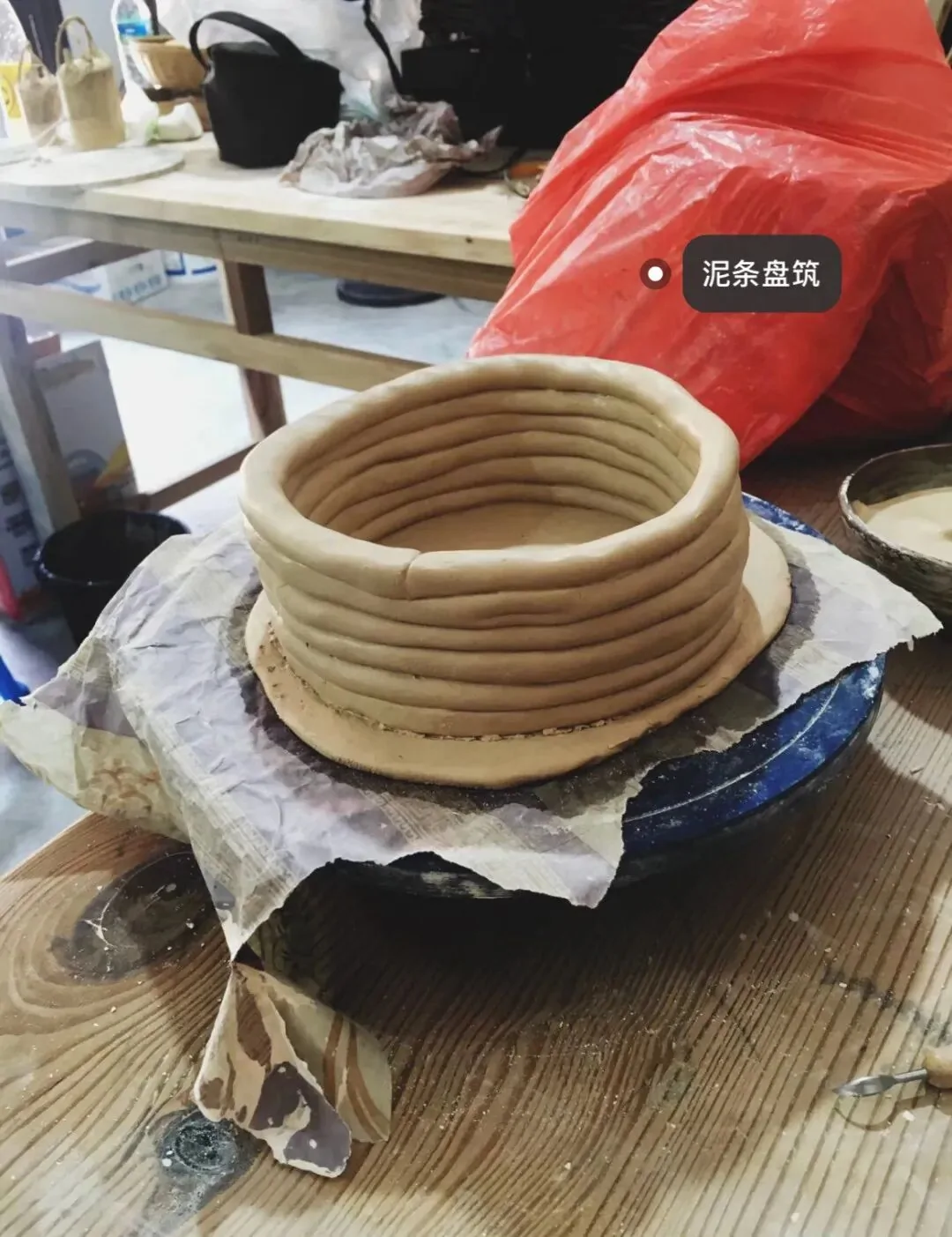
Press moulding (印坯) presses clay cakes or coils into the plaster mould. Air pockets and laminations must be avoided, especially on complex curves. Where the mould is convex (the form’s concave side), extra clay coils reinforce against deformation. After both halves are pressed, their edges are slip-coated and the mould is closed. Release once the rim shrinks away from the mould. A base is made with a central vent hole, then attached and the seam smoothed.
Slip casting (注浆) is used for batch production. The two mould halves are tied, slip poured in, and the plaster absorbs water to build the wall. After the correct dwell time, surplus slip is drained. The mould is opened once the rim shrinks clear.
Assembly and Finishing
Parts outside the main body are attached with slip. Once the slip takes up, the joints are trimmed flush with no visible seam.
Glazing
Sculpture is glazed by dipping, spraying or brushing, similar to shaped ware. Before spraying, areas that must remain unglazed—such as a figure’s face and hands—are masked with paper (闭纸, bì zhǐ) to keep atomised glaze off. The paper is removed after spraying, leaving the biscuit surface to be overpainted after firing. For fǎcuì (珐翠) glaze, the biscuit-fired body is poured with glaze and rotated to cover everything except the base.
Decoration
Jingdezhen sculpture combines freely with painted decoration: underglaze blue (青花), underglaze red (釉里红), overglaze enamels (古彩, 粉彩, 新彩), and a dazzling range of coloured and flambé glazes. The result ranges from refined, quiet elegance to opulent splendour.
Two Carved Pieces That Show the Method
Two imperial pieces are often used to explain why the four techniques are kept apart, and what happens when they are combined.
| Piece | Period | Techniques visible | Why it matters |
|---|---|---|---|
| Blue-and-white jar with underglaze red and an openwork lid (青花釉里红镂雕盖罐) | Yuan | Pierced carving on the lid, raised panels on the body | The lid is cut through before firing, so every opening has to be planned around the strength of the wall; the underglaze red beside it cannot be corrected once the piece enters the kiln |
| Peach vase with a brown ground and gilt high relief (酱地描金凸雕灵桃瓶) | Qing, Qianlong | High relief carved into the body, then gilded | The relief has to stand far enough out to remain legible under gold, because gilding softens edges and hides shallow modelling |
The comparison points to the rule that governs all of this work: the cut is made while the clay is soft, and the surface treatment that follows either tolerates the relief or refuses it. Gilt sits over the carving and rounds it off. Underglaze red is painted beside it and cannot be repaired, so the carving has to be right before the colour is applied.
The same logic carries into the two branches of the craft described separately here: carved Jingdezhen porcelain, where the surface is cut away, and pinched porcelain flowers, where the decoration is built up in clay and joined wet.
Frequently Asked Questions
What is the difference between round sculpture and the other three techniques?
Round sculpture (圆雕) is a fully free-standing three-dimensional form. The other three—pinched, applied and openwork—are typically decorative techniques applied to or through a body surface, rather than independent forms.
Why can’t a solid-clay original be fired directly?
A solid body would crack or fire unevenly (raw inside, over-fired outside). The original is therefore reproduced as a hollow shell through moulding and press-forming or slip casting.
Which techniques are purely hand-made?
Pinched sculpture and openwork carving are done entirely by hand. Applied sculpture can partly use moulds, and round sculpture relies on moulds for production.
Related Reading
For the broader picture of sculptural ceramics, see Ceramic Sculpture Art: Forms, Kilns and Material Magic and Ceramic Forming Techniques: Six Methods from Coil to Slip Casting.
Interested in a commissioned porcelain sculpture or collecting Jingdezhen sculptural ware? Visit our shop or email our studio.