
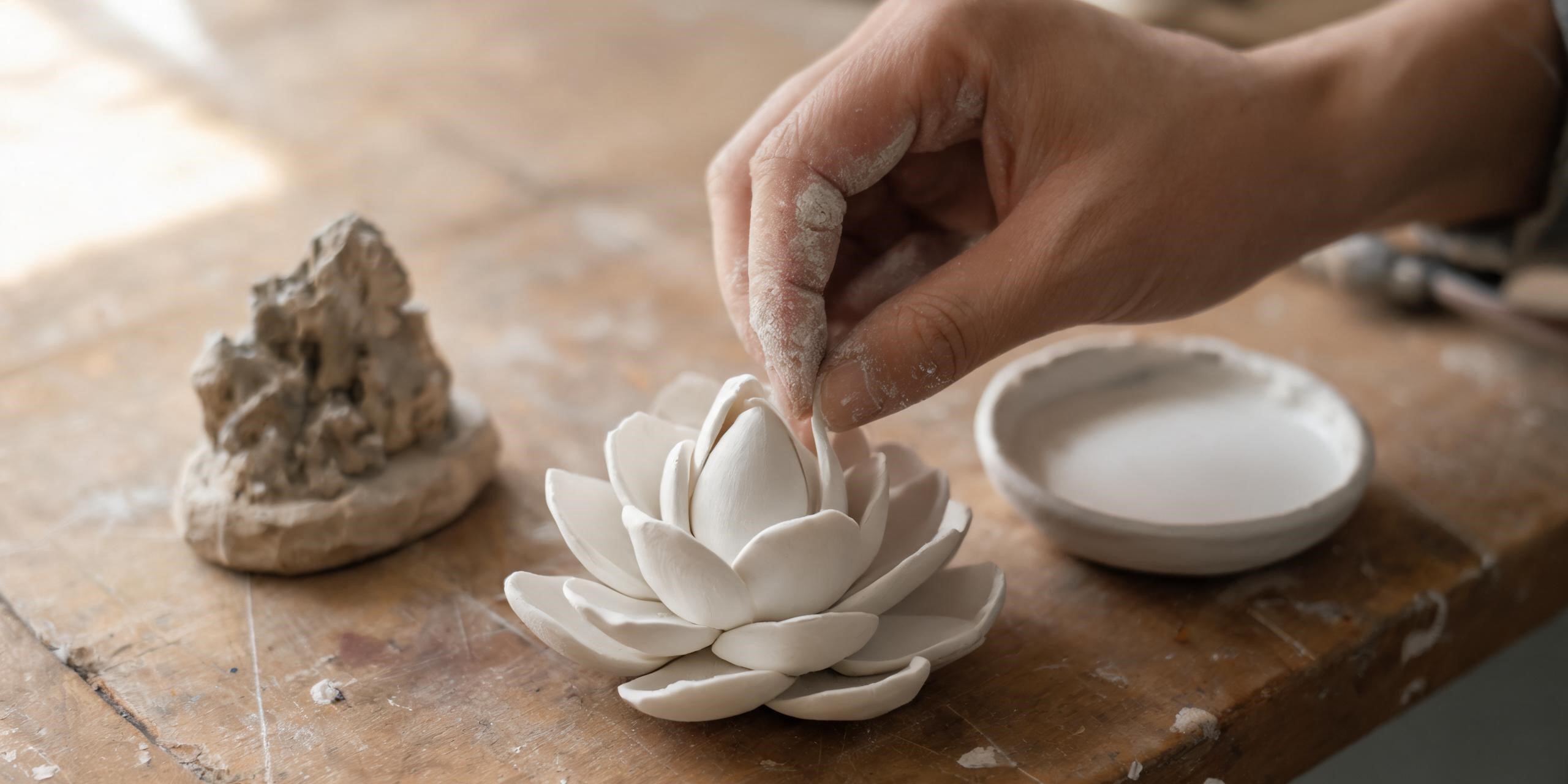
Almost every porcelain flower sold as decoration today is painted. The ones built in Jingdezhen are assembled petal by petal from white clay, then fired with no glaze at all.
In the workshops around Jingdezhen, Jiangxi, China, a single porcelain peony four centimetres across can be built from sixty separate petals. Each petal begins as a ball of clay the size of a thumbnail, is pressed flat on the palm of the hand, and is joined to the flower with a brush of slip. Nothing is painted on afterwards: the colour comes from the body itself, and the only surface is the natural sheen of high-fired white porcelain.
This branch of the craft is called niu0113diu0101o (u634fu96d5), sometimes translated as pinched sculpture and known locally as diu0101ohuu0101 (u96d5u82b1), flower carving. It belongs to the same family of Jingdezhen techniques as the four core sculpture techniques, but it is the one least often explained in English. What follows is the sequence as it is actually taught in the workshops: the support, the branch, the bud, the petals, the feathers, and finally the openwork constructions that test the whole method.
Why Jingdezhen Builds Flowers in Clay
A painted flower sits on the surface of a vessel. A pinched flower stands away from it, casting its own shadow. That shadow is the reason the technique exists. White porcelain is a hard, dense, slightly translucent material, and when a petal is built thin enough u2014 two or three millimetres at the edge u2014 light passes through it and the form reads as soft even though the material is effectively glass and mullite.
The work also demands a particular clay. The workshops use what they call shu00e0ngdu011bng bu00e1inu00ed (u4e0au7b49u767du6ce5), a fine, very plastic white body. It has to hold a shape that is only a few millimetres thick while still wet, be joined to other pieces with slip, and survive drying without cracking. Coarse or heavily grogged clay cannot do this. The finest pinched work is made from a body so smooth that it behaves, in the words of one master, like dough.
Step One: The Rockery and the Branch
When the base is a rockery, the clay is first rolled into long strips. These are the nu00edchu00e1 (u6ce5u69ce) that will become the trunk and the branches. The trunk is built up beside the rockery and pressed into it so that the two read as one form, then the secondary branches are attached to the trunk, and only then are flowers placed on the branches. The order matters because each join has to be closed with slip while both parts are still soft enough to accept it.
The alternative is a hanging plate: a shallow dish with the flower built on its face and the leaves arranged to cover the joins at the rim, which is the more common form for wall decoration.
Step Two: Building the Flower Head from the Centre Out
The flower always begins with the bud. A small quantity of clay is rolled into a shape like a garlic bulb, and its top is then punched with a dense pattern of small holes. These holes are not decoration. They give the slip a key, so that each petal has something to grip when it is pressed on.
Petals are made from oval balls of clay. The ball is placed on the left palm and flattened, then pressed with a flat paddle and scraper called a yu00e0pu00e1 (u631cu6252) until it becomes an irregular thin sheet. The irregularity is deliberate: a petal that is perfectly symmetrical looks machine-made, while one with a slightly uneven edge looks grown. The sheet is dipped in slip and pressed onto the bud, working from the inside outwards, one petal at a time, each overlapping the last.
Leaves are made by the same method, with a slightly heavier sheet and a pressed central vein. The finished flower therefore has three separate builds u2014 bud, petals, leaves u2014 joined wet into one piece. A peony may consume an entire working day before it is put aside to dry.
Step Three: Feathers and the Limits of the Material
The most demanding subject is not a flower but a bird. For a peacock, the crest is built first, then the body, and then the feathers u2014 each feather pinched into a leaf-shaped sheet and attached individually, one after another, until the tail is complete. At a distance the result reads as a single mass. Close up, it is a stack of hundreds of separately joined pieces.
Speed is part of the skill. A trained hand can build a flower head in a fraction of the time a beginner needs, because the clay is judged by touch rather than measured. Historically the best-known practitioners of the technique in Jingdezhen include Cai Shousheng and Yang Haisheng, whose work is cited in the local literature on pinched decoration.
The material imposes hard limits. Once a joined piece has dried past the leather-hard stage it can no longer be corrected, and any attempt to force a new petal onto it produces a crack at the join that survives firing. Deep joins also create drying stress, which is why the thickest parts are built first and the thinnest last.
Openwork: How a Porcelain Dragon Boat Is Built
Openwork, lu00f2udiu0101o (u9542u96d5), takes the same wet-joining method and adds piercing. Walls are cut through so that light passes into the interior, and the pierced structure is combined with pinched figures and low relief. The technique produces vases, brush pots, hanging plates, flower baskets, three-legged censers, palace lanterns and miniature pavilions. It also produces the pierced pattern used in rice-grain ware, where the openings are filled with translucent glaze.
The classic test piece is the dragon boat, lu00f3ngzhu014du (u9f99u821f). It is built in a fixed order, and every stage depends on the one before it.
| Order | Stage | What is done |
|---|---|---|
| 1 | Hull | The boat bottom is pinched, then scales are cut in low relief along both sides |
| 2 | Head and tail | Pinched separately and joined to the hull with slip while all three are still soft |
| 3 | Cabin walls | Window openings and columns are pierced through the wall |
| 4 | Decks and figures | Two decks are built, each carrying small pinched figures on the floor and the deck edge |
| 5 | Chain and anchor | Link by link, the chain is pinched and attached to the bow |
| 6 | Firing | The whole piece is dried slowly and fired once, with no glaze |
The first dragon boat of this type in Jingdezhen is credited to Xu Shunyuan. The form has remained in production ever since, and it is still made unglazed from a high-white body, because a glaze would fill the pierced openings and soften the relief that carries the scales.
Piled Relief: When Decoration Is Pressed On
Relief work, duu012bdiu0101o (u5806u96d5) or fu00fadiu0101o (u6d6eu96d5), is a flatter relation of the same idea. It is classed as planar sculpture rather than full three-dimensional work, and it is almost always attached to a vessel: a flower pot, a vase, or an unfired porcelain slab. The subjects are flowers, trees, fish, insects and ornamental stone; larger pieces take dragons or figures.
The method is layering. Clay is built up from the lowest plane to the highest in a single pass, so that the relief does not delaminate; alternatively, strips and blocks of different sizes outline each part of the design, are pressed down with the fingers and trimmed with the scraper. High relief and low relief are distinguished by how far the surface stands out from the ground.
| Method | Chinese term | How the clay is handled | Typical subject | Main risk |
|---|---|---|---|---|
| Pinched sculpture | u634fu96d5 | Thin pressed sheets joined with slip, built from the centre outwards | Flowers, feathers, insects | Petals pulling away during drying |
| Piled relief | u5806u96d5 / u6d6eu96d5 | Layers pressed on from low to high in one pass | Flowers, trees, dragons on vessels | Uneven thickness, cracking at the deepest layer |
| Openwork | u9542u96d5 | Pierced walls combined with pinching and relief | Dragon boats, lanterns, brush pots | Collapse around the pierced section |
What to Check in a Pinched Porcelain Piece
Pinched decoration is easy to confuse with moulded decoration, because a mould can reproduce a flower far more cheaply. The difference is visible at the joins and at the edges.
| Check | Hand-built sign | Warning sign |
|---|---|---|
| Petal edges | Crisp but slightly varied; thin at the rim | Every petal identical, uniform thickness |
| Joins | A thin slip seam, fully closed | Visible gap, white scar, or crack at the base of a petal |
| Body | Translucent at thin edges under strong light | Heavy and opaque throughout |
| Support | Rockery or branch integrated into the design | Flower appearing to float without support |
| Surface | Unglazed, matte, with the sheen of the body | Patchy glaze used to disguise a defect |
Frequently Asked Questions
What is the difference between pinched and painted porcelain decoration?
Pinched decoration is built in clay before firing, so it stands away from the surface, casts a shadow and survives as part of the body. Painted decoration is applied after the body has been fired and glazed, and sits on the surface. A pinched flower cannot be added to a finished piece, and a painted flower cannot be removed from one.
Why must a pinched flower be built on a support?
A petal only a few millimetres thick cannot carry its own weight while wet, and porcelain softens rather than stiffens as it is fired. The flower is therefore grown onto a rockery or a hanging plate, which holds the form during drying and becomes part of the composition. A flower built without a support will usually sag or collapse in the kiln.
Is a pinched flower one piece or many?
Many. A single peony may consist of a bud with dozens of punched holes, forty to sixty petals and a set of leaves, all joined wet with slip. The dragon boat is more extreme still, with hull, pierced cabin, decks and figures built separately before a single firing.
Can a pinched flower be repaired after firing?
No. Once the piece has been fired, the clay and the joins have fused into one body, and any damaged petal can only be replaced by cutting the piece back and rebuilding it, which destroys the original surface. Repairs are possible only at the leather-hard stage, which is why the build order is fixed and the thinnest parts are always added last.
Related Reading
For the wider system of Jingdezhen figure and flower work, see the four core sculpture techniques and statuary porcelain and painted decoration. The opposite approach, where the surface is cut away rather than built up, is covered in carved Jingdezhen porcelain.
If you are looking for a piece that is built rather than moulded, we commission hand-built Chinese porcelain sculpture in Jingdezhen, working from a reference or from a written brief. Every piece is assembled in the workshop and fired unglazed, so the surface is the body itself.
Write to service@jingdezhenheritage.com or send a message on WhatsApp with the subject, the approximate size and the deadline you have in mind. We will reply with the build order, the firing schedule and photographs of comparable work.
Published 31 October 2026 by Jingdezhen Heritage, a porcelain studio in Jingdezhen, Jiangxi, China.