Statuary porcelain is the branch of Chinese ceramics that is judged first as sculpture and only second as pottery. A figure, an animal or a pillow has to hold its shape through modelling, drying and a high-temperature firing, and only then can it carry colour. In Jingdezhen the discipline is understood as two separate skills joined in one object: su00f9 (u5851, building the form) and cu01cei (u5f69, painting the surface). This article looks at how the two are combined, and at what that combination tells you about a piece.
What Statuary Porcelain Is
The term covers any three-dimensional ceramic built by modelling rather than by throwing: it is shaped by hand, press-moulded in sections, inlaid, pierced, built up or carved, then fired. The Chinese classification divides the work by how the mass is handled rather than by subject, which is why the same figure can belong to two categories at once u2014 a pierced lamp and a pierced vase share a technique but not a use.
| Chinese term | Pinyin | How the mass is handled | Typical subject |
|---|---|---|---|
| u5706u96d5 yuu00e1ndiu0101o | round sculpture | Free-standing, finished on every side; modelled solid then hollowed or press-moulded in halves | Figures, deities, animals |
| u6d6eu96d5 fu00fadiu0101o | relief | Raised from a flat ground; read from one side | Plaques, vase bodies, architectural panels |
| u9542u96d5 lu00f2udiu0101o | pierced / openwork | Material cut through, leaving a lattice or a freestanding core | Revolving vases, lamp covers, tiered jars |
| u5806u96d5 duu012bdiu0101o | built-up relief | Clay added in successive layers and modelled on the surface | Flowers, dragons, applied ornament |
| u96d5u9576 diu0101oxiu0101ng | carved inlay | Separately carved pieces inset into a prepared body | Panels, furniture fittings, composite figures |
| u96d5u523b diu0101oku00e8 | carving | Material removed from an already formed body at leather-hard or dry stage | Incised detail, texture, inscription |
The distinction matters practically. Round sculpture demands a hollow interior; relief can sit on a wall thin enough to fire safely; openwork removes the very material that carries load. Each decision is taken before the clay stiffens, and each one limits what the painter can later do.
1. How the Form Is Built
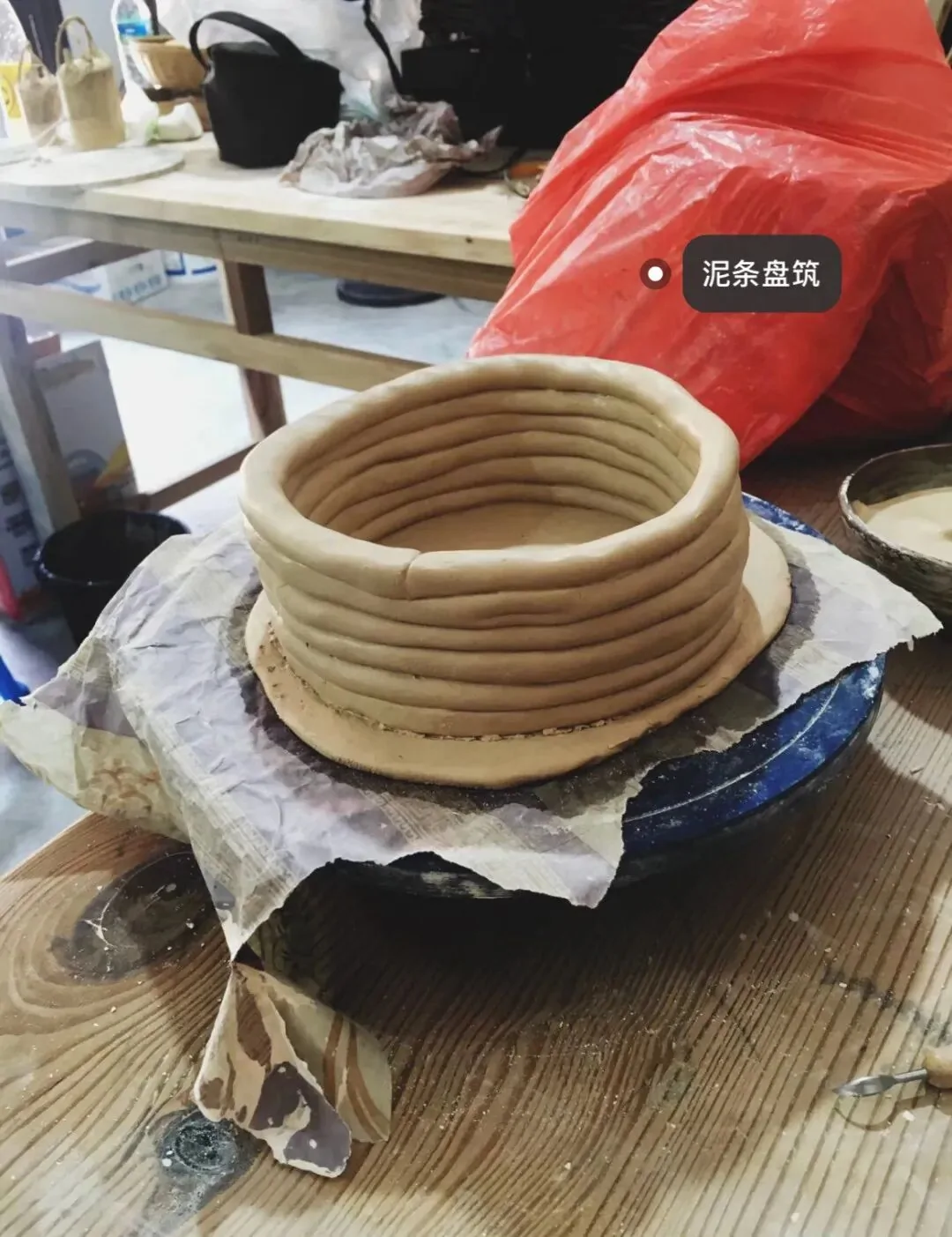
Jingdezhen sculpture is rarely a single lump of clay. A figure is normally modelled first as a solid master, then reproduced through a plaster piece-mould, with the hollow cast or press-moulded sections joined in leather-hard state. Heads, hands and attributes are often made separately and luted on. The sequence u2014 model, mould, cast, join, refine, dry, fire u2014 is what allows a workshop to produce a matched pair of temple guardians or forty identical figurines without losing the modelling of the original.
The full production sequence, and the four core techniques of round modelling, pinching, built-up relief and openwork, are set out in Jingdezhen Porcelain Sculpture: Four Core Techniques. What concerns us here is what happens after the first firing.
2. The Painted Surface
Glazing a sculpture and painting a sculpture are not the same operation. A glaze is fused glass; it rounds off sharp modelling and softens shadow. Painting adds information the clay cannot carry: the red of a robe, the gilding on a halo, the black of an eye. Jingdezhen’s solution is usually to leave the face and hands in a clear or lightly tinted glaze, where modelling must speak for itself, and to paint the drapery, base and attributes, where colour can carry the eye.
Decoration is chosen from a fixed repertoire, and the choice is a reliable guide to date and quality:
| Decoration | Applied | Firing | Effect |
|---|---|---|---|
| u7c89u5f69 fu011bncu01cei (famille rose) | Overglaze enamel, built up with opaque white and glass powder | Second firing, c. 700u2013800 u00b0C, oxidising | Soft, opaque colour with a slightly raised, satin surface |
| u65b0u5f69 xu012bncu01cei (new colour) | Overglaze enamels, painted directly and blended on the piece | c. 700u2013800 u00b0C | Broader, brighter palette; the standard modern overglaze method |
| u7ea2u63cfu91d1 hu00f3ngmiu00e1oju012bn | Iron-red ground with gilded line | Overglaze firing, then gilding fired lower | Strong but not garish; gilding sharpens edges and haloes |
| u9ad8u6e29u8272u91c9 gu0101owu0113n su00e8yu00f2u | Coloured glaze on the raw or bisque body | c. 1250u20131300 u00b0C, reduction | Depth and run; kiln variation is part of the result |
| u91c9u4e0bu4e94u5f69 yu00f2uxiu00e0 wu01d4cu01cei | Colour painted under the glaze | c. 1300 u00b0C, then glazed and fired together | Permanent, sealed colour; no wear at the surface |
| u7efcu5408u88c5u9970 zu014dnghu00e9 zhuu0101ngshu00ec | Underglaze colour plus overglaze enamel and glaze | Two or three firings | Maximum range; the most demanding to control |
Among these, famille rose is the technique most often judged best suited to sculpture. Its opaque pigment can sit on a rounded shoulder or a modelled fold without running, and its soft, slightly milky colour does not compete with the modelling underneath. The result is a surface that reads as painted skin over a carved form rather than as a coloured coating.
The weakness is cumulative. Every extra firing is another chance for a thin ankle, a raised finger or an overhanging sleeve to slump, craze or part from its join. A richly painted figure has therefore survived three or four firings, not one, and the survival itself is part of the evidence of quality.
3. Two Pieces That Show the Principle
The Han storyteller: form without colour
The clearest demonstration that modelling comes first is a piece with almost no decoration at all. A pottery storyteller figure excavated in 1957 from a tomb at Tianhuishan, Chengdu, stands 53 cm high and dates to the Han dynasty. It shows a stout elderly man, upper body bare, belly thrust forward, left arm clasping a small drum, right hand holding the beater, one foot flat and the other lifted, face creased in mid-joke.
Nothing about it depends on glaze. The comic effect is carried entirely by posture: the twist of the torso, the slack belly, the lifted foot. Han tomb sculpture in general worked this way, reproducing daily life u2014 servants, horses, granaries, wells, dogs u2014 with an observed realism that has more in common with later portrait sculpture than with the symmetrical ornament of the Song. It is also evidence of a workshop practice: these figures were moulded in parts and assembled, which is why so many survive with a repaired or replaced limb.
The qingbai lion pillow: form and glaze as one
At the opposite extreme is a Songu2013Yuan pillow in qingbai glaze, built in three registers. The top is a ruyi-shaped headrest incised with scrolling floral ornament; the middle is modelled as two lions rolling and grappling; the base is a thick oval pad left unglazed underneath. The whole is covered in a single pale blue-green glaze of even tone.
Here the glaze is the decoration. Qingbai u2014 literally “clear white” u2014 was made in southern China from the Song onward in deliberate imitation of pale green jade, and was known by the flattering, slightly misleading name jiu01ce yu00f9qu00ec (u5047u7389u5668, “false jade”). Where the glaze pools in the lion’s mane it reads dark; where it thins on a haunch it reads almost white. A second colour would have destroyed the effect.
The pillow is also a reminder that much of this production was made for use. Ceramic pillows were summer bedding, valued for staying cool against the skin, and they were turned out in quantity by Song kilns. The best of them u2014 modelled, incised and glazed in one controlled operation u2014 are collected today as sculpture.
4. Three Turning Points
Read as a history of technique rather than of style, the tradition has three clear shifts, each of which changed what a sculpture could be painted:
| Period | What changed | Why it mattered for the surface |
|---|---|---|
| Song (960u20131279) | Kiln practice absorbed the modelling of tomb figurines, stone carving and clay sculpture; qingbai glaze perfected | Monochrome glaze becomes a deliberate choice; carving and incision carry the detail |
| Ming (1368u20131644) | Press-moulding refined; finely detailed porcelain Buddhist figures produced in numbers | Reliable thin-walled bodies make overglaze painting on figures practical |
| Qing (1644u20131912), especially Qianlong | Openwork and multi-part assembly mastered: revolving vases, the “fairness cup” that empties itself when overfilled | Composite pieces require section-by-section glazing and firing, then assembly |
The Qing openwork revolving vase is the extreme case: an inner vessel is painted and fired, an outer pierced shell is cut and fired, and the two are joined so that the inner body turns. Every element has to survive its own firing before the assembly can exist. For the fuller dynasty-by-dynasty account, see Jingdezhen Sculpture Porcelain from Sui to Qing.
Since the mid-twentieth century the range has widened rather than narrowed. Contemporary Jingdezhen workshops produce deities and Buddhas, flowers and fish, pavilions, animals and toys, and the craft is organised into separate specialisms u2014 modellers, mould-makers, painters, gilders u2014 that rarely existed as distinct trades in the historical kilns.
5. What to Look For in a Piece
Because two skills are involved, a piece can be strong in one and weak in the other. The useful check is to look at the modelling with the colour ignored, then at the colour with the modelling ignored.
| Criterion | Hand-modelled work | Mould-reproduced work |
|---|---|---|
| Silhouette | Asymmetry in the pose; weight visibly shifts | Symmetrical, front-facing, evenly balanced |
| Surface | Tool marks, slight facets, uneven pressure | Smooth, uniform, faint seam lines at part joins |
| Joints | Luted joins with visible variation in thickness | Seams at identical positions on every example |
| Underside | Hand-finished, hollowed or vented individually | Standard vent hole, even thickness, maker’s mark |
| Paint | Follows the modelling; colour placed where the form needs it | Follows a printed outline; colour independent of the form |
| Firing evidence | Slight lean or shrinkage variation accepted as part of the piece | Matched sets identical in height to within a millimetre |
A hand-modelled figure and a mould-reproduced one can be painted to the same standard; the difference is not quality but intention. What should be rejected is a piece where the paint is used to hide the modelling u2014 heavy enamel over a soft, unmodelled face, or gilding over a join that has not been cleaned.
Frequently Asked Questions
Is statuary porcelain always hollow?
In practice, yes. A solid mass of clay of any size will crack or explode during firing as water and organic matter escape. Solid masters are made in plaster or clay and then moulded; the fired piece is hollow, with a vent to let air out.
Why are faces usually left unpainted?
Because the face is where modelling is most closely read. A clear or faintly tinted glaze lets the planes of the cheek and brow do the work; opaque enamel flattens them. Where flesh is painted, it is normally a thin wash rather than a solid colour.
How many firings does a decorated figure need?
Two at minimum u2014 one for the glazed body, one for overglaze enamel u2014 and three or four where gilding, underglaze colour and overglaze colour are all used. Each additional firing adds risk, particularly to thin projections such as fingers.
Does a later copy have any value?
Yes, on the same terms as any other ceramic: quality of modelling, control of glaze, standard of painting and condition after firing. Age is one factor among several, not a substitute for them.
Related Reading
For the classification of forms and the regional traditions of Dehua, Shiwan and Jingdezhen, read Ceramic Sculpture Art: Forms, Kilns and Materials. For the argument that Jingdezhen’s sculptural idiom was shaped by its clay and its institutions as much as by its painters, see The Craft Logic of Jingdezhen Porcelain Sculpture.
To see finished sculptural work from our own studio, browse the collection, or email us about a commission. We also answer questions on WhatsApp.