
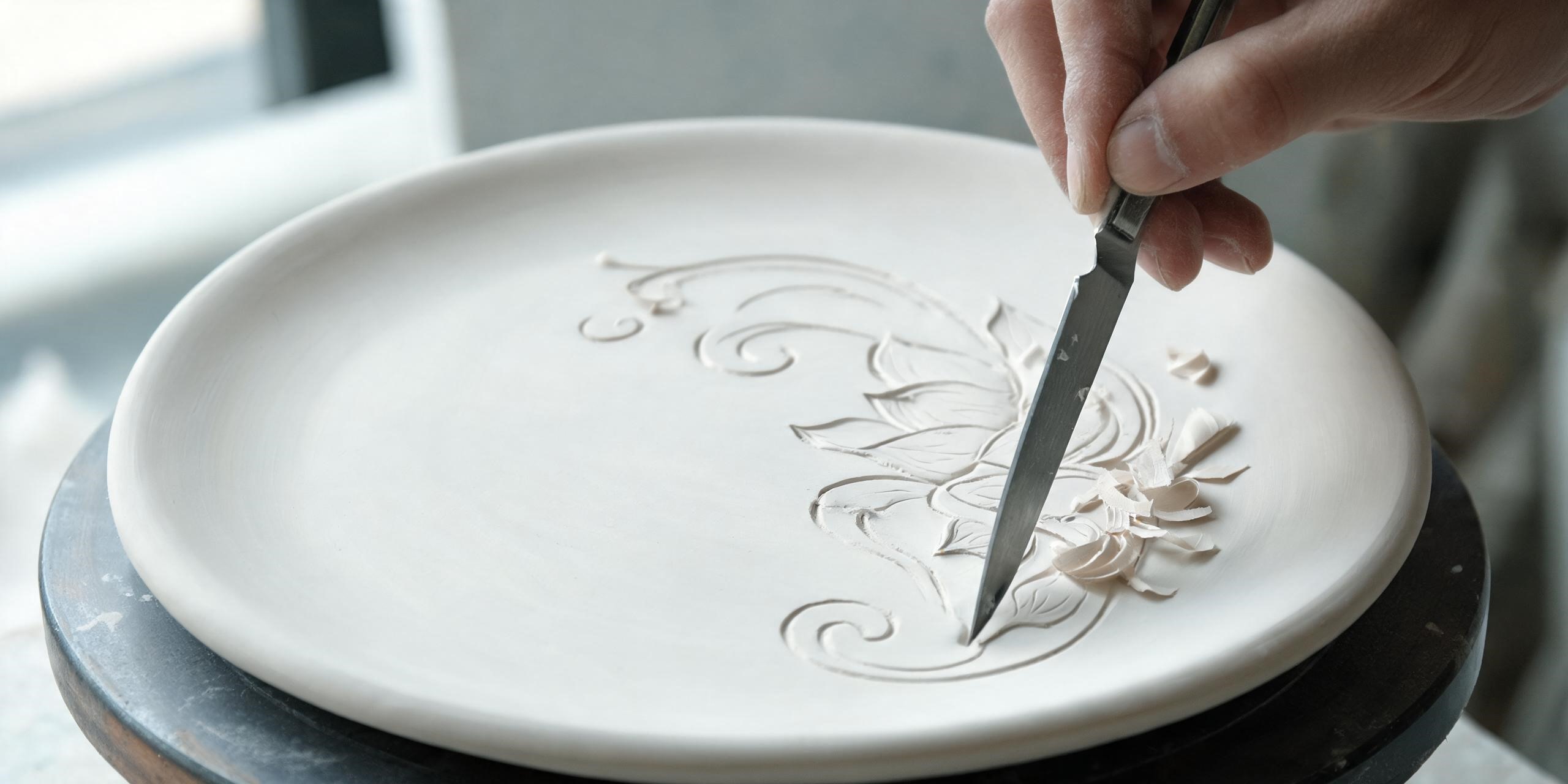
Before a Jingdezhen plate is glazed, a carver may spend two days cutting a lotus scroll into its unfired body. Once the knife has passed, the line cannot be put back.
Carved Jingdezhen porcelain is made by removing clay from a formed but unfired body. Painters add; carvers subtract. In the workshops of Jingdezhen, Jiangxi, China, the technique is called tu00e1ocu00ed diu0101oku00e8 (u9676u74f7u96d5u523b), and it is understood as a way of writing with a knife in place of a brush: the subject is drawn, cut, glazed thinly and fired once, so that the line sits under the glaze rather than on top of it.
The result looks deceptively close to painted decoration from a distance. Up close, the difference is physical. A painted line is flat. A carved line has a wall on one side and a shadow on the other, and when the glaze is thin, the carving is what produces the modulation of colour across the surface.
What Carved Jingdezhen Porcelain Is
The technique is applied to bodies that have already been formed, whether round ware thrown on the wheel or angular ware built from slabs, and before any glaze has been applied. The knife then replaces the brush. Three cuts are used: yu012bndiu0101o (u9634u96d5), carving inwards; yu00e1ngku00e8 (u9633u523b), leaving the design standing while the ground is cut away; and tu00f2udiu0101o (u900fu96d5), piercing the wall altogether.
Subjects are drawn from painting and calligraphy: flowers and birds, landscape, figures. After carving, the piece is given a very thin transparent glaze, a coloured glaze, or no glaze at all, and fired once at high temperature. Because everything happens before the glaze is applied, the finished object is an underglaze piece, and the carving is protected by the glaze rather than exposed on top of it.
How the Technique Began in Song Jingdezhen
The local record places the origin of carved porcelain in the Song dynasty, at the moment the town received its name. The Jiangxi Provincial Gazetteer states that in the Jingde period the town was established, officials were sent to supervise tribute wares for the court, and potters were ordered to inscribe the reign name on the vessels. The town took its name from that reign, the kiln industry grew with it, and the carved yu01d0ngqu012bng (u5f71u9752) ware u2014 a pale blue-green glazed porcelain with cut decoration showing through the glaze u2014 belongs to this moment.
The carving and the glaze developed together. A qingbai glaze is translucent and slightly milky; where the body has been cut, the glaze pools in the groove and reads darker, and where the body has been left standing, the glaze thins and reads paler. The decoration is therefore produced by the interaction of the cut surface and the glaze, not by pigment. By the Qing dynasty the trade had become specialised enough that carving was recognised as its own occupation within the Jingdezhen industry.
The Three Cuts: Yin, Yang and Pierced
The three cuts are not simply variations of depth. Each produces a different kind of image, and most carved pieces combine at least two of them.
| Cut | Chinese term | What the knife does | How it reads | Main risk |
|---|---|---|---|---|
| Incised | u9634u96d5 / u9634u523b | Cuts a groove into the surface, removing a thin line of clay | A dark line where glaze pools in the groove | Groove too shallow to hold glaze, or too deep to fill |
| Raised | u9633u523b / u6d6eu96d5 | Leaves the design standing and cuts the ground away around it | A pale form standing proud of a darker ground | Ground cut unevenly, so the relief reads lopsided |
| Pierced | u900fu96d5 / u9542u7a7a | Cuts through the wall so that light passes | A hole read as light against the body | Wall weakened until the piece collapses in the kiln |
Rice-grain ware, lu00ednglu00f3ng (u73b2u73d1), is the best-known use of piercing. Small openings are cut through the wall in a pattern, then filled with a translucent glaze so that they read as bright windows in the body when the piece is held to the light. The same piercing logic is used for the openwork sections of vases, brush pots, hanging plates, censers and lanterns.
Carving the Unfired Body
Carving on the unfired body, ku00e8pu012b (u523bu576f), starts with a drawing. The design is sketched onto the leather-hard surface in ink, and the knife then follows the ink line. The carver works by subtraction, removing clay from the outside inwards and bringing the form out gradually rather than cutting to a final depth in one stroke.
The state of the body governs everything. If the clay is too wet, the knife drags and the line smears; if it is too dry, the edge chips and the chip cannot be filled. The window is narrow, and in a Jingdezhen summer it may last only a few hours. Deep cuts also set up drying stress: a groove that is too deep will open into a crack as the water leaves, and the crack will widen in the kiln.
Because the work is subtractive, errors are permanent. A line cut too deep cannot be raised again, and a design that has been cut away cannot be re-cut. Carvers therefore plan the order of cuts before starting, working from the outline inwards and leaving the finest lines until the shallow cuts are finished.
Carving the Fired Surface: Keci
A separate branch of the technique works on the glazed and fired surface. This is ku00e8cu00ed (u523bu74f7), and it is closer to engraving than to carving. The design is drawn on the finished glaze, then cut with a tungsten-steel or all-steel knife. Instead of a continuous line, the image is built from a dense field of small incised points, each cut to a similar depth, with no chipping at the edge of any point. Pigment or ink is then rubbed into the points and sealed with wax.
The most cited example in the local record is Li Mianting, who in 1915 spent six months carving a portrait of King George V of Britain on porcelain, described at the time as remarkably true to life. The technique is still used for portrait plaques, calligraphy and decorative panels where a photographic level of detail is wanted.
| Aspect | Carving the body (u523bu576f) | Carving the fired surface (u523bu74f7) |
|---|---|---|
| When it is done | Before glazing, on a leather-hard body | After glazing and firing |
| Tool | Carving knife or bamboo blade | Tungsten-steel or all-steel stylus |
| Mark made | Continuous line, groove or pierced opening | Field of fine points of even depth |
| Finish | Thin glaze, coloured glaze or none, fired once | Pigment or ink rubbed in, sealed with wax |
| Reversible | No | No |
From Imperial Tribute to Village Bowls
The technique has two histories that rarely appear in the same account. One is the tribute ware of the Song and the specialised carving trade of the Qing, where the work was made for official use and for the export market. The other is domestic and informal.
Itinerant carvers moved from village to village cutting surnames into the bowls and plates of ordinary households. Because weddings and funerals were held in the ancestral hall and required borrowed tableware, each family had its name carved on its own vessels so that they could be returned to the right owner after the event. Many of these marked bowls and plates are still in use, and the carved characters remain legible decades later because the glaze has protected the groove.
Carved or Painted: How to Judge a Piece
Carved decoration is easiest to read on monochrome wares, where there is no pigment to distract the eye. A qingbai or celadon glaze over carving will show a clear shift in tone between the cut and the standing surface, and the line will remain visible when the piece is tilted away from the light.
| Check | Carved by hand | Warning sign |
|---|---|---|
| Line | Slightly varied pressure, tapering at the ends | Uniform depth and width from start to finish |
| Depth | Consistent enough to hold glaze without trapping it | Pools of glaze sitting in a shallow groove |
| Edges | Clean, with no chipping along the cut | Chipped or rounded edges on the line |
| Light | Carving visible when backlit through a thin wall | Decoration visible only from one angle |
| Ground | Relief ground cut by hand, slightly uneven | Ground perfectly flat, suggesting a mould |
Frequently Asked Questions
What is the difference between yin carving and yang carving?
Yin carving cuts a line into the surface, so the design sits in a groove and reads darker where glaze collects. Yang carving does the reverse: the design is left standing and the ground around it is cut away, so the motif reads pale against a darker field. Many pieces combine both on the same surface.
Why is carved porcelain usually fired only once?
Because the carving is complete before the glaze is applied. The piece is cut, glazed thinly or not at all, and fired once at high temperature, which fuses body and glaze together. Additional firings are needed only when enamels or gilding are added on top of the glaze afterwards.
Can a mistake in carved decoration be repaired?
Not in the clay. A cut that is too deep cannot be raised, and a motif that has been removed cannot be restored, so the carver must plan the sequence of cuts in advance. Once the piece is fired, the only remedy is to cut the decoration back and rebuild the surface, which removes the original work.
Is rice-grain openwork the same as pierced carving?
It is one application of it. Pierced carving cuts through the wall to create openings; in rice-grain ware those openings are small, arranged in a pattern and filled with translucent glaze, so that they read as glowing windows rather than as holes. The same piercing technique is used at a larger scale for lanterns, censers and the openwork sections of vases.
Related Reading
For the wider vocabulary of cutting and texturing, see carving and texturing techniques for ceramic art and the history of Jingdezhen sculpture porcelain. The opposite approach, where decoration is built up in clay rather than cut away, is covered in how Jingdezhen porcelain flowers are made.
We make Chinese porcelain carved to order in Jingdezhen, from incised qingbai-style pieces to pierced and relief-carved forms. Carving is done on the unfired body and fired once, so the decoration is part of the wall rather than applied to it.
Send the design, the dimensions and the intended use to service@jingdezhenheritage.com or message us on WhatsApp. We will confirm whether the design can be cut at the required wall thickness before any work begins.
Published 31 October 2026 by Jingdezhen Heritage, a porcelain studio in Jingdezhen, Jiangxi, China.