
The beauty of a ceramic object comes partly from the clay’s plasticity and partly from the marks a tool leaves on it. Carving and texturing are subtractive and impressional surface work: the body is cut, scraped, stamped or pressed so that the surface carries texture before it is ever glazed. Twenty-five methods are in common use, and almost all of them can be improvised with shop-made tools.
Tools First
Carving results depend on three variables: the angle of the cut, the pressure applied, and the state of the clay (soft, leather-hard or bone-dry). Soft clay tears and smears; leather-hard clay cuts cleanly; bone-dry clay chips. Most traditional carving is done at leather-hard.
The tool kit is small: loop and ribbon wires, skew and V-gouges, needle tools, scrapers, combs, stamps, rollers, paddles, hollow tubes and brushes. Bamboo, bone, wood and wire all work, and many carvers make their own.
The Twenty-Five Methods
| # | Method | Chinese | Tool / Action | Result |
|---|---|---|---|---|
| 1 | Carving | 刻花 (kèhuā) | Angled knife, deep incisions | Faceted, light-catching cuts |
| 2 | Incising | 划花 (huàhuā) | Bamboo or bone needle, single line | Fine linear drawing |
| 3 | Comb-scratching | 篦划纹 (bìhuàwén) | Multi-tooth comb drawn across | Parallel wave or grass bands |
| 4 | Mille-dot ground | 珍珠地划花 (zhēnzhūdì) | Hollow tube punched around incisions | Incised motif on dotted field |
| 5 | Sgraffito | 剔花 (tīhuā) | Ground cut away, motif left raised | Cameo relief in two levels |
| 6 | Piercing / openwork | 镂空 (lòukōng) | Knife or wire through the wall | See-through lattice |
| 7 | Chatter marks | 跳刀 (tiàodāo) | Springy tool held to a turning body | Rhythmic scalloped dashes |
| 8 | Stamping | 印花 (yìnhuā) | Carved stamp pressed in | Repeated crisp motif |
| 9 | Press-moulding texture | 压印 (yāyìn) | Mould or textured pad pressed | All-over repeat pattern |
| 10 | Paddle impression | 拍印 (pāiyìn) | Carved wooden paddle struck | Faceted, beaten surface |
| 11 | Roller impression | 滚印 (gǔnyìn) | Engraved roller rolled over | Continuous banded motif |
| 12 | Stippling | 戳印 (chuōyìn) | Tube or nail-end tapped | Dotted matte field |
| 13 | Applied relief | 堆贴 (duītiē) | Shaped clay fixed with slip | Raised motif on the surface |
| 14 | Pinched modelling | 捏塑 (niēsù) | Fingers only | Soft, hand-pressed detail |
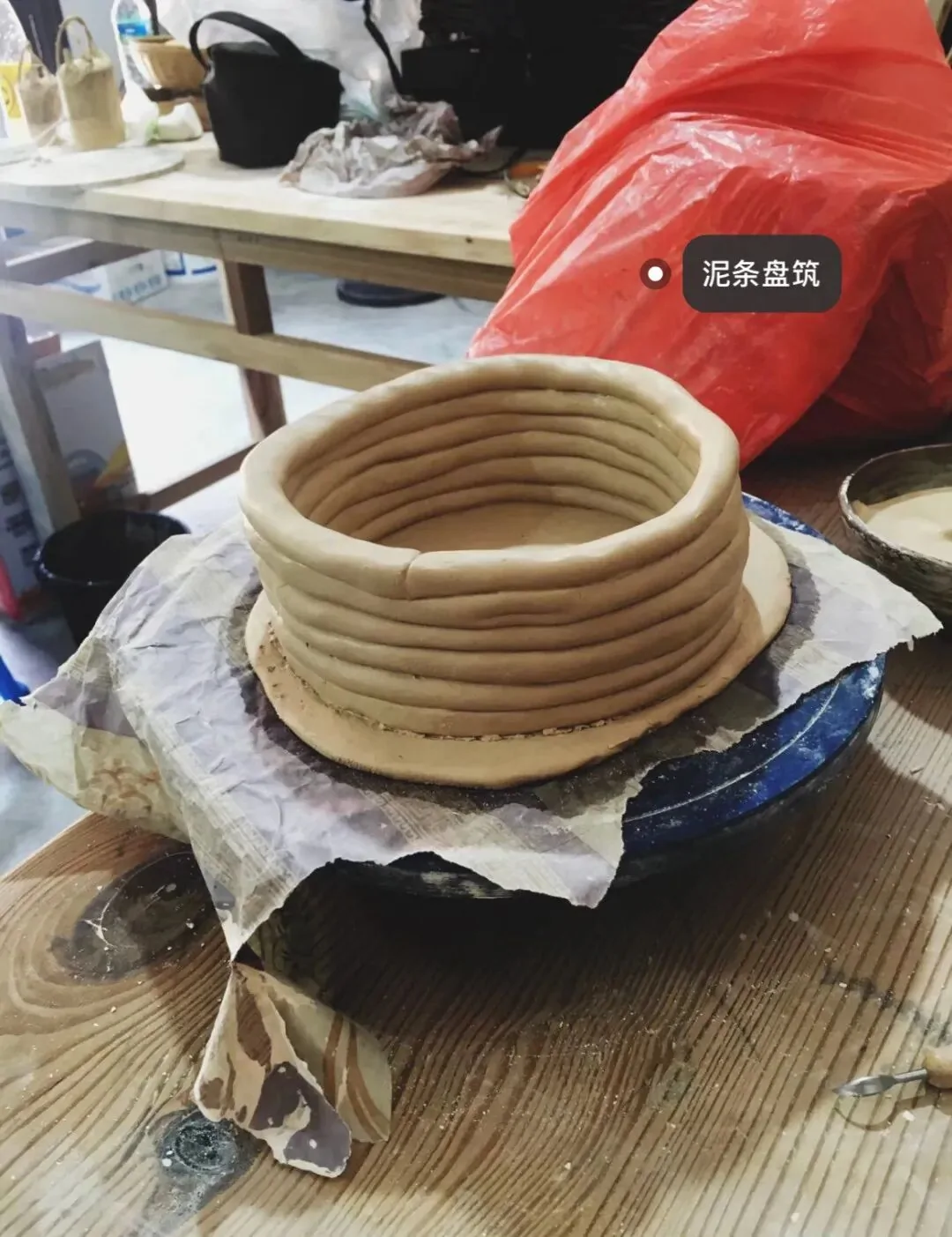
| 15 | Coil appliqué | 泥条堆饰 (nítiáo) | Thin coils laid and pressed | Ridged linear ornament |
| 16 | Marbled body | 绞胎 (jiǎotāi) | Two coloured clays wedged together | Swirled colour through the thickness |
| 17 | Slip coating | 化妆土 (huàzhuāngtǔ) | Contrasting slip brushed on | Ground colour to carve through |
| 18 | Slip resist-scratch | 刮花 (guāhuā) | Slip scratched away before firing | Two-tone drawn line |
| 19 | Mould-embossed relief | 模印浮雕 (móyìn) | Piece pressed into a carved mould | Reproduced low relief |
| 20 | Weave impression | 织物压痕 (zhīwù) | Textile pressed into soft clay | Cloth and basket grain |
| 21 | Organic impression | 树叶压印 (shùyè) | Leaf, wood or stone pressed | Natural silhouette and veining |
| 22 | Cord, basket and mat | 绳纹·篮纹·席纹 | Wrapped paddle or mat beaten on | Archaeological textile texture |
| 23 | Shrinkage crackle | 龟裂肌理 (jūnliè) | Controlled uneven drying | Craquelure of fine fissures |
| 24 | Burnishing | 磨光 (móguāng) | Stone or spoon rubbed over leather-hard clay | Compacted, semi-lustrous skin |
| 25 | Chemical texture | 化学肌理 (huàxué) | Salt, ash, soluble salts or acid resists | Pitted, mottled or crystalline surface |
How the Methods Group
Cutting and incising (1–7)
These remove material. Kèhuā gives a faceted cut that holds light; huàhuā gives drawn line; the comb (bìhuà) gives speed and rhythm; mille-dot ground frames an incised motif with thousands of punched points. Tīhuā is the boldest: the background is cut down so the motif stands in relief. Lòukōng goes through the wall and must follow curved or geometric lines, because irregular openings distort in the kiln. Tiàodāo is a by-product of throwing — a flexible tool held against the spinning wall leaves a scalloped chatter that later became a deliberate decoration.
Impressing (8–12, 19–22)
These add no material and remove none; they transfer a pattern from a harder surface. Stamps and rollers repeat; paddles facet; tubes stipple. Organic impressions — leaf, cloth, cord, basket, mat — carry the memory of an object that burned away in the firing. In archaeological wares these impressions are the main evidence of how a pot was built.
Adding (13–16)
Applied relief, pinched detail and coil ornament build the surface upward, always with slip as the adhesive and always pressed firmly to avoid a trapped air layer that will lift in firing. Jiǎotāi is different: two clays of contrasting colour are wedged and sliced so the pattern runs through the body, then the surface is carved back to reveal it.
Colour and chemistry (17–18, 23–25)
Slip coating and scratch-through give a two-tone image without a second clay body. Burnishing compacts the surface to a soft sheen. Shrinkage crackle exploits the body’s own drying stress. Chemical texture — salt, ash, soluble salts and acid resists — works at the glaze interface rather than in the clay.
Practical Rules
- Cut at leather-hard. Too soft tears and drags; too dry chips and dusts.
- Keep wall thickness in mind. Deep carving on a thin wall creates a weak point that will crack in firing or in use.
- Never leave a sharp interior corner. Stress concentrates there; round the bottom of every groove.
- Compact after carving. A light rub over cut edges closes micro-cracks before drying.
- Test the tool on scrap. The angle of a loop tool changes the cut more than its size does.
Frequently Asked Questions
What is the difference between 刻花 and 划花?
Kèhuā (carving) cuts with an angled blade into the body, producing a faceted groove with visible depth. Huàhuā (incising) draws a thin line with a pointed tool, more like drawing than carving.
Why must openwork follow curved or geometric lines?
Straight-edged or irregular openings create stress concentrations and uneven shrinkage, so the piece distorts or splits in the kiln. Curved and regular geometric shapes distribute stress and are self-supporting.
Can I carve a bone-dry body?
You can, but the clay chips rather than cuts, and the dust is a health hazard. Leather-hard gives the cleanest cut and the least risk of firing cracks.
Is 跳刀 deliberate?
Originally it was an artefact of holding a trimming tool against a spinning pot. Potters noticed the rhythm and kept it as decoration, deliberately using a springy tool to control the spacing.
Related Reading
For the forming methods underneath the decoration, see Ceramic Forming Techniques: Six Methods from Coil to Slip Casting and Jingdezhen Porcelain Sculpture: Four Core Techniques. For how these surfaces behave once glazed, read Glaze Pinholes and Bubbles: Forming-Side Causes.
Hand-carved pieces from our studio are listed in the shop; for bespoke carving work, email us.