Official kiln porcelain — guan ware — spans a thousand years of Chinese ceramic history, from the austere Five Famous Wares of the Song dynasty to the lavishly decorated imperial output of Ming and Qing Jingdezhen. What unites all of it is not a single style but a single mandate: porcelain made by official order, at official expense, for imperial or state use. This article traces the evolution of guan ware through its two great aesthetic ages.
Song dynasty: The minimalist peak
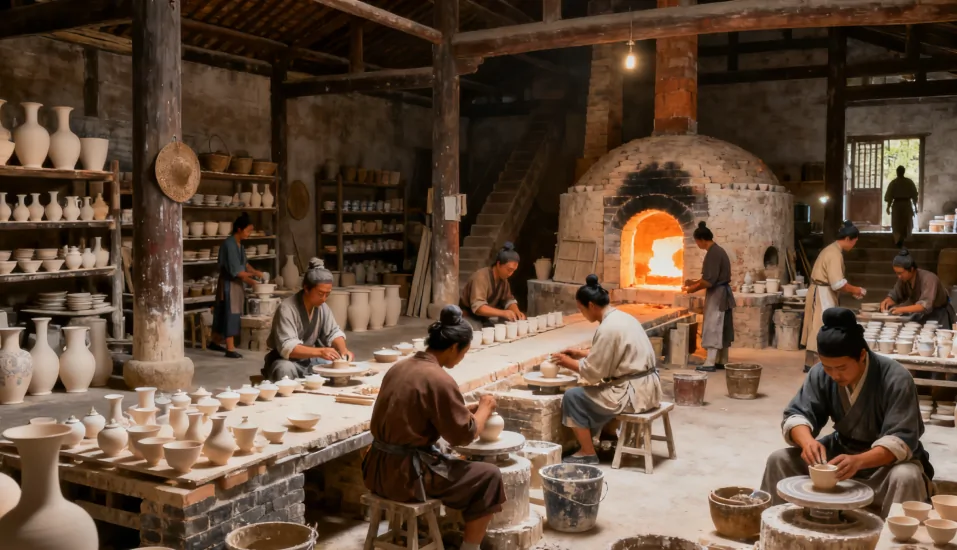
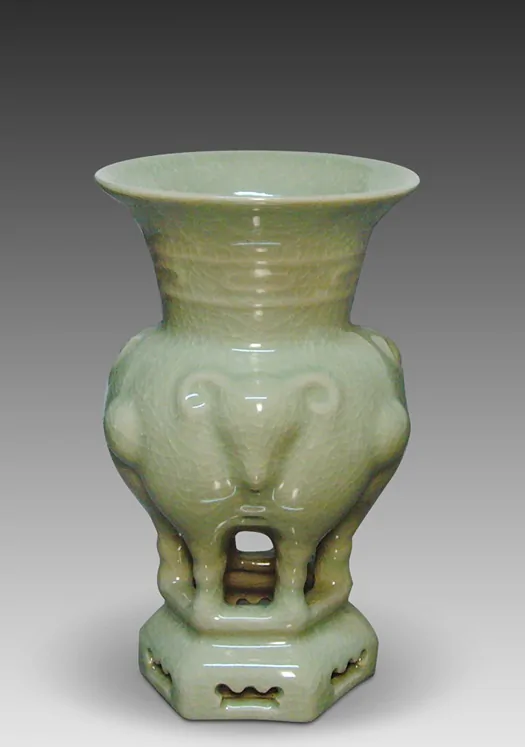
The Five Famous Wares — Ru (u6c5d), Guan (u5b98), Ge (u54e5), Jun (u94a7), Ding (u5b9a) — are the canonical peak of official kiln porcelain. The Northern Song court under Emperor Huizong (a serious ceramic collector and poet) elevated porcelain production to a state art form. These kilns did not supply the masses; they supplied the palace and the ritual apparatus of the Song state. The objects were small, the glazes were single-colour, the decoration deliberately restrained. If the porcelain of the following centuries was to become a medium of opulence, the Song remained its moral and aesthetic foundation.
Ru ware: The rarest of all
Ru kiln porcelain is the most sought-after of the Five. Only around one hundred complete pieces are believed to survive worldwide, a number that helps explain the record prices at auction. Its sky-blue glaze — sometimes described as “the colour of cloud-covered sky after rain” — uses crushed agate as a raw material, giving the surface a distinctive soft velvety appearance. Ru is the purest expression of the Song court aesthetic: refined, inward-looking, and technically beyond ordinary reach.
Guan ware: The crackle that became art
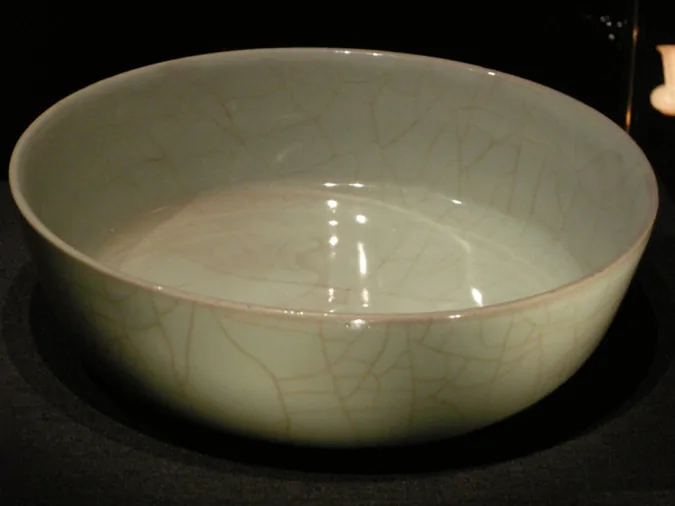
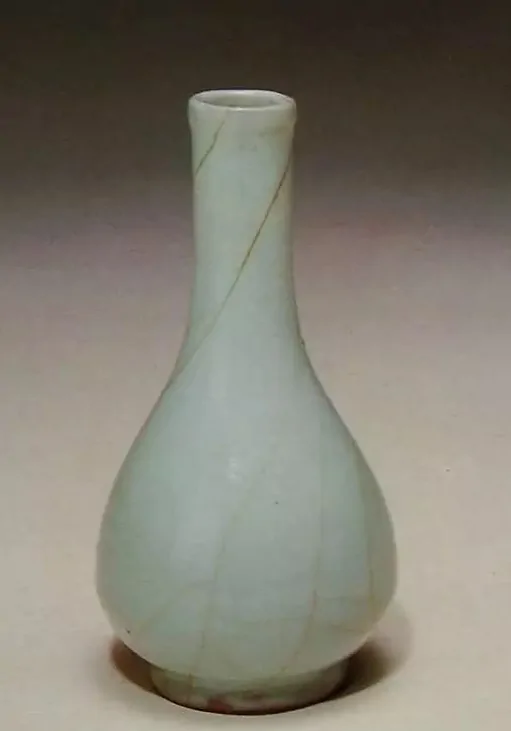
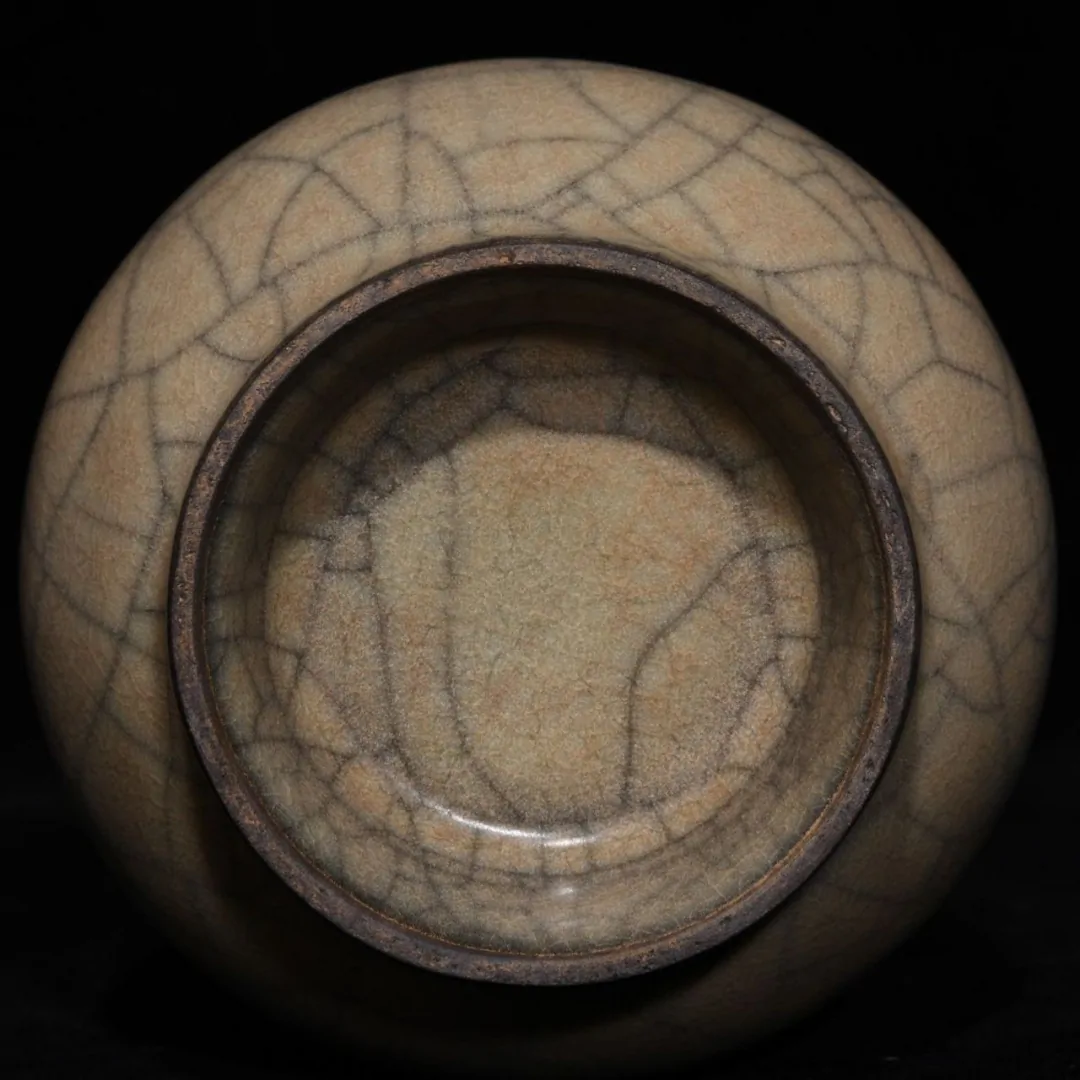
After the Northern Song fell in 1127 the capital moved south, and a new official kiln was established below Phoenix Hill in Hangzhou. Its wares combined a pale celadon glaze with a prominent network of crackle. That crackle was a technical accident — the glaze and clay body cooled at different rates — but it quickly became the defining aesthetic feature of Southern Song guan ware, and later of Ge ware which deliberately amplified the effect. Close inspection of a guan ware piece often reveals a dark outer rim where the thin glaze pooled at the edge during firing.
Ge ware: Large and small crackle
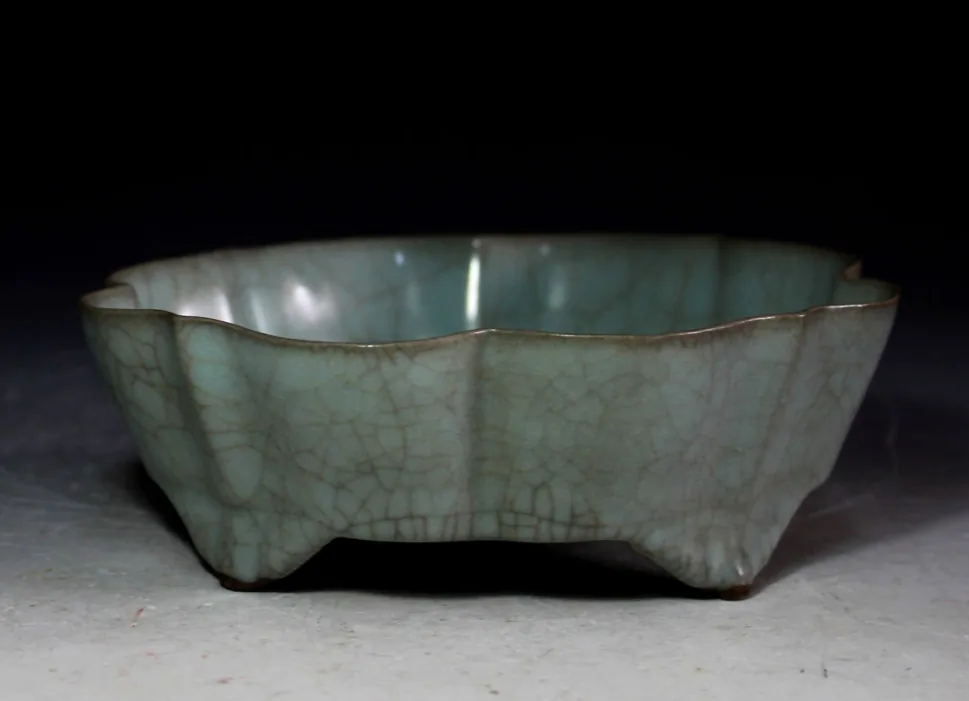
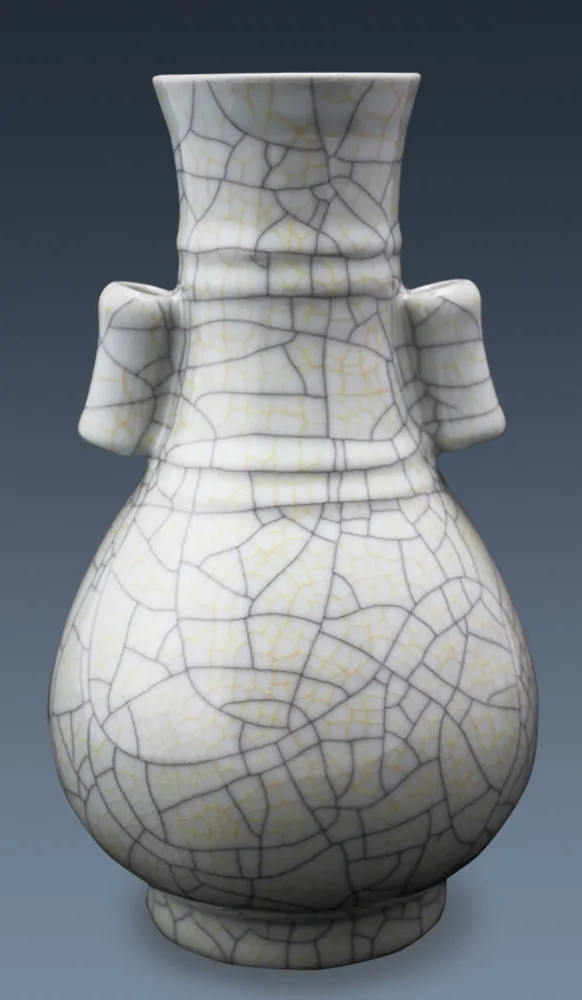
Ge ware, one of the Five, is defined by the dramatic contrast of its crackle: large open cracks infilled with black lacquer, and a finer network of smaller crackles in brown. Collectors call this “gold threads, iron lines” (jin si tie xian). Ge kiln porcelains were made in Zhejiang, and their crackle was deliberately sought after by later official kilns as well.
Ming and Qing: The Jingdezhen scale
The Ming dynasty founded a permanent official kiln in Jingdezhen in 1369, an institution that ran continuously for roughly 500 years. Where the Song kilns had been small and experimental, the Jingdezhen imperial factory was an industrial complex employing thousands of potters, decorators and kiln managers — the largest porcelain factory in the world at its time. This scale allowed the court to demand both technical excellence and vast quantity: one Ming order called for 176,000 pieces in a single year.
Blue and white with imported cobalt
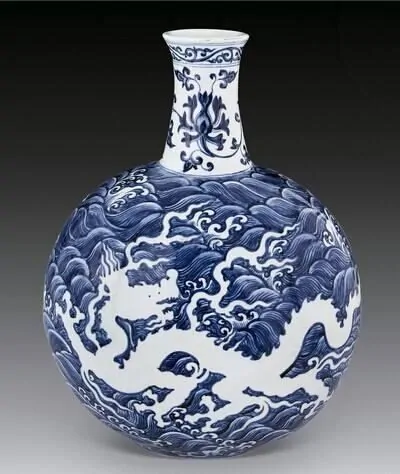
The Ming official kiln’s signature product was blue-and-white porcelain. At its best, particularly under the Xuande emperor, it used sumaliqing — a cobalt pigment imported from Persia, purer than anything available in China. Where the blue collected densely it turned near-black, giving the decoration a depth that local cobalt could never match. The Xuande celestial bottle illustrated below bears the classic dragon-and-sea-wave motif that travelled along the Ming court’s tributary and trade networks as far as Africa.
The full evolution of blue-and-white across dynasties is mapped in the dynasty-by-dynasty history.
Enamel, famille rose and doucai
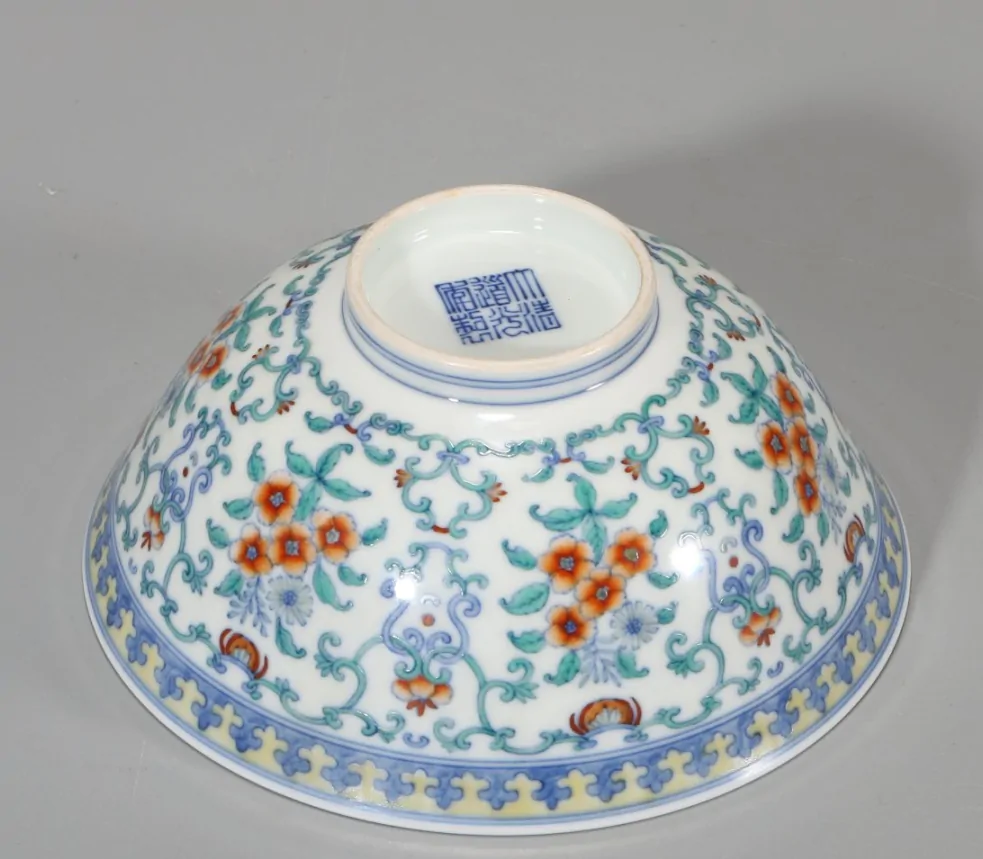
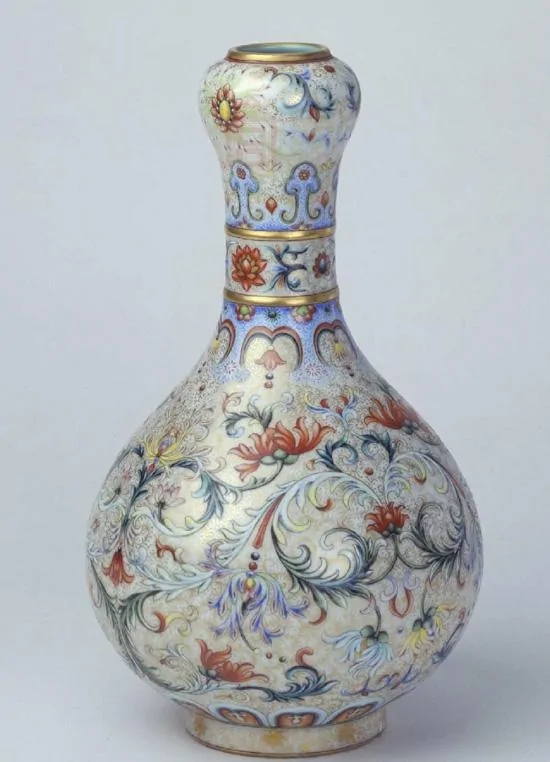
The Qing court imported mineral-based enamel paints from Europe (falangcai) and developed from them famille rose and doucai. These techniques allowed pigments of unprecedented brightness and delicacy, covering surfaces with floral scrolls, figural scenes and geometric patterns. The Tongzhi doucai bowl below shows the characteristic doucai style: outlines painted in underglaze blue, then filled with coloured enamels. Famille rose (such as the Qianlong garlic-head vase) used gold-based pigments to produce a soft peach-pink that had never appeared on Chinese porcelain before.
What official kilns did differently
Three features separated official kiln porcelain from everything else being made in China during these centuries.
Extreme raw materials. The court seized the best porcelain stone and the purest kaolin clay from Jingdezhen’s mines — materials too expensive for private kilns to procure. For the Five Famous Wares, special clays and glazes were mined exclusively for official kiln orders.
Extreme technique. The three-pronged firing support technique left characteristic “sesame seed” marks on the base of Song guan ware. Ming blue-and-white required precise kiln temperature control so that the sumaliqing cobalt developed its characteristic blue-black palette without blurring. Qing monochrome red glaze (the “Sacrificial Red” of the court) could only be achieved within a narrow 30-degree temperature band — outside that window the red turned brown, grey or green.
Extreme aesthetic control. Every design issued from the Board of Rites. A dragon must have five claws — any fewer would be inappropriate for imperial use. Yellow glaze was reserved exclusively for the palace until the Qianlong emperor permitted it for a small number of tributary princes. The full system of rank and decoration is detailed in how guan ware marked rank and status.
After the kiln: rejection and punishment
The official kiln operated under strict supervision. In the Song, every rejected piece was smashed and buried on site — evidence of this survives in the thousands of fragments excavated from kiln sites at Longquan and Hangzhou. In the Ming and Qing, rejection of substandard batches was common, and court officials who failed to meet quotas could lose their posts. This ruthless quality control is one reason official kiln porcelain remains so highly valued: the pieces that survive are ones the court itself approved.
Modern official kilns: the end of monopoly
The Jingdezhen imperial factory was formally dissolved in 1911 with the fall of the Qing. Today, official kiln work survives in a different form: state-run kilns produce porcelain as national gifts for visiting heads of state, and private workshops revive traditional wares — often to a standard that rivals the historical originals. The distinction between “official” and “private” in this context is no longer political; it is a matter of commission and purpose.
Collectors approaching modern official-kiln revival ware can use the same framework set out in our buyer’s guide and the price ladder: judge not by the label alone but by the actual standard of materials, technique and finish.
Related reading
- Official vs Private Kilns: the two distinctions that separate guan ware and min ware
- How guan ware marked rank and status in the imperial system
- Yongzheng’s meiping revival: sloping shoulders and imperial taste
- Blue-and-white porcelain: a dynasty-by-dynasty history
Explore our collection
Browse the Jingdezhen Heritage collection for hand-made porcelain inspired by official-kiln traditions, documented and sold as what they are.
Contact Jingdezhen Heritage
Questions about a piece, a glaze or an order? Email service@jingdezhenheritage.com or message us on WhatsApp. We reply within one working day.