
The shoulder is the first thing to read on any meiping. When a Yongzheng vessel descends from the neck in a long, soft slope instead of rising to a high, square-set shoulder, the potter is usually quoting a Ming model or something older. Shape does not settle a date by itself, but it indicates which period the maker had in mind.
For the wider definition of this tradition u2014 where it began, what it copied, and why a revival piece is not the same thing as a forgery u2014 see our article on what revival porcelain is. For the checks used to separate an original from a later copy, see how to tell a revival copy from an original. This article sits between the two: one reign, one form, and one feature that can be judged with the eye.
What is a meiping vase?
A meiping u2014 literally a “plum vase” u2014 is a tall vessel with a small mouth, a short neck, a broad shoulder and a body that tapers to a narrow foot. The name is usually explained by its later use, as a container for a single branch of plum blossom; earlier examples were wine jars. The form was established by the Tang dynasty and never fell out of use.
That continuity is what makes the type informative. Because the meiping survived for a thousand years, its proportions changed with period taste, and any Jingdezhen porcelain meiping can be placed against a known sequence. The shoulder, the waist and the foot will suggest where in that sequence a piece belongs.
How did the meiping change from Tang to Qing?
The clearest summary is a chart published by Liu Cui in Wenwu Shijie (Cultural Relics World) in 2020. It arranges excavated and museum examples in a single sequence from the Tang to the Qing, and the change in silhouette is visible at a glance.
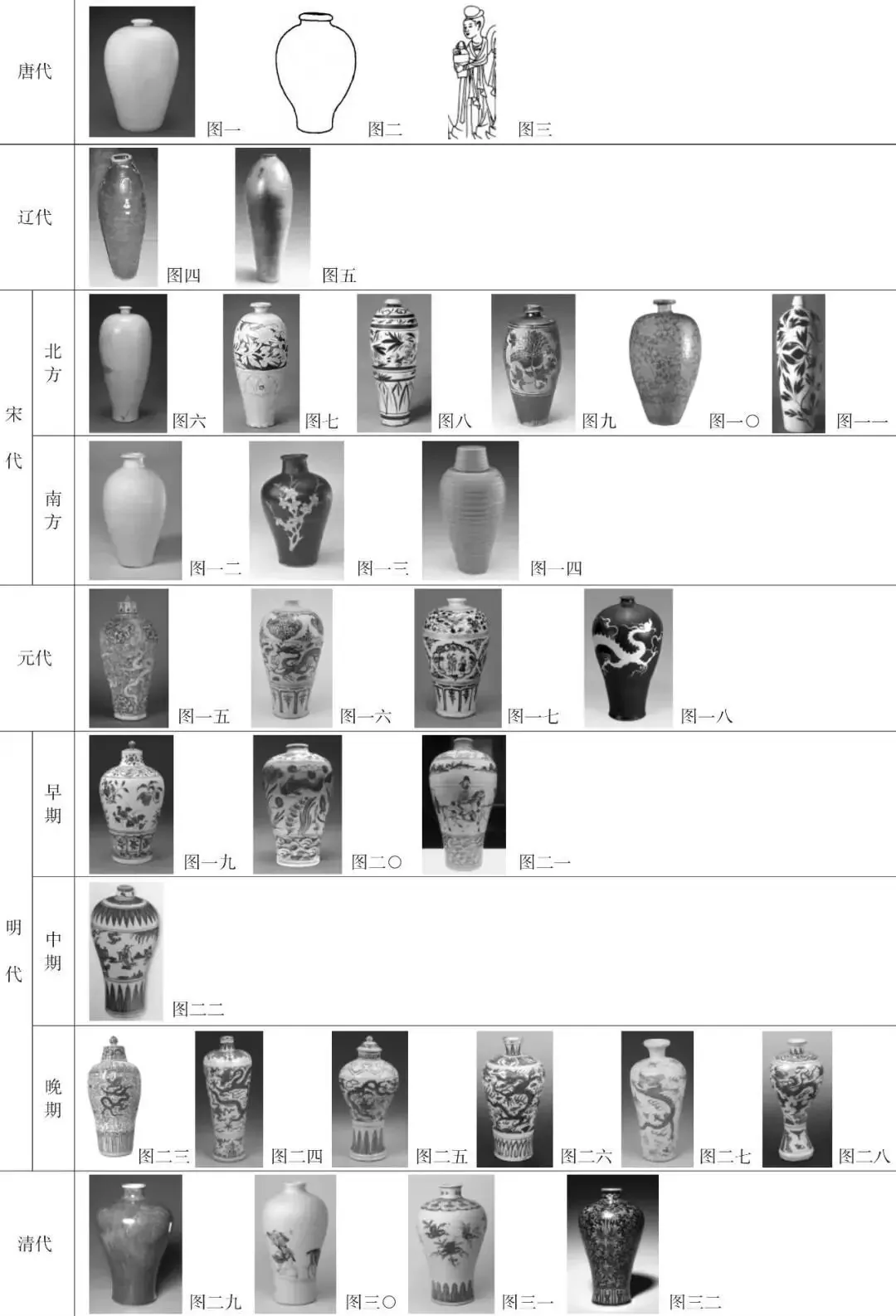
Tang. The earliest meiping are low, rounded and sturdy, with a heavy body and a low centre of gravity. Song. The form becomes taller and more slender, with a decisive shoulder and a long, elegant taper; this is the profile most often taken as the classical type. Yuan. Vessels grow heavier and plainer, with a more substantial neck and foot and less refinement in the line. Early Ming. Yongle and Xuande meiping are steady and dignified: the shoulder is broad but controlled, and the descent to the foot is confident rather than exaggerated. Qing. Forms multiply, and through the eighteenth century the shoulder becomes fuller and rounder.
The sequence is a scale, not a rule. Kilns overlapped, provincial workshops lagged, and a single period produced more than one profile. But the broad direction is reliable, and it gives a collector a first question to ask of any meiping: does this silhouette sit early or late in the series?
Why do sloping shoulders point to an earlier model?
Set a group of Yongzheng meiping against that chart and the resemblance is immediate. The pieces shown below differ from the standard eighteenth-century type in one consistent respect: the shoulder falls away in a long, concave slope, and the widest point of the body sits lower than it does on a typical Qing vessel.
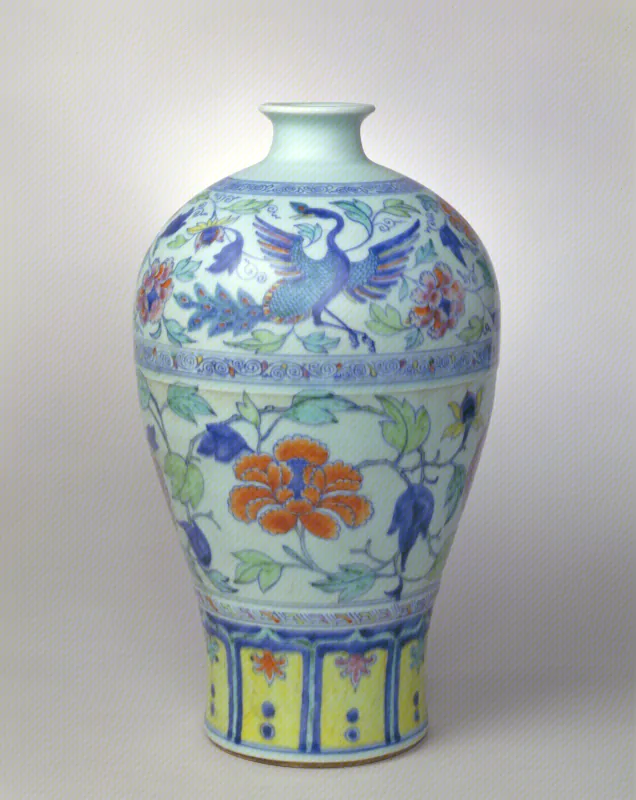
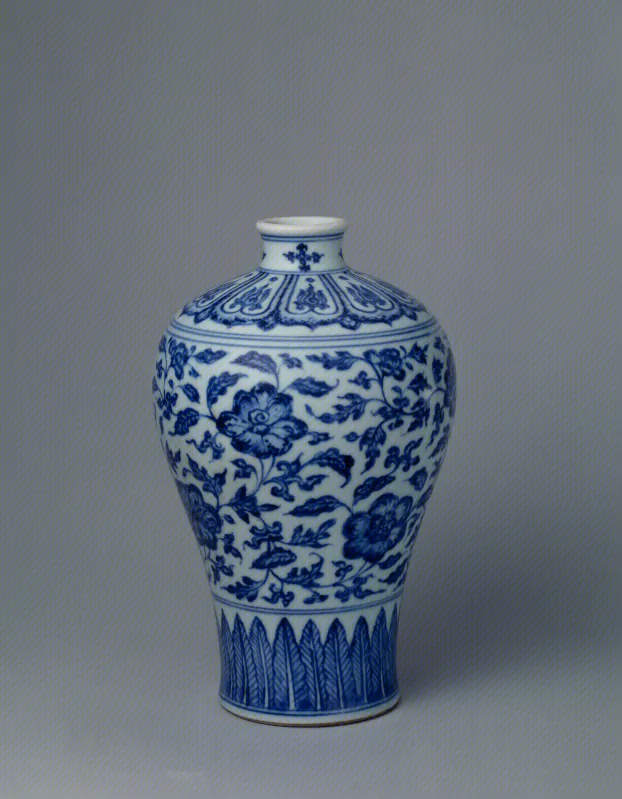
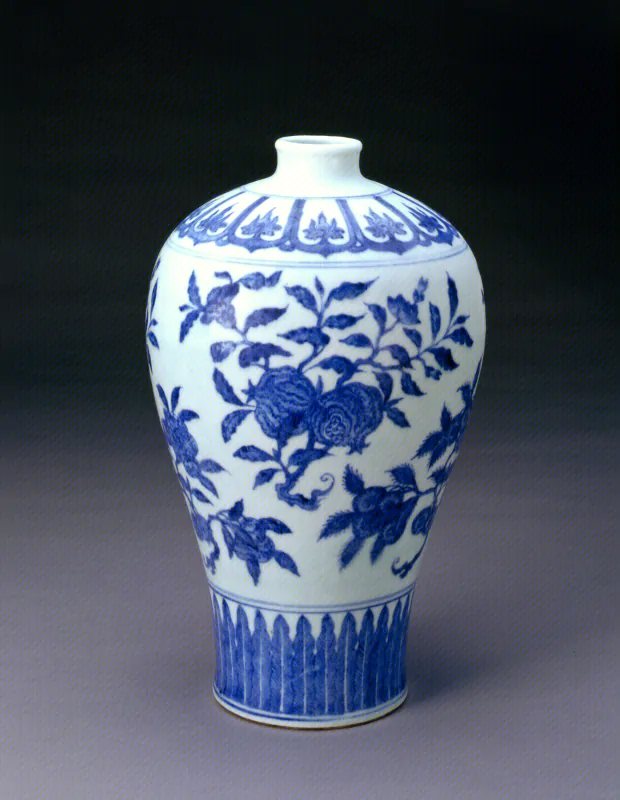
The feature appears across decorative classes, which is the point. A doucai vessel, an underglaze-blue vessel and a copper-red monochrome can share the same profile, because the shape was decided before the decoration was applied.
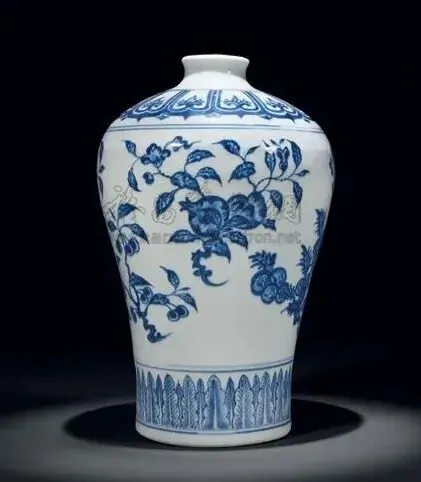
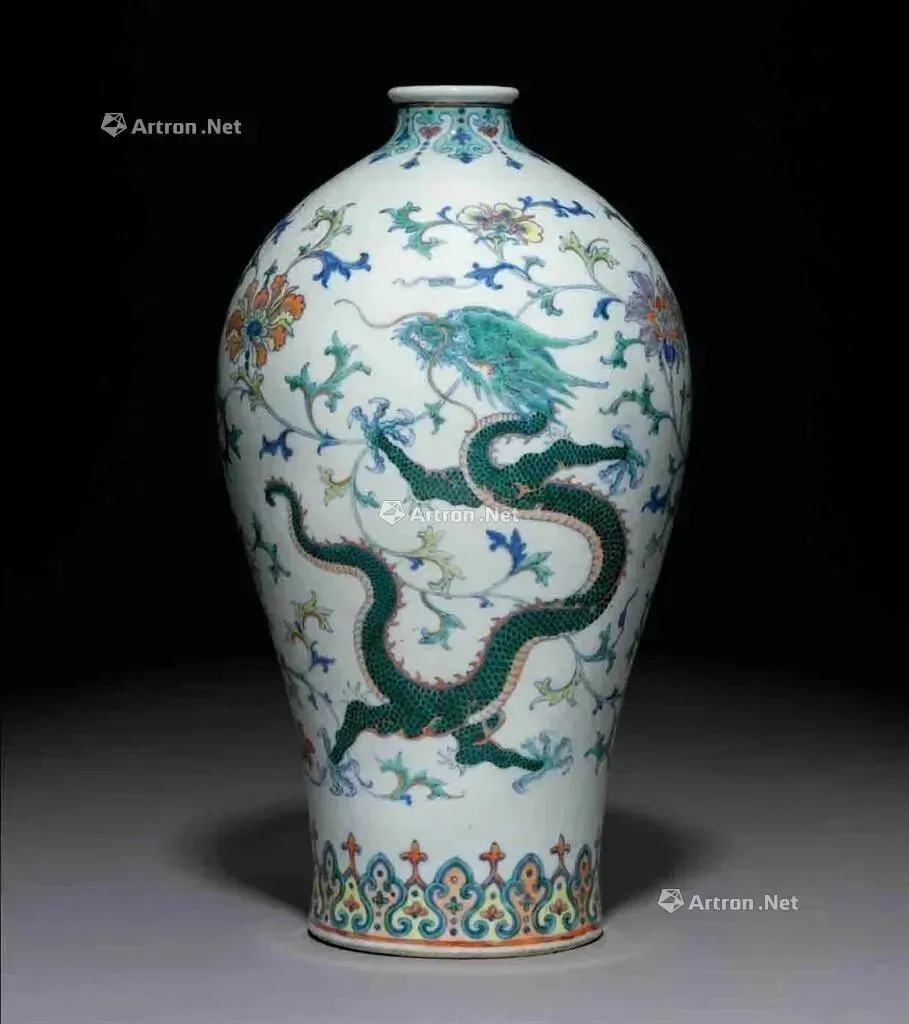
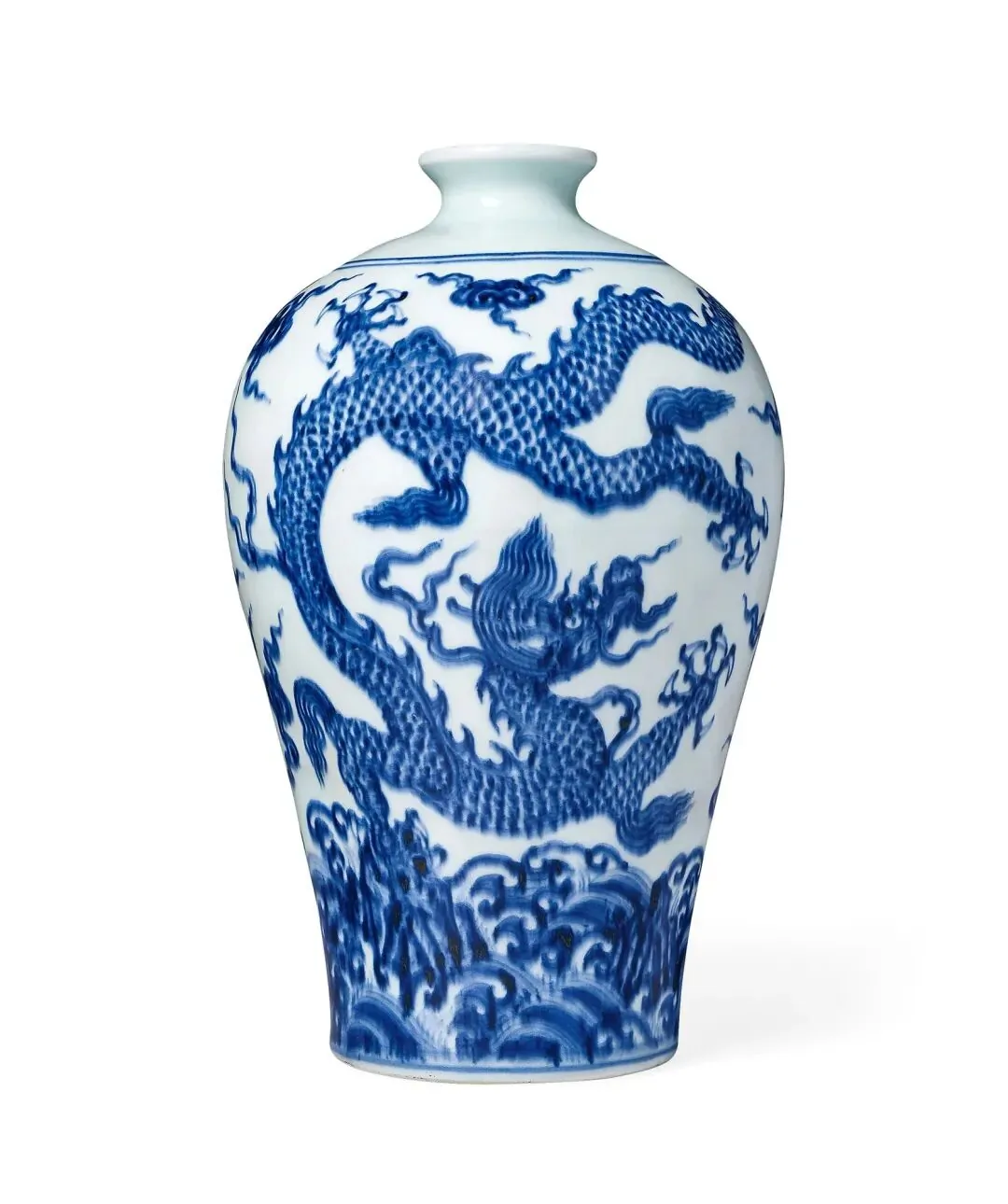
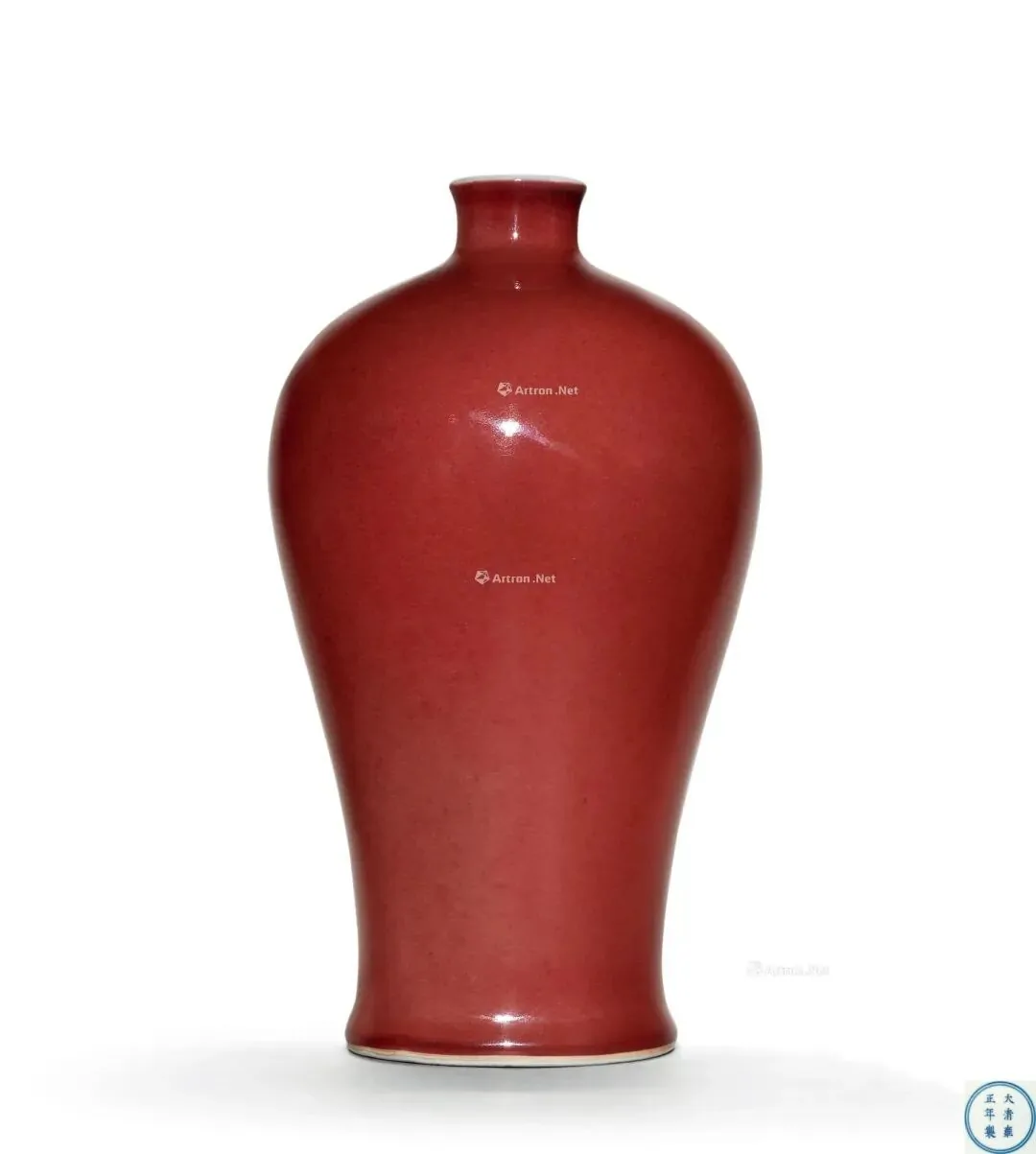
Read together with the whole line of the body, a pronounced slope is good evidence that the model was Ming or earlier. It is not proof. A restorer can alter a silhouette, a photograph can flatten a curve, and a potter can quote an old shoulder on an otherwise late vessel. The observation sets a direction for further examination rather than closing it.
The models themselves survive in some number. Yongle meiping in the Palace Museum in Beijing show a shoulder that sits high but never hard, with an even taper beneath it, and the type is not confined to blue and white:
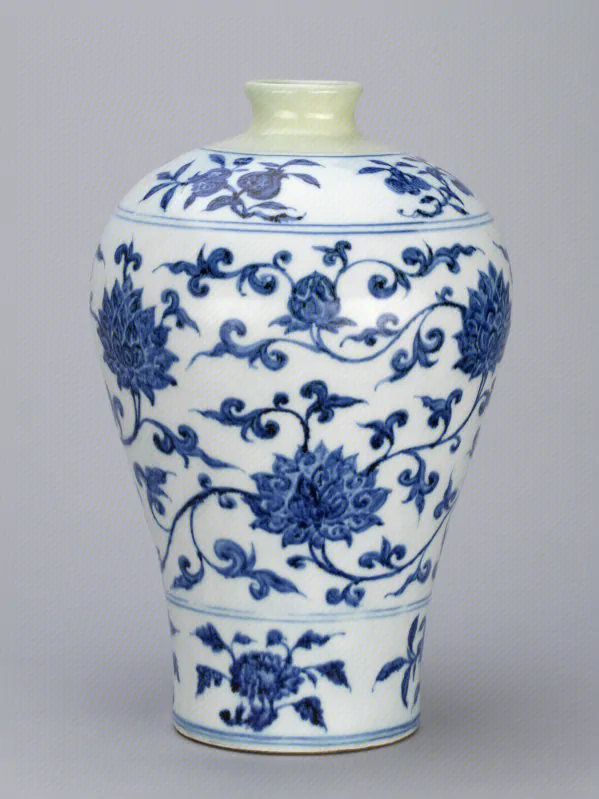
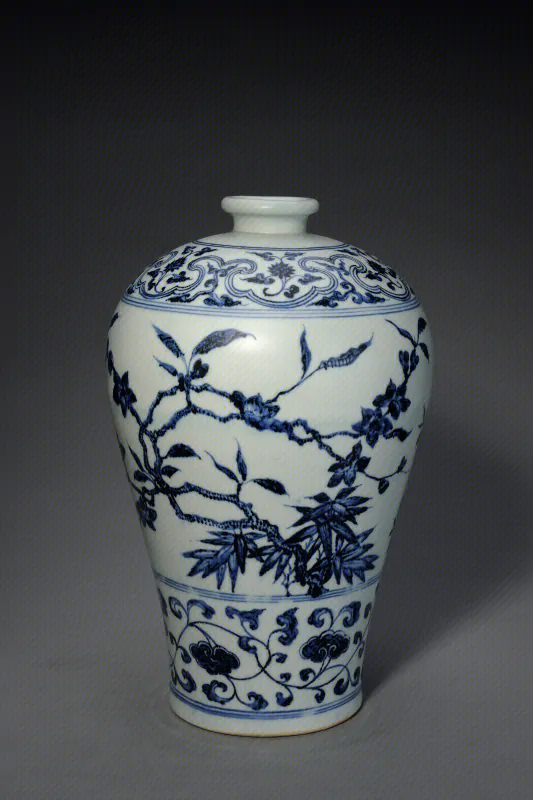
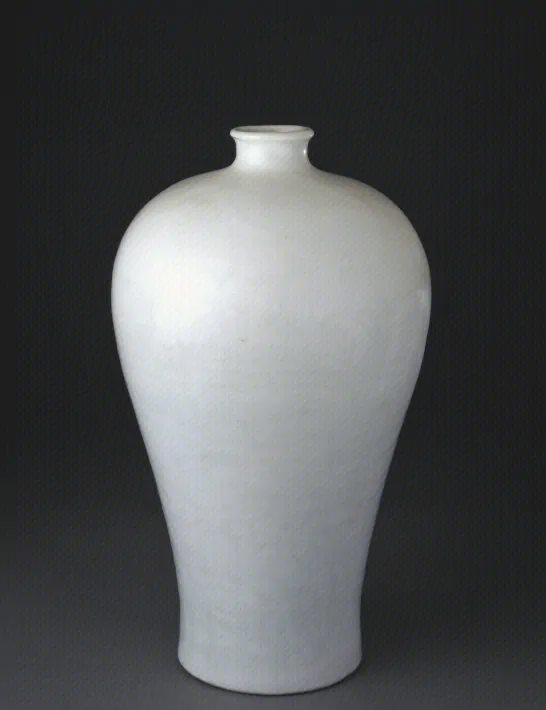
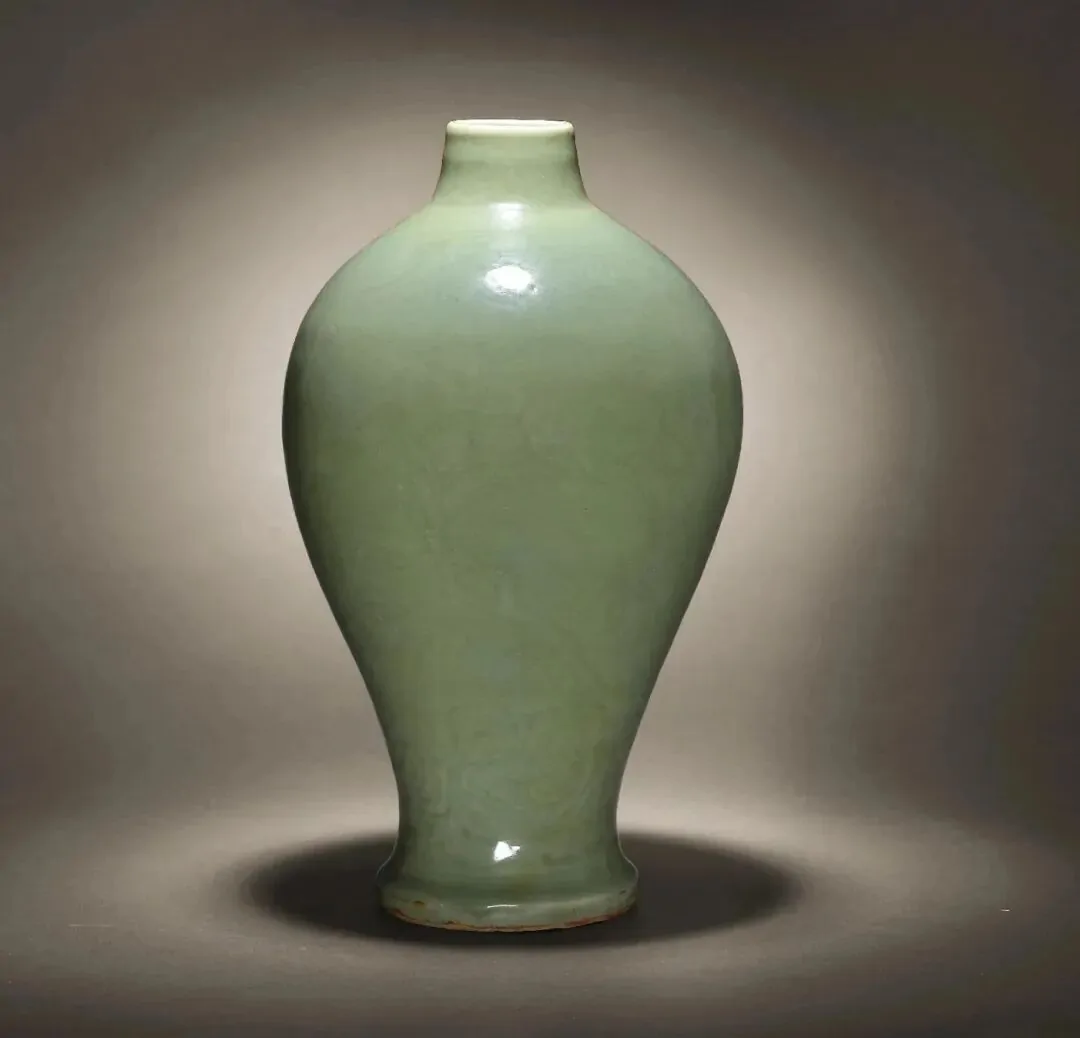
Put the two groups side by side and the relationship becomes legible. The Yongzheng pieces repeat the line rather than the measurements. Necks, feet and the degree of taper vary from one example to the next; the reference to the earlier form does not.
What did Yongzheng potters copy?
Yongzheng reigned from 1722 to 1735, thirteen years, the shortest of the three great Qing reigns. Output in that period is nevertheless remarkable, and the source identifies four areas of achievement: revival wares, painted enamels (falangcai), famille rose and monochrome glazes. Of these, the revival group is among the largest, with more than forty recorded types.
The source divides them into three families:
- Song dynasty kilns. Vessels modelled on the celebrated wares of Ru, Guan, Ge, Jun and Ding, and on the celadons of Longquan.
- Ming blue and white. Copies of blue and white from several Ming reigns, with Yongle and Xuande regarded as the highest achievement.
- Chenghua doucai. Copies of the enamelled wares of the Chenghua period, in which underglaze-blue outlines are filled with overglaze colour.
The second and third groups depend on painting rather than on glaze alone, and they belong to the same lineage as the hand-painted porcelain still made in Jingdezhen. For the Ming blue and white that supplied so many of the models, see our history of blue and white porcelain.
How was an imperial copy commissioned?
What distinguishes Yongzheng revival work from ordinary imitation is the administrative chain behind it. The source describes a sequence that ran from the palace to the kiln and back again:
- Search. Officials were sent out repeatedly to locate old porcelain.
- Inspection. The emperor examined the pieces himself.
- Transfer. Approved pieces went to the Imperial Household Department (Neiwufu).
- Model. The Imperial Workshops (Zaobanchu) produced a wooden model of the form and a colour sample for the glaze.
- Copy. Model and sample travelled to the imperial kiln at Jingdezhen, where the piece was reproduced.
- Supervision. The emperor followed the firing and questioned the results.
The arrangement explains why the copies are close in proportion as well as in decoration: the potter was not working from memory or from a drawing in a manual, but from a physical model and a colour standard supplied by the court. It also explains the limits. A wooden model fixes a profile; it cannot reproduce the clay, the glaze batch or the firing conditions of the original.
The source gives one dated example. In the thirteenth year of the reign, 1735, the emperor instructed Nian Xiyao to produce 130 jihong vessels u2014 sacrificial red, a copper-red glaze among the most difficult to fire consistently.
How did Yongzheng copy without merely imitating?
Two phrases from the Chinese literature sum up the result: fanggu er bu nigu, “copy antiquity without being bound by it”, and, for glaze, “both inheritance and innovation”. In practice this meant taking the profile and the decorative vocabulary of an earlier piece and adjusting proportion, finish and colour to eighteenth-century court taste. A Yongzheng meiping may answer a Yongle model while standing taller, carrying a different foot, or wearing a monochrome glaze in place of underglaze blue. The reference is deliberate; the copy is not a facsimile.
The source attributes the direction of this taste partly to personal preference and partly to education. It describes the emperor as a highly cultured ruler with a strong Confucian formation and a marked liking for quiet, unadorned glazes u2014 the wares of Ru, Guan, Ge, Jun and Ding, and the celadons of Longquan among them. That preference, rather than a general antiquarianism, is presented as the reason monochrome revival wares flourished as they did.
What does the shoulder tell a collector?
It tells you where to look next. A sloping shoulder on a Yongzheng-marked meiping raises the possibility of a Ming model and invites comparison with the Yongle and Xuande pieces in the same museum case. It does not establish the date of the piece, and it says nothing about authenticity on its own.
The practical order of examination is therefore: shape first, then body and glaze, then decoration and mark, then condition. Each answers a different question. The shoulder proposes a period; the paste, the glaze and the painting confirm or contradict it; the mark and the wear pattern place the object in a workshop and a century. Where the value justifies it, scientific analysis of the body and glaze settles questions that the eye cannot.
A collector should also be cautious about the word “revival” itself. It covers imperial pieces made for the court, later commercial production of good quality, and modern workshop copies, and the three carry very different values. The shoulder helps to identify the model; it does not by itself identify the maker.
Why does the meiping still matter?
Because it compresses the whole argument about revival into a single outline. A meiping carries the memory of its predecessors in the width of its shoulder and the length of its taper, and a potter who chooses those proportions is making a statement about which past to follow. Yongzheng’s kilns made that choice deliberately, with the emperor’s own eye on the result.
The form also remains a living one. Potters in Jingdezhen still throw and assemble meiping, and the profile is still judged against historical examples. A contemporary piece is not a Yongzheng copy and should not be sold as one, but the discipline of reading shape is the same, and it is the reason the form continues to be worth studying.
Explore Jingdezhen craftsmanship
Jingdezhen Heritage works with workshops in the city across blue and white, colour-glaze and enamelled wares. Browse the porcelain collection to see current pieces, or write to us about a commission.
Contact Jingdezhen Heritage
Questions about a piece, a commission or an order are welcome. Email Jingdezhen Heritage u00b7 Message us on WhatsApp
Text and images: adapted from a Chinese essay on revival porcelain published by the WeChat account Handers. The shape chart is reproduced after Liu Cui, “The evolution of the meiping form”, Wenwu Shijie (Cultural Relics World), 2020, no. 2. Object photographs are reproduced from the source article.