
In the auction rooms, Ming and Qing revivals change hands for six and seven figures. On today’s market, the finest newly made archaistic porcelain sells for a few thousand to a few tens of thousands. That gap is the story of this article: why fine modern revivals remain a value pocket, what could close it, and how to judge a piece before the market does it for you.
What the market prices today
Three price bands now coexist. Newly made archaistic porcelain in general circulation runs from roughly a thousand yuan up to a hundred thousand, with even the finest pieces rarely exceeding that. Jingdezhen’s export-oriented workshops, whose output flows mainly to overseas buyers, work in a band of tens to hundreds of thousands. And the Ming and Qing revivals that have already aged a few centuries pass six figures and beyond at auction — the ladder is set out in our price ladder from originals to copies, and its export-era middle rung in how the factory decades changed prices.
Survey the field and the conclusion is hard to avoid: the top of the contemporary market is a low-lying pocket. The best new revivals sell at a fraction of what comparable quality from the Ming and Qing achieves, and collectors who understand the history know what happened to the last generation’s “cheap” revivals — the Yongzheng workshop’s pieces, once made by the hundred, now start near ten million, as our survey of Yongzheng wares at auction documents.
The museum endorsement
Two institutional signals point the same way. Museums in China now routinely display high-grade revivals in place of fragile originals, precisely because the displays, the visual effect and the teaching value stand up. And the work of individual masters is entering public collections: Yang Shiqi, the recognised inheritor of the imperial famille-rose tradition, has had his archaistic porcelain accepted into the collection of a museum in Beijing. He follows a line we have documented before — Huang Yunpeng’s revivals, endorsed by Palace Museum experts, and Geng Baochang’s dictum that a revival able to fool the experts is worth as much as a national treasure. When public institutions buy declared revivals, the floor under the category rises.
Judging a piece: four checks
Archaistic porcelain invites suspicion, so a buyer’s first job is separation: the honest revival from the deceptive fake. The definitions are settled — intent, not age, makes the fake, as we explain in fake, copy or original — and the practical check is a walk around the object:
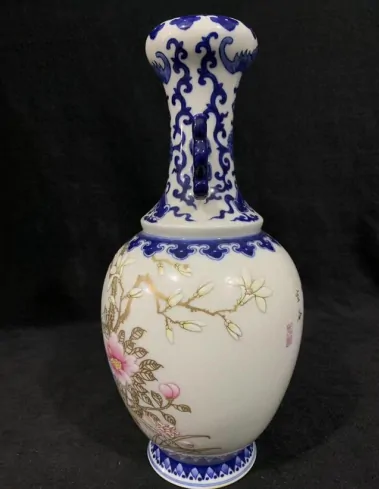
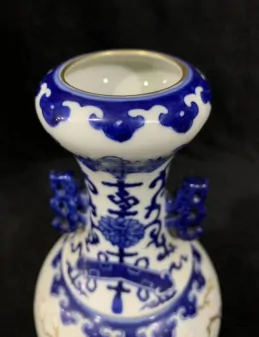
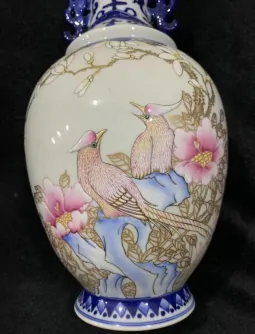
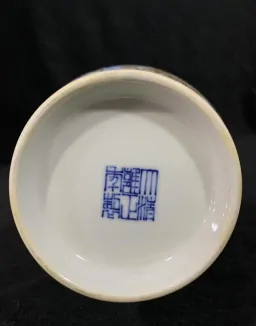
Materials and body. Hand-thrown porcelain has weight, a ringing tone and a clean, dense paste; shortcuts announce themselves at the foot and the glaze edge. Craft. Each decorative system belongs to its body: famille-rose belongs to this kind of vase in a way no substitute technique could achieve, and the layering of enamel over enamel is the product of generations of trial. That accumulated technique is exactly why recreating a lost glaze is harder than inventing a new one. Form. The silhouette must carry the proportions of the model — the garlic-shaped mouth, the twin handles, the swelling shoulder in the piece shown here. Picture. Birds, flowers and gilt accents must sit together in one harmonious composition, with brush logic an enameller, not a printer, would produce.
Our full buying sequence, from handwork verification to dealer openness, is set out in archaistic porcelain worth collecting.
What happens next
Honesty about the caveats: revival porcelain is not a smoothly appreciating asset. Prices respond to fashion and to capital, and a workshop’s standing can move faster than its quality. But the structural case is simple. Fine revivals are made in small numbers by named hands, they require months of skilled work per piece, and they carry a cultural weight that grows as the reference objects recede further out of reach. Every rung below the originals — Republican, factory-era, and now contemporary — followed the same path from undervalued to respected, as old copies became treasures before. The demand that keeps the category alive is described in why archaistic porcelain exists at all.
For buyers, the pocket is the opportunity and the four checks are the protection. Choose pieces whose materials, craft, form and picture all pass, from makers who sell them as what they are — everything in the Jingdezhen Heritage collection is documented that way.
Contact Jingdezhen Heritage
Questions about a piece, a glaze or an order? Email service@jingdezhenheritage.com or message us on WhatsApp. We reply within one working day.