
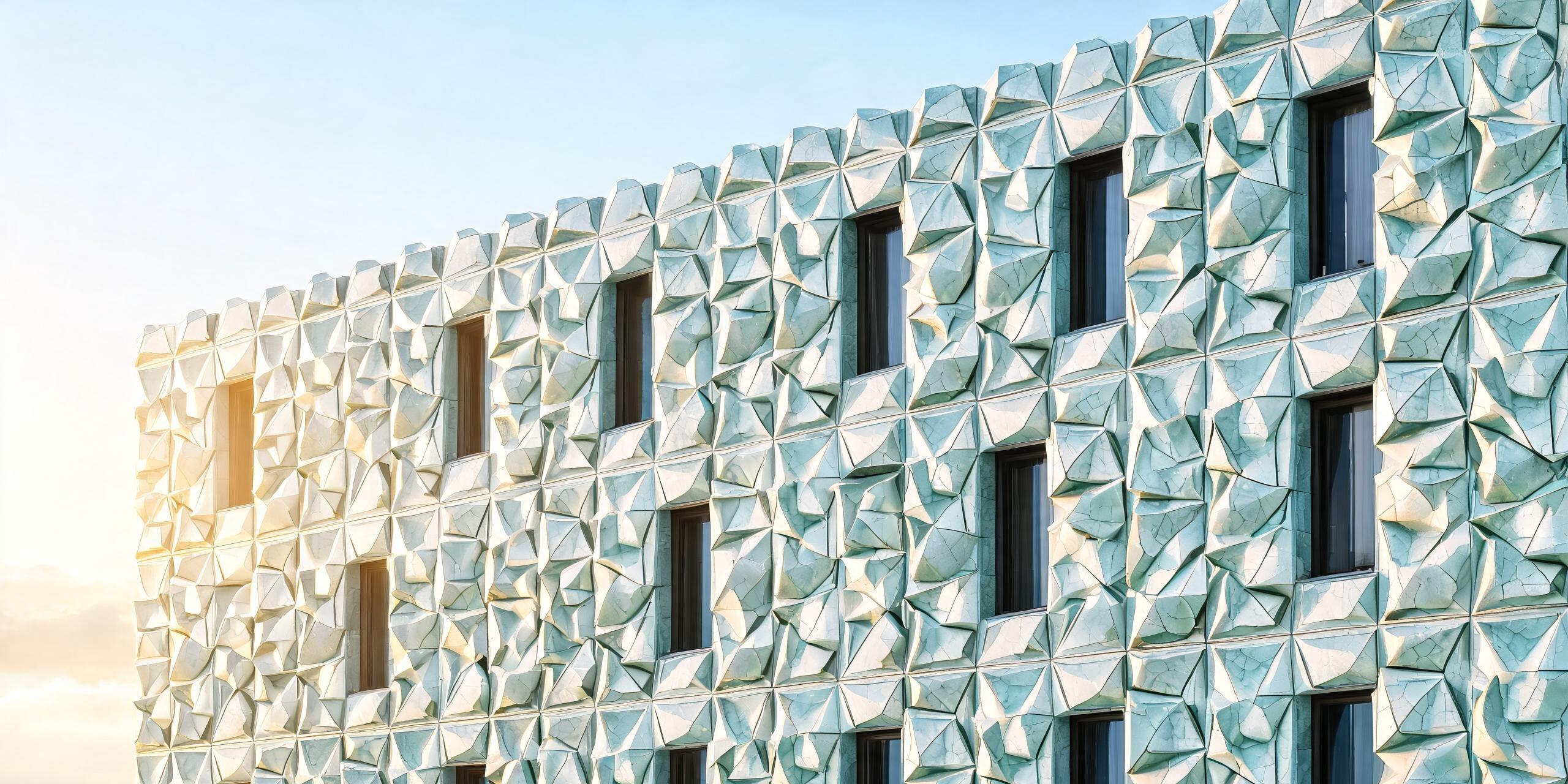
Across China, leading developers are moving beyond stone, aluminium and glass to commission hand-finished porcelain components for facades, lobbies and arrival halls. Almost every one of those experiments leads back to one city: Jingdezhen.
Why are porcelain components appearing on luxury buildings in China?
For two decades the premium facade palette in China was settled. Stone, aluminium and glass were standardised, predictable and fast to build with, and a sufficient budget could always buy high-specification finished products off the shelf. The side effect was convergence: luxury facades in many cities began to look alike.
On recent visits to three high-end residential projects, Poly Tianyi in Foshan, Poly Tianjun in Hangzhou and Jiushang Langchen in Shanghai, the most distinctive surfaces were no longer stone or metal. They were porcelain, custom-fired as three-dimensional components more than a thousand kilometres away in Jingdezhen, Jiangxi. At first glance the choice looks irrational. Why would a developer travel to another province for a material most people associate with vases and tableware?
The answer is shaping freedom. Stone is cut and metal is folded, but porcelain is modelled before it is fired, so an architect’s idea is fixed directly into a three-dimensional module rather than printed on a flat panel. That single property is persuading developers to work with a custom porcelain manufacturer in Jingdezhen instead of ordering standard cladding.
Three projects that put porcelain on the building skin
Each project uses the material differently, and together they map the range of what a commissioned ceramic component can do.
| Project and city | Ceramic element | What the material achieves |
|---|---|---|
| Poly Tianyi, Foshan | Modular facade units abstracted from a Han-dynasty jade cicada | An original three-dimensional screen whose hand-glazed surfaces carry unique crackle and tonal variation |
| Poly Tianjun, Hangzhou | Curved ceramic panels wrapping the structural columns of the double-height lobby | Rings of custom-curvature panels dissolve the weight of the concrete column into a rounded sculptural surface |
| Jiushang Langchen, Shanghai | Around 280 square metres of angled, vertically folded panels in the central carriage hall | Alternating folded planes throw continuous shadow under shifting light; rain runs off the ring edge as a translucent curtain |
At Poly Tianyi the design team wanted an oriental motif with real depth for the main arrival facade, something flat panels could not carry. They abstracted a Han jade cicada into a modern linear module, refining its micro-curvatures until the concept stood as a ceramic unit that extends vertically and repeats horizontally. Individually moulded, hand-trimmed and hand-glazed, each module settles into slightly different textures and depths of colour, giving the building skin a gradation of light and shadow that no flat board can produce.
At Poly Tianjun the same shaping ability was applied to structure. The studio fired curved ceramic panels to a specified radius and interlocked them ring by ring around the lobby columns, so light slides gently along the curved glaze and the heavy support reads as a tall, rounded surface. At Jiushang Langchen, porcelain lines the roughly 280 square metre central carriage hall: groups of vertical folded panels set at precise angles, which under artificial and natural side light form a continuous rhythm of shade, and in the rainy season turn the dripping roof edge into a quiet water curtain.
Such trimming and incised refinement belong to the same tradition as the techniques surveyed in our guide to ten Chinese carving techniques, scaled up from the object to the building.
Why is architectural porcelain so difficult to manufacture?
The honest answer is that ceramics is an unreliable material asked to meet a very reliable standard. A clay blank shrinks by roughly ten per cent in the kiln, so a one-metre module leaves the fire measurably smaller; the larger and more complex the section, the harder the geometric tolerance is to hold. A small fluctuation of temperature inside the kiln shifts the depth of the glaze. Yet an exterior wall permits almost no error: joints and flatness are checked to the millimetre, and a deviation of two or three millimetres is enough to break a straight seam. Corner and special-shaped units need their own moulds and colour matching, which raises both difficulty and cost.
| Variable | Typical figure | Consequence on the facade |
|---|---|---|
| Firing shrinkage | Around 10 per cent | Final dimensions must be back-calculated from the shrinkage of each body recipe |
| Dimensional tolerance | 2u20133 mm | Anything wider visibly misaligns neighbouring units on the flat subframe |
| First-class yield | About 30 per cent conventionally; roughly 10 per cent at the Poly Tianyi water wall | Nine in ten pieces may be rejected when glaze flow and deformation must match exactly |
| Selection rounds | Three | Factory sorting, on-site layout by number, and re-checking after installation under real light |
At the entrance water wall of Poly Tianyi, every unit passes five hand-grinding stages before firing, yet glaze flow and deformation in the kiln can never be made fully identical. Even after installation, the team checks each piece against the actual light; any module showing a faint colour difference or an uneven seam is taken down and replaced. This is why developers cannot wait for material to arrive on site and hope for the best. The uncertainty has to be absorbed earlier, in research and sampling.
How do developers de-risk an unpredictable material?
The clearest change is how early developers now engage with the craft. Core members of the team behind Jiushang Langchen made repeated trips to Jingdezhen to understand the production sequence, meeting craftspeople face to face and running test firings around glaze reflectance and junction details. Before construction began, the team erected a full one-to-one mock-up wall outdoors, so that visual and installation problems which would normally surface during large-scale work could be judged and adjusted under natural light.
The research did not stay inside one project. In Shanghai’s Daning Park, the same developer commissioned Wutopia Lab to convert a 190 square metre building into The Lake House cafe, where a ceramic curtain wall with a metal skin reshapes the park elevation. The material strategy is being fed back to the city, not just to one sales gallery.
Why does all of this lead back to Jingdezhen?
China has no shortage of ceramic regions. Foshan is superb at standardised architectural ceramics at scale, Zibo has deep roots in industrial ceramics, and Dehua is famous for its white porcelain bodies. For non-standard architectural commissions, however, a developer needs two things at once: research capacity to prove a new idea, and a workshop system deep enough to make it.
Jingdezhen offers both. Jingdezhen Ceramic University hosts the national engineering research centre for domestic and architectural ceramics, whose remit covers new bodies, forming methods and shapes. For a new facade concept, its specialists can test whether a clay recipe will form, whether a section will fire through, and where to look when a first trial fails. The developer of Jiushang Langchen held extended exchanges with Yu Jianfeng, dean of the university’s school of design and art, on exactly these questions. Research alone is not enough, though. The city’s other asset is a division of labour refined over centuries: the seventy-two recorded processes of handmade porcelain, in which forming alone splits into three specialised routes.
| Forming route | Steps | Key stages |
|---|---|---|
| Slip casting | 12 | Mould cleaning, assembling, measuring slip density, sieving, pouring, draining, opening, trimming, joining, stamping, drying, wiping |
| Throwing | 8 | Dewatering, pugging, wedging, throwing, turning, joining, stamping, drying |
| Mould pressing | 9 | Mould cleaning, assembling, rolling clay strips, pressing, opening, trimming, joining, stamping, drying |
A sculpted module with a special glaze is rarely the work of one pair of hands; it is a chain of specialists, each responsible for a link, as explored in our article on ceramic sculpture forms, kilns and materials and in our guide to carving, modelling and casting. This is why a developer looking for bespoke porcelain at architectural scale ends up in Jingdezhen: the city pairs a research bench with a collaborative workshop culture that can deliver custom porcelain art in built form.
The continuity runs deep. Six hundred years ago the glazed components of the Porcelain Tower of Nanjing were precision-fired modules assembled into a pagoda. On 25 July 2026 the handmade porcelain heritage of Jingdezhen was inscribed on the World Heritage List, forty-five sites in five components from porcelain-stone quarries and ancient kilns to production centres and fuel-growing hills, the first porcelain-themed World Heritage in the world. The system behind those kilns is the one now asked to wrap a tower column.
What does porcelain on buildings signal for the industry?
For a long time the Chinese luxury facade was defined elsewhere: Italian quarries defined prestige stone, and London and New York towers defined aluminium and glass. Budgets bought efficiency, and skylines converged. Porcelain reopens a native construction lineage, now backed by modern materials research and engineering. The real promise is not a more expensive cladding option but the confidence to create original surfaces again.
The same discipline scales down as well as up. If you are considering a private piece, whether a mural, a dinner service or a pair of vases in one of the classic forms documented in our guide to Chinese vase shapes, the rules are the same: approve a sample, agree tolerances and put everything in writing. Our companion guide to commissioning custom porcelain vases walks through the process step by step.
Frequently Asked Questions
Why choose porcelain over stone or aluminium for a facade?
Porcelain is shaped before firing, so architects can fix original three-dimensional forms, curved sections and hand-glazed surfaces that cutting or folding cannot achieve. The trade-off is lower yield and longer schedules, which developers manage through sampling and selection.
What yield should be expected for custom architectural ceramics?
Conventional ceramic production typically yields around thirty per cent first-class output. For demanding facade work such as the Poly Tianyi water wall in Foshan, yield fell to roughly ten per cent, because even slight colour or dimensional deviation is rejected.
How is quality controlled on site?
Through three rounds of selection: sorting at the factory, layout by number on site, and a final check after installation under real light. Any unit showing colour deviation or uneven joints is removed and replaced.
Can the same workshops handle interior and object-scale commissions?
Yes. The Jingdezhen workshops behind these facades also accept interior pieces and object-scale work, from murals to vases. Approve a physical sample first and put the specification in writing, exactly as the developers do.
Commission porcelain with Jingdezhen Heritage
Jingdezhen Heritage is a porcelain studio based in Jingdezhen, Jiangxi, China. We work with architects, developers and private clients on bespoke ceramic components and sculptural commissions of every scale. Share your drawings or references and we will advise on feasibility, sampling and schedule: commission custom ceramic work with our studio.
Email service@jingdezhenheritage.com or message us on WhatsApp.
Published 1 November 2026 by Jingdezhen Heritage, a porcelain studio in Jingdezhen, Jiangxi, China.