
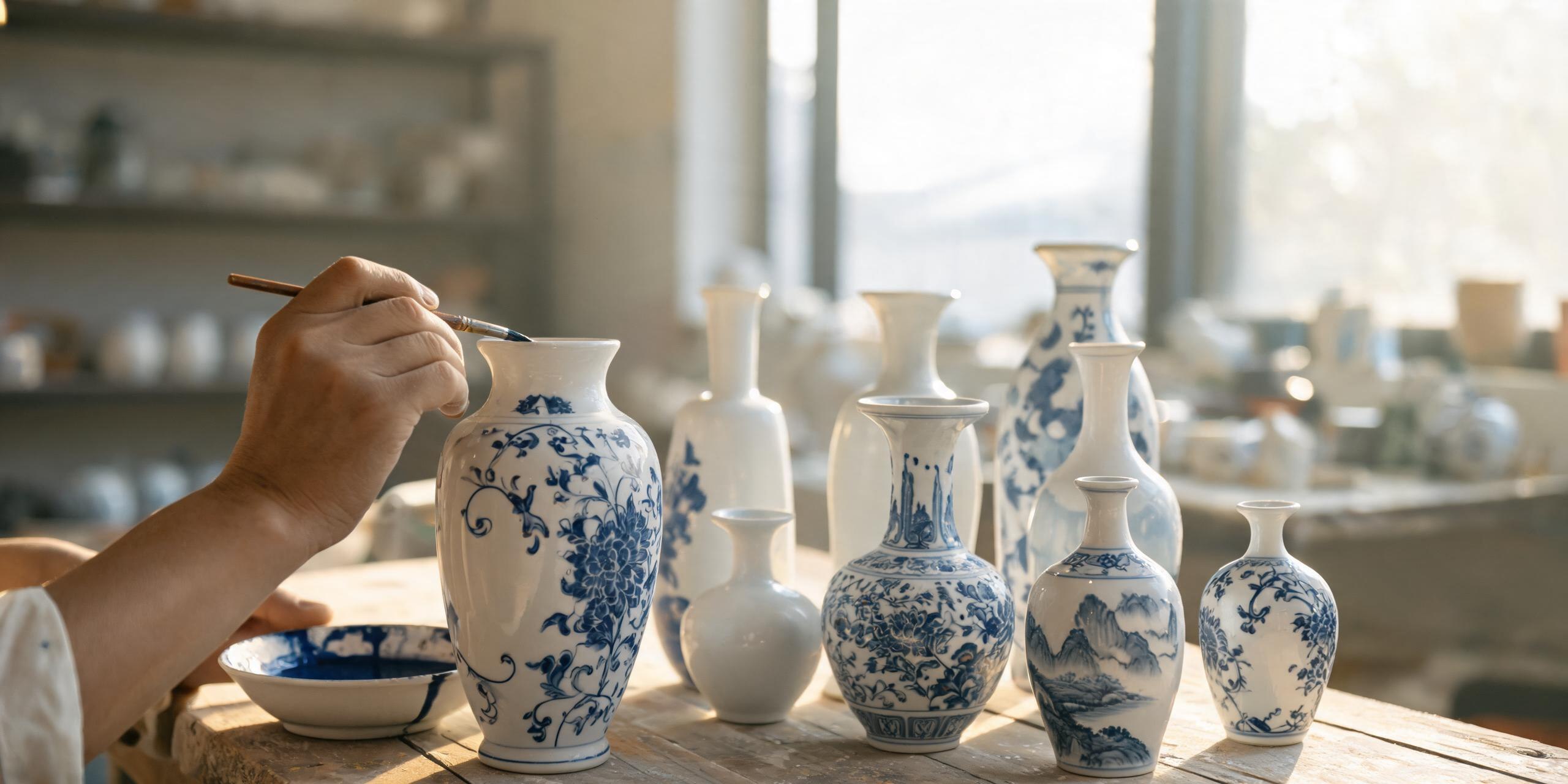
Commissioning custom porcelain vases in Jingdezhen should be a pleasure, not a gamble. Wildly inconsistent quotes, opaque craft names and month-long delays almost always trace back to a few decisions made at the very beginning. This guide sets those decisions out in order.
What do you actually want the piece to do?
Commissioning is not about following fashion; it starts with purpose. A run of gift tea sets or dinnerware for clients, a collectible painted plaque by a senior painter, a line of brand merchandise such as ceramic badges or mascot figures, and a large ceramic mural for a hotel lobby are four different roads. They lead to different workshops, different crafts and very different budgets. Ordering souvenirs for staff and asking a recognised master to create an artwork may both be called custom porcelain, but they share almost nothing else.
Purpose also decides who you should talk to. Volume gift work suits an established factory; a single collectible piece suits an independent painter or a small studio; brand merchandise needs a partner used to licensed artwork; murals need a team with installation experience.
Which craft route fits your design?
The craft you choose fixes the look, the cost and the schedule. In practice most people searching for custom porcelain vases or tableware end up on one of three routes.
| Route | What it is | Best for | Typical minimum | Trade-off |
|---|---|---|---|---|
| Decal (transfer) | A printed design is applied to the surface and fired in | Logos and standard patterns in volume | 100u2013200 pieces | Low cost and fast, but limited uniqueness and artistic value |
| Hand painting | A painter decorates each piece by hand in blue-and-white, famille rose or colour glaze | Gifts and collectables | A single piece is possible | Highest cost; every piece unique; painter skill varies, so inspect real work first |
| Moulded bespoke shape | A new form is modelled and moulded from scratch | Signature brand forms and flagship products | Usually 500 pieces or more | Adds mould and sampling fees and a longer schedule |
Decal work is the industrial end: honest, quick and repeatable. Hand painting is the soul of Jingdezhen, covering underglaze cobalt blue, overglaze famille rose and high-temperature colour glazes, each painted by hand and each piece unrepeatable. The catch is that skill levels vary widely, so always look at real finished pieces, not just photographs, before committing. If your design is a shape that does not yet exist, it must be modelled and moulded, which means a mould fee, a sampling fee and patience, and it only makes sense at volume.
If your design references a classic form, naming it precisely will save days of miscommunication. Our guide to Chinese vase shapes covers twelve standard forms, from the meiping to the yuhuchun, with the proportions workshops expect.
What does a reliable commissioning process look like?
A trustworthy studio runs the same five steps every time: briefing, design and sampling, contract, production, then inspection and dispatch. Of these, sampling is the step buyers most often regret skipping. However simple your design looks, only a physical sample tells you whether the body texture, the glaze effect and the painted detail are what you imagined. It is the single most effective defence against receiving something that is not what you ordered.
Sampling fees usually run from a few hundred to a few thousand yuan depending on complexity, and they are normally deductible from the production order once confirmed. The contract then protects both sides: it should state the craft in writing, whether the decoration is hand-painted or decal, the firing temperature, and whether a master’s seal and a collection certificate are included. These clauses become your acceptance criteria at delivery.
Which pitfalls cost buyers the most?
| Pitfall | What goes wrong | How to protect yourself |
|---|---|---|
| Minimum order confusion | Minimums differ completely between decal, hand painting and moulding | Ask for the minimum per route before discussing price |
| Schedule slippage | Standard work takes 25u201335 days; complex painting and the pre-Spring-Festival peak extend it | Fix the delivery date in the contract and leave yourself margin |
| Opaque pricing | A lump-sum quote hides what you are paying for | Ask for an itemised breakdown of body, craft, firing, packing and freight |
| Skipped sample | The finished order does not match the photographs | Never approve production without a confirmed physical sample |
For cast and moulded pieces it also helps to know the common defects before you approve a sample. Our buyer’s guide to slip quality and casting defects shows what to reject and what to question.
What are the high-end routes, and when are they worth it?
Beyond standard custom work, Jingdezhen studios offer two deeper services. In custom-from-artwork production, your logo or exclusive pattern is fused permanently into the surface with high-temperature colour glaze; it will not fade or peel with age, which makes it the right choice for limited brand editions. In custom-from-sample production, a workshop replicates the texture or glaze of a supplied reference piece, recreating an antique surface or a rare historic colour as closely as the kilns allow.
For premium commissions, some source factories in the Changjiang and high-tech districts of Jingdezhen now accept bespoke shapes from around five hundred pieces, with every piece still thrown, painted, glazed and fired by local hands. Whether you call them custom ceramic vases or bespoke porcelain, the warmth and weight of that handwork is what an industrial line cannot reproduce.
Why has porcelain always been trusted with meaning?
The logic of commissioning is older than any brand. Among historical memorial objects, the blue-and-white porcelain epitaph holds a particular charm: porcelain was prized as a material that endures for a thousand years without decaying, which made it a natural carrier for recording a life. During the Southern Song dynasty, ceramic epitaphs became fashionable precisely because people believed an unfading material would let the story of the deceased travel further into the future. By the Ming and Qing dynasties the craft had matured, with cobalt decoration and ink calligraphy sharing the surface of these memorials, displaying both the technical mastery of Jingdezhen’s painters and a society’s considered attitude to memory and remembrance.
That is the deeper logic of commissioned porcelain art: the object outlives the occasion. A vase commissioned for an anniversary, a plaque marking the founding of a company, a dinner service for a wedding, each carries meaning the way those epitaphs did, so choose the subject, the inscription and the maker with equal care.
What should you ask yourself before commissioning?
Three questions resolve most of the anxiety. First, what is the piece mainly for: daily use, gifting, collecting or display? Second, how much are you willing to pay for uniqueness and hand craft? Third, when do you need it in hand at the latest? Answer these honestly and your route, budget and schedule largely choose themselves.
The same discipline now shapes entire buildings. Chinese developers commission whole facades from Jingdezhen workshops using exactly the principles above, samples first, tolerances in writing, patient selection, as described in our article on working with a custom porcelain manufacturer on architectural ceramics.
Frequently Asked Questions
How much does it cost to commission a custom porcelain vase?
It depends on the route. Decal work can cost tens of yuan per piece at volume, hand-painted pieces start in the hundreds and rise with the painter, and a bespoke moulded shape adds mould and sampling fees. Always ask for an itemised quote before comparing prices.
Can I commission just one hand-painted vase?
Yes. Hand painting accepts single-piece orders because no mould or print run is involved. Decal and moulded routes need volume to be economical, typically one to two hundred pieces for decals and five hundred or more for new moulds.
How long does a commission take?
Allow twenty-five to thirty-five days for standard work. Complex hand painting, large murals and the production peak before the Spring Festival can extend this, so agree the delivery date in the contract and keep some margin.
What should the contract specify?
State the craft, whether decoration is hand-painted or decal, the firing temperature, whether a master seal and certificate are included, the confirmed sample as the acceptance standard, itemised costs and the delivery date.
Commission your piece with Jingdezhen Heritage
Jingdezhen Heritage is a porcelain studio in Jingdezhen, Jiangxi, China. We make bespoke vases, tableware, plaques and sculptural pieces to order, from a single hand-painted vase to a full brand edition. Tell us your purpose, budget and deadline and we will recommend the right route: start a custom ceramic commission.
Email service@jingdezhenheritage.com or message us on WhatsApp.
Published 1 November 2026 by Jingdezhen Heritage, a porcelain studio in Jingdezhen, Jiangxi, China.