
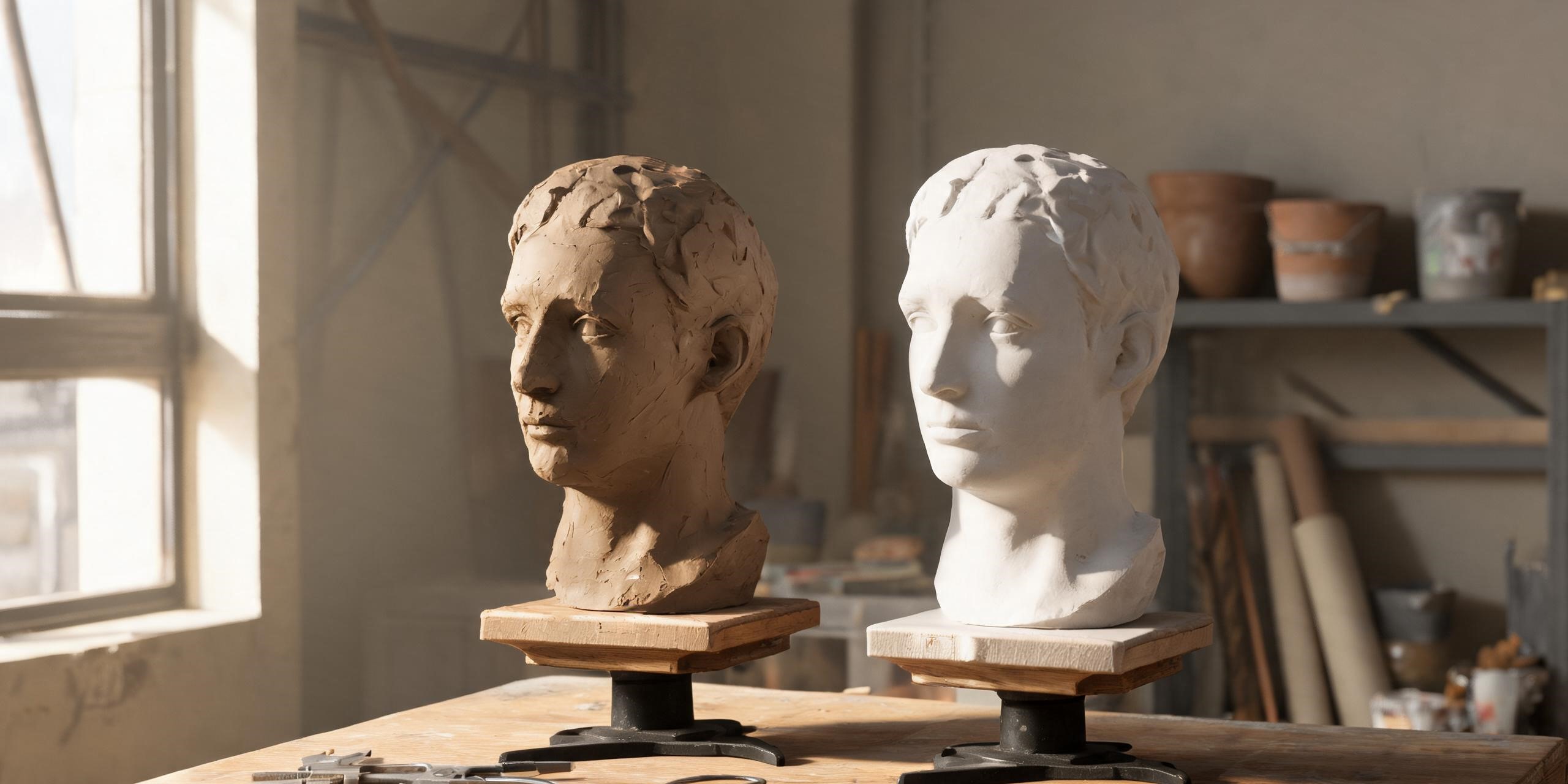
Every portrait sculpture begins before the clay is touched: with a plaster cast, two turntables, a measured armature and a window that faces north.
The portrait head is the standard exercise of the sculptor’s training, and it is taught in a fixed order. The student starts by copying a plaster cast u2014 still, monochrome, already simplified by another sculptor u2014 and moves to the living sitter only when the method of seeing has been learned. What follows is the working sequence as it is taught in the academies, from the choice of cast to the final adjustment of the whole.
Why the Plaster Cast Comes First
A plaster cast does not move, does not change expression, and presents the head as a set of simplified planes. It is the simplest possible version of the subject, and it allows the beginner to learn the sequence without the distraction of a living face. The rule is from simple to complex, from shallow to deep: the cast teaches the method, the sitter tests it.
Working at life size u2014 a ratio of one to one u2014 is essential. A smaller scale hides errors of proportion that become obvious when the head is the size of a real head.
Setting Up: Tools, Light and Position
Before any clay is lifted, the workplace is arranged. The requirements are specific:
| Item | Purpose |
|---|---|
| Plaster head with clear structure | The subject to be copied |
| Sitter’s turntable and sculptor’s turntable | So cast and sculpture can be turned to the same angle |
| Fine, sticky clay at the right dampness | The modelling material |
| Head armature, wood blocks, nails, coir rope | The internal skeleton |
| Pliers, hammer, mallet, axe, saw, plumb line, callipers | Construction and measurement |
| Spray bottle, plastic sheet | Keeping the clay workable |
The light is natural and faces the work: side light distorts the symmetry of the head, and back light flattens the volume. The sculpture and the cast stand at the same height and are seen from the same angle, and the sculptor works at a distance of two and a half times the height of the head u2014 close enough for detail, far enough for the whole.
The Armature: Strong, Hidden, Light
The armature is the internal skeleton that holds the clay. It is built to two rules: it must be firm and must not show outside the finished form, and it must use as little material as possible while still carrying the full weight of the clay.
For a metal armature, a wooden core is bound to the central rod with wire so that the wood blocks can take root and the clay can grip. Two horizontal bars form a cross: the transverse bar carries the clay of the cheekbones and temples, and must be shorter than the width of the cheekbones; the vertical bar carries the jaw, the back of the neck and the skull, and is longer at the front than the back because the jaw projects further than the skull. A beginner can add small adjustable crosses of wire and wood at the top, fixed to the central rod, to reinforce any point that still feels insecure.
Once the armature is bound, it is wrapped in coir rope and sprayed with water, which gives the clay something to hold.
The First Clay: Mass Before Form
The first application of clay is done in two stages. The first stage ignores the subject entirely: the clay is packed firmly onto the armature, slightly smaller than the finished head will be, beaten tight with a mallet. No modelling tool is used at this stage. The second stage builds the basic forms: the sphere of the skull, the cylinder of the neck, the block of the base, and the proportional relations between them.
With the basic forms in place, the movement of the head and neck is adjusted and the composition is settled. Then the large planes are established u2014 front, side, back, top, base u2014 by tapping with a flat block of wood, always checking that the five faces read as one volume.
The geometry underneath is the geometry of the cube: six faces, eight points, twelve lines. The points are the most important, because a point is where three lines and three faces meet. On the head, the forehead eminence is such a point u2014 the place where the top, the side and the front of the skull come together. From the points come the lines of the face: forehead to cheekbone, cheekbone to jaw. From the lines come the planes, and the planes carry the features.
Building the Form: Sphere, Structure, Symmetry
The head is a sphere that has been broken and re-formed, and it keeps the property of a sphere: every point on the surface is a highest point, and every other point falls away from it. A sculpture built with this in mind reads as solid and full of force.
The cranium and the face are established first, then the features are divided out: forehead, cheekbones, jaw, nose, and the spatial relations between them. Each is checked for its length, width and height, and for the symmetry of the whole. Horizontal and vertical lines are set up, or the plumb line and callipers are used, because symmetry is a matter of volume as much as of measurement.
The anatomy is then laid over the basic forms: the sternocleidomastoid and the trapezius change the cylinder of the neck without breaking it. The features are modelled, and then the basic forms are re-asserted, because a feature that is not carried by the underlying form will float.
Deepening: The Four Relations and the Two Zones
As the work deepens, the forms enter into four relations with one another: a single form twisting from shadow to light; one form sitting on and partly covering another, as the nose sits on the face; one form suspended over another, which almost never occurs in the head but often occurs in a badly constructed sculpture; and one form passing through another, as bone passes through muscle.
The surface is read as a map of high zones and low zones. High zones u2014 where planes meet u2014 expand and give the feeling of force. Low zones u2014 the recesses that hold shadow u2014 contract and give the feeling of depth. The two are not fixed: they exchange places as the head turns, and this exchange is what makes a sculpture read as alive.
The Features and the Surface
The features are worked last. The eyes are built from the relation of the four corners: the inner corner lower than the outer from the front, the inner corner forward of the outer from the side, so that the line of the four corners forms an arc on the sphere of the head. The eyeball sets the high points of the lids, and the gaze is fixed by those high points, not by the eyeball itself.
The mouth is a cylinder, and all the lines of the orbicularis oris follow its curve. The nose combines the hardness of the bone with the softness of the tip. The ear is a set of small planes. Bone is sharp, hard and tight; flesh is rounded, elastic in youth, slack in age; hair is soft, blurred and varied.
The surface is the final argument. A polished sphere of lead reads as heavier than a rough sphere of the same size, because the surface controls how the light is returned. The sculptor learns to use this: smooth where the form should read as dense, rough where it should read as light.
The Final Adjustment: Sacrificing the Part to the Whole
The last stage is subtraction. The detail is already there, and much of it must now be weakened so that the whole can speak. The rule is that the parts that are full are made fuller, the parts that are empty are made emptier, and the contrast is increased. Rodin is said to have cut the hands off his Balzac because they were too good u2014 the whole is always more important than any part, and when the two conflict, the part is sacrificed.
Frequently Asked Questions
Why must the beginner copy a plaster cast before working from life?
A cast is still, monochrome and already simplified, so it removes the distractions of movement, colour and expression and lets the student learn the sequence of seeing. The cast teaches the method; the living sitter tests it. The rule is from simple to complex.
What is the purpose of the armature?
The armature is the internal skeleton that carries the clay. It must be firm, must not show outside the finished form, and must use as little material as possible while still holding the full weight. Two bars form a cross inside the head: the transverse bar carries the cheekbones, the vertical bar carries the jaw and the skull.
Why is the clay applied slightly smaller than the finished head?
Because the first application is only the mass, packed tight and beaten firm. The forms are built on top of this mass in the second stage, so the first stage must leave room for the clay that will follow. If the mass is already the full size, there is no room to build.
What does it mean that the whole is more important than any part?
That a detail, however good in itself, must be weakened or removed if it fights the whole. Rodin cut the hands off his Balzac because they drew attention away from the figure. The sculptor works from the whole to the part, and the part is always adjusted back to the whole.
Related Reading
For the grammar that underlies this sequence, see sculpture techniques: carving, modelling and casting. For how the same methods are applied in porcelain, see the four core sculpture techniques of Jingdezhen and statuary porcelain.
Jingdezhen Heritage accepts commissions for portrait sculpture in porcelain, built by the method described here and fired hollow. Send a photograph, the intended size and the deadline to service@jingdezhenheritage.com or message us on WhatsApp.
Published 31 October 2026 by Jingdezhen Heritage, a porcelain studio in Jingdezhen, Jiangxi, China.