
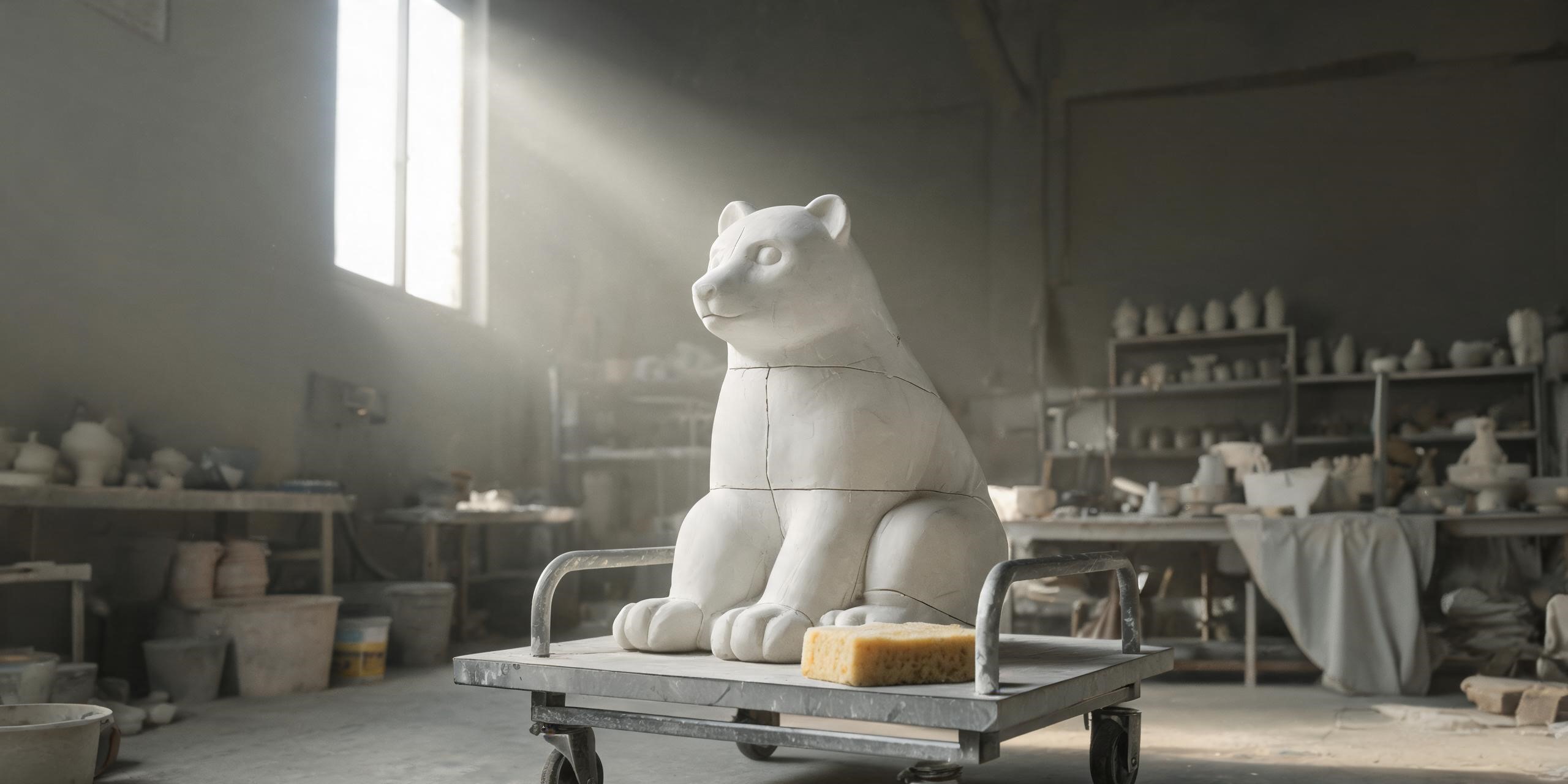
In a studio inside the Jingdezhen Sculpture Porcelain Factory, the shelves carry moulds in every shape: carp leaping the dragon gate, horses heads in profile, the three Star Gods of fortune, prosperity and longevity. Almost all of them are made by slip casting, the forming method behind most slip cast ceramic sculpture produced in the city. It is also the most misunderstood process in ceramics, routinely dismissed as mechanical and soulless by buyers who happily pay a premium for anything thrown on a wheel.
The dismissal does not survive contact with the process itself. Slip casting is not automated production; it is a hand skill with its own grammar of timing, weather and touch, and it carries a history in China that reaches back through the Southern Song to the ritual bronzes of the Western Zhou. This article looks at what the process actually involves, why it deserves equal standing with throwing, and how a new generation of makers is reclaiming the mould.
What Slip Casting Actually Involves
The method is easy to state. A maker designs a form, builds a mould for it u2014 most often plaster u2014 and pours in a fluid clay slip. The porous mould draws water out of the slip, depositing a clay layer of even thickness against its walls. As the layer loses more water it stiffens into a body with enough strength to hold its shape, and the piece is released from the mould, dried and fired.
The advantages are real and worth stating plainly. A well-made mould can be used many times, which multiplies output without multiplying labour. Material loss drops because almost every gram of slip ends up in a piece or back in the tank. And because the mould fixes the form, every cast emerges with the same geometry, giving a consistency that no amount of wheel skill can guarantee across a hundred pieces. For sculpture, where a single model may be editioned, and for tableware, where a set must match, these are decisive strengths.
The Three Stages of a Cast
What looks like a single pour is, physically, three distinct stages, and each one can be helped or ruined by the person doing the work.
The first stage begins the moment slip meets plaster. The mould wall starts absorbing water, and with it the dissolved salts and the finest sub-micron clay particles are drawn into the plaster surface. As the water nearest the wall disappears, the slip there concentrates into the first thin skin of clay. The second stage is thickening. The mould keeps absorbing, and the fresh skin now acts as a filter: water from the still-liquid slip in the middle must migrate through the deposited layer to reach the plaster, and the thicker the layer grows, the greater the resistance to that flow. When the wall reaches the thickness the piece requires, the remaining slip is poured out, leaving what Chinese makers call the young body. The third stage is shrinkage and release. The mould continues to pull moisture from the body while the exposed surface begins to evaporate its own, and the body shrinks just enough to detach itself from the mould wall. Once it can stand handling, it is demoulded as a green piece.
| Stage | What happens | What the maker controls |
|---|---|---|
| Skin formation | Mould absorbs water; first thin clay layer deposits | Slip fluidity, mould dryness |
| Thickening | Layer grows; deposited clay filters the remaining slip | Dwell time for target wall thickness |
| Shrinkage and release | Body loses water, shrinks, detaches from mould | Timing of demoulding |
Why Casting Is a Hand Skill
Every variable in those three stages is judged, not measured by machine. The water content, fluidity and density of the slip decide how fast the skin forms. The absorbency, air permeability and strength of the mould decide how evenly it draws. Different clay recipes bring different plasticity and strength, and the maker has to feel each batch and adjust dwell time and pouring speed accordingly. In Jingdezhen, experienced casters say casting is no faster than throwing for a given piece u2014 the hours simply move from the wheel to the preparation and the waiting.
The process is also at the mercy of the weather. Humidity and temperature shift the casting result from day to day, and spring and autumn, with their dry winds, are the dangerous seasons in Jingdezhen: a room of freshly cast bodies exposed to moving dry air can crack across entire batches before anyone notices. And like throwing, casting punishes distraction. A pour left a few minutes too long, a mould opened a day too early, and the work is lost. The idea that the mould does the work is exactly backwards u2014 the mould does nothing except what the makers preparation allows it to do.
The Prejudice Against the Mould
None of this has protected slip casting from a deep market bias. In China the current cult of the handmade prizes irregular form, visible finger marks and the evidence of human effort, and thrown porcelain commands higher prices and easier admiration precisely because it advertises the hand. Cast work, with its uniform geometry and erased surface traces, is read as industrial even when every stage of it was executed by a person standing at a bench.
The bias is not new, and it is not only a consumer taste. In the study of ancient Chinese ceramics, a long connoisseurship tradition treated mould-formed and cast pieces with suspicion, and more than a few genuine historical wares were written off as later imitations simply because their forming method did not match an idealised image of ancient handwork. The mould, in that view, was a shortcut, and whatever came out of it was automatically lesser.
A History Older Than the Prejudice in China
The archaeological and textual record says otherwise. Mould-based forming in China grew directly out of bronze casting, the defining technology of the Western Zhou, and potters adapted its logic to clay over the following centuries. The famous eggshell black pottery of the Longshan culture u2014 vessels with walls thinned to under a millimetre that still stand perfectly true u2014 was made possible by the use of refined, levigated clay, the same u6f84u6ce5 principle that later mould work depended on.
The clearest textual evidence comes from the Southern Song. The writer Ye Zhi, in the Tanzhai Bijheng, records that after the court moved south, the kilns re-established under the palace workshop made their wares with u6f84u6ce5u4e3au8303 u2014 refined clay formed against moulds u2014 producing the celadons of the Xiu Nei Si kilns that were treasured in their own time. A court that could have commanded any technique chose mould forming for its finest official ware. The pieces made this way were typically the complex shapes that a wheel cannot produce, which remains the natural territory of slip casting ceramic sculpture in China today.
| Period | Evidence of mould forming |
|---|---|
| Western Zhou | Bronze casting tradition provides the technical model for clay moulds |
| Longshan culture | Eggshell pottery made with refined levigated clay, walls under 1 mm |
| Southern Song | Ye Zhi records refined clay formed against moulds for official Xiu Nei Si celadons |
| Present day | Studios in Jingdezhen and abroad cast sculptural and design-led editions |
Contemporary Makers Reclaim the Mould
Among working potters, the divide is increasingly one of training rather than value. Makers raised inside the traditional Chinese ceramics curriculum spend years on the wheel and naturally reach for throwing. Those arriving from industrial design often choose casting instead, precisely because it removes the authors ego from the surface. One Jingdezhen studio founder with an industrial design degree and years of study in Finland casts every piece u2014 milk jugs, coffee sets u2014 and argues that erasing the makers self is itself the truest form of handwork. A Paris-based studio has built its signature range on layered slip casting, pouring different coloured clays in sequence so the strata of the earth appear as bands of colour across each cup. Much of the Nordic-style tableware now popular across China is slip cast, whatever its marketing implies.
For collectors and clients, the useful lesson is to judge a piece by the quality of its making rather than the romance of its method. A cast piece with a clean foot, invisible seams and a flawless glaze reflects more skill than a poorly thrown one, and studios that accept custom ceramic sculpture commissions will usually discuss casting and throwing as equal options, choosing whichever serves the form. Both carry the makers attention into the object. Both deserve the same standing.
Frequently Asked Questions
What are the three stages of slip casting?
First the mould absorbs water and a thin skin of clay forms on its wall. Then the layer thickens until the target wall thickness is reached and the excess slip is drained. Finally the body shrinks away from the mould and is released as a green piece.
Is slip casting a handmade process?
Yes. The slip recipe, the mould condition, the dwell time and the demoulding moment are all judged by hand and eye, and weather and humidity change the result daily. The mould assists the maker rather than replacing them.
How old is mould forming in Chinese ceramics?
Very old. It descends from Western Zhou bronze casting, appears in Longshan eggshell pottery, and is documented in the Southern Song text Tanzhai Bijheng for official court celadons formed with refined clay against moulds.
Why is cast porcelain often cheaper than thrown porcelain?
Mainly because the market pays for visible hand marks and irregularity, not because casting demands less skill. A well-cast piece reflects as much control as a well-thrown one and often greater consistency.
Related Reading
For the mechanics of the process, read The Slip Casting Process Step by Step and the Slip Casting Ceramics Guide. For sculptural context, see Modern Ceramic Art in China.
We cast and throw Jingdezhen porcelain to the same standard, from sculptural editions to full tableware services. Browse the collection, see our custom ceramic sculpture commissions, or email us. We also answer questions on WhatsApp.
Published 31 October 2026 by Jingdezhen Heritage, a porcelain studio in Jingdezhen, Jiangxi, China.