
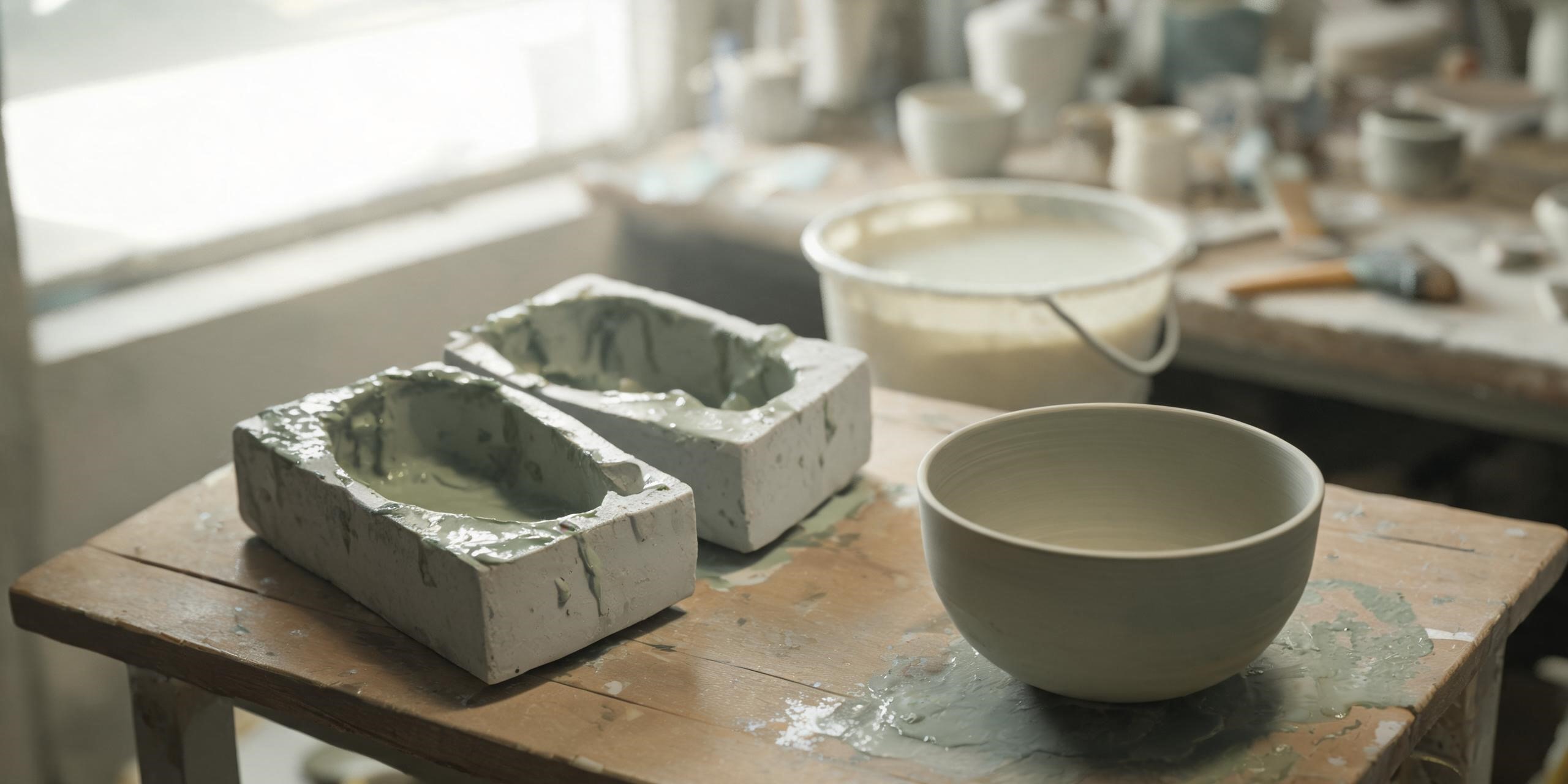
Hollow casting is the workhorse of Jingdezhen tableware. Slip is poured into a plaster mould, the mould draws water through its wall, a shell of clay builds up against the inside face, and the surplus slip is poured back out. What separates a good hollow cast from a poor one is rarely the design or the mould: it is the control of wall thickness, and that control lives in a handful of variables that shift from hour to hour in a working workshop.
This article stays inside the hollow method u2014 how Jingdezhen casters read a mould, judge a wall, set a drain and decide when a body is ready to come out. For the full sequence from powder to fired ware, including drying and firing, read the complete slip casting process. For the other three methods and how they compare, see the four casting methods compared.
Why Hollow Casting Dominates Jingdezhen
Almost every hollow form in porcelain tableware and decorative ware u2014 teapot bodies, vases, bottles, lidded jars, footed bowls u2014 is made this way, because the method solves a problem the wheel cannot: a narrow neck, an undercut, a shape that must be thin-walled and closed. The mould defines the outside; the drained slip leaves the inside open and even. No other technique produces a closed hollow body with a controlled wall at production speed.
The economics follow from the mould. One plaster master can yield hundreds of identical bodies, and each costs only the slip it consumes plus the labour of pouring, draining and finishing. That is why hollow casting, not throwing, underpins the volume end of Jingdezhen production, and why the same method lets a sculptor edition a form precisely.
Reading the Mould
Plaster is porous by structure rather than texture: its set crystals form a capillary network that pulls water out of the slip. That network is a consumable. A fresh, dry mould draws fast; a mould that has cast three times in a row is part-saturated and draws slowly, and the difference can halve the thickness gained in the same dwell time.
So the first judgement of the day is not about the slip but about the mould. Casters check the weight by hand and look at the colour of the plaster face u2014 a pale, dry face will pull hard, a darker, cool face is still wet inside. Moulds are rotated through a drying rack, and no mould is asked to work twice without a rest.
Weather enters the same judgement. In the humid summer a mould dries slowly and a casting sets slowly; in the dry winter the plaster dries fast and the same piece may set in half the time. Workshops that cast all year keep a seasonal record of dwell times rather than one fixed number, because a number that works in January will over-thicken a wall in July.
| Variable | Effect on wall thickness | Typical Jingdezhen range |
|---|---|---|
| Slip specific gravity | Higher gravity means a faster, thicker wall | 1.7u20131.85 g/cmu00b3 for porcelain |
| Viscosity | Lower viscosity means faster absorption | Flowing, cream-like |
| Mould moisture | A drier mould absorbs faster | Reused moulds cast slower |
| Dwell time | Longer means thicker | 5u201330 minutes for tableware |
| Workshop temperature | Warmer means faster casting | 20u201328 u00b0C |
The Drain: Angle, Timing and the Rim Test
Wall thickness is set by dwell time, and dwell time is ended by the drain. The test is physical: pour a little slip out and look at the rim, or press a thumbnail into the shell at the pouring hole and feel the resistance. When the shell resists the thumb and the rim reads even, it is ready.
Draining is slower than it looks. The mould is inverted in one controlled movement and held at an angle so the slip leaves in a steady sheet. Tip it too fast and the moving slip scours the still-soft shell at the rim, leaving a thin ragged edge that will crack later. The angle also steers where the last film of slip settles: on the inside of the base, where it thickens the foot and can cause a shrink crack if it pools.
A second, short pour is sometimes used to build the base while keeping the walls thin. It is a technique rather than a correction. The caster pours, drains, lets the floor firm, then pours again briefly to thicken the base without adding to the sides.
Setting, and the Risk of Collapse
After draining, the body is still a wet shell supported only by its own green strength. It stays in the mould while the plaster keeps drawing water, gaining rigidity from the outside in. This is the most dangerous hour of the process: too early and the wall folds under its own weight as soon as the mould is opened; too late and the body has shrunk hard onto the plaster and will tear at the seam.
The signs of readiness are consistent across workshops. The surface has lost its wet sheen, a light press leaves no dent, and the body has visibly released a fraction from the mould face. A hollow body should always be lifted with a flat support underneath, never gripped by the rim, because the rim is the thinnest and weakest part of the wall.
Assembly and Editioning
Hollow casting rarely finishes at the demould. Spouts, handles, lugs and lids are usually cast separately u2014 solid where a part is small and needs strength u2014 and joined at the leather-hard stage with slip as the adhesive, the joint worked closed with a sponge before the body stiffens. A teapot may therefore pass through four casts before it becomes one object.
This is also where hollow casting earns its place in sculpture. Because the master mould is fixed, an edition can be repeated with the same wall, the same weight and the same interior volume u2014 properties that matter when a series has to read as one object repeated rather than a set of near-misses. For a client commissioning a series, the mould is the guarantee of consistency; for a one-off, it is a tool that can be cut, altered and re-cut until the form is right.
| Component | Cast as | Reason |
|---|---|---|
| Teapot or jar body | Hollow | Keeps weight down and the interior open for glazing |
| Spout | Solid or thin hollow | Needs strength at the tip and a clean bore |
| Handle | Solid | Load-bearing and thin in section |
| Lid | Hollow with a gallery | The seating ring must stay flat through firing |
| Knob and finial | Solid | Small volume, handled constantly |
Where Hollow Casts Fail
Four failures account for most rejections. A wall thick at the base and thin at the shoulder comes from a drain that pooled. Bubbles in the wall come from air in the slip or a pour that splashed. A rim crack follows from draining too fast or from a mould opened too early. A shrink crack across the foot follows from a floor left too thick. Each traces back to a control described above rather than to the material itself.
The full inspection routine, and what these defects mean when you are buying rather than making, is set out in our guide to slip quality and casting defects. For the material that goes into the mould in the first place, see how the Jingdezhen porcelain body is made.
Frequently Asked Questions
What is hollow slip casting?
A method in which slip is poured into a porous plaster mould and left until a shell of the required thickness has formed, after which the remaining slip is poured out, leaving a hollow body.
What controls the wall thickness of a hollow cast?
Dwell time is the main control, but it is itself set by the specific gravity and viscosity of the slip, the moisture left in the mould, and the temperature and humidity of the workshop.
Why does the same mould cast differently on different days?
Because plaster absorbs a finite amount of water. A mould used repeatedly draws more slowly, and humid weather slows drying and setting, so dwell times have to be adjusted seasonally.
Why are handles and spouts cast separately?
Because small parts need solid clay for strength, and a separate cast is easier to trim and join cleanly at the leather-hard stage than to model onto a thin hollow wall.
Related Reading
For the full production sequence, read The Slip Casting Process Step by Step. For the four methods and when to use each, see Slip Casting Methods Compared. For slip quality and defect inspection, read Slip Quality and Casting Defects.
We cast Jingdezhen porcelain hollow, solid and under pressure, from single sculptural pieces to full tableware editions. Browse the collection, see our custom ceramic sculpture commissions, or email us. We also answer questions on WhatsApp.
Published 31 October 2026 by Jingdezhen Heritage, a porcelain studio in Jingdezhen, Jiangxi, China.