The mu00e9ipu00edng (u6885u74f6) is the most recognisable silhouette in Chinese porcelain and the easiest to misjudge. It is a tall jar with a small mouth, a short neck, a high rounded shoulder and a body that narrows steadily to a small foot. The curve is not decorative: every point on it is constrained by the fact that the vessel had to be thrown, dried and fired without the shoulder collapsing.
What the Shape Actually Is
The name means “plum vase”, and the usual explanation is that the narrow mouth was sized to hold a single flowering plum branch. That reading is only half right. The form began as a wine container u2014 a ju012bngpu00edng (u7ecfu74f6) used to store and carry liquor u2014 and only later became a display object for flowers and for display in its own right. The narrow mouth suits a cork; the high shoulder gives capacity; the taper makes the jar easy to lash to a pack frame.
Three measurements decide whether the shape reads correctly:
- the mouth, normally 3u20136 cm across on a 30u201340 cm jar;
- the shoulder, the widest point, sitting at roughly two-thirds of the total height;
- the foot, about one-third to one-half the shoulder width, with a clean recessed base.
Move the shoulder lower and the jar looks squat; raise it and the profile becomes stiff. The best examples have an unbroken S-curve from neck to foot, with no visible change of direction at the join.
How the Shape Changed
| Period | Profile | Typical height | Decoration usually found |
|---|---|---|---|
| Northern Song (960u20131127) | Slender, tall, shoulder high and soft; foot narrow | 25u201335 cm | Incised lotus or plain monochrome glaze |
| Yuan (1271u20131368) | Fuller shoulder, heavier body, less taper | 35u201345 cm | Blue and white with dense horizontal bands |
| Ming, Yongleu2013Xuande (1403u201335) | Broad shoulder, short neck, confident weight | 35u201345 cm | Underglaze blue, dragon and lotus scrolls |
| Qing, Kangxiu2013Yongzheng (1662u20131735) | Tall, elegant, shoulder slightly lower | 30u201340 cm | Famille rose, archaistic revivals, reign marks |
| Modern revival | Copied from Yongzheng proportion; often taller | 35u201355 cm | Any, including deliberately aged surfaces |
The reason the profile moves with the period is technical rather than aesthetic. A taller, thinner body needs a cleaner clay and better kiln control; the broader Yuan shoulder reflects a heavier, more pragmatic vessel made in larger numbers for export and for storage.
Why It Is Difficult to Make
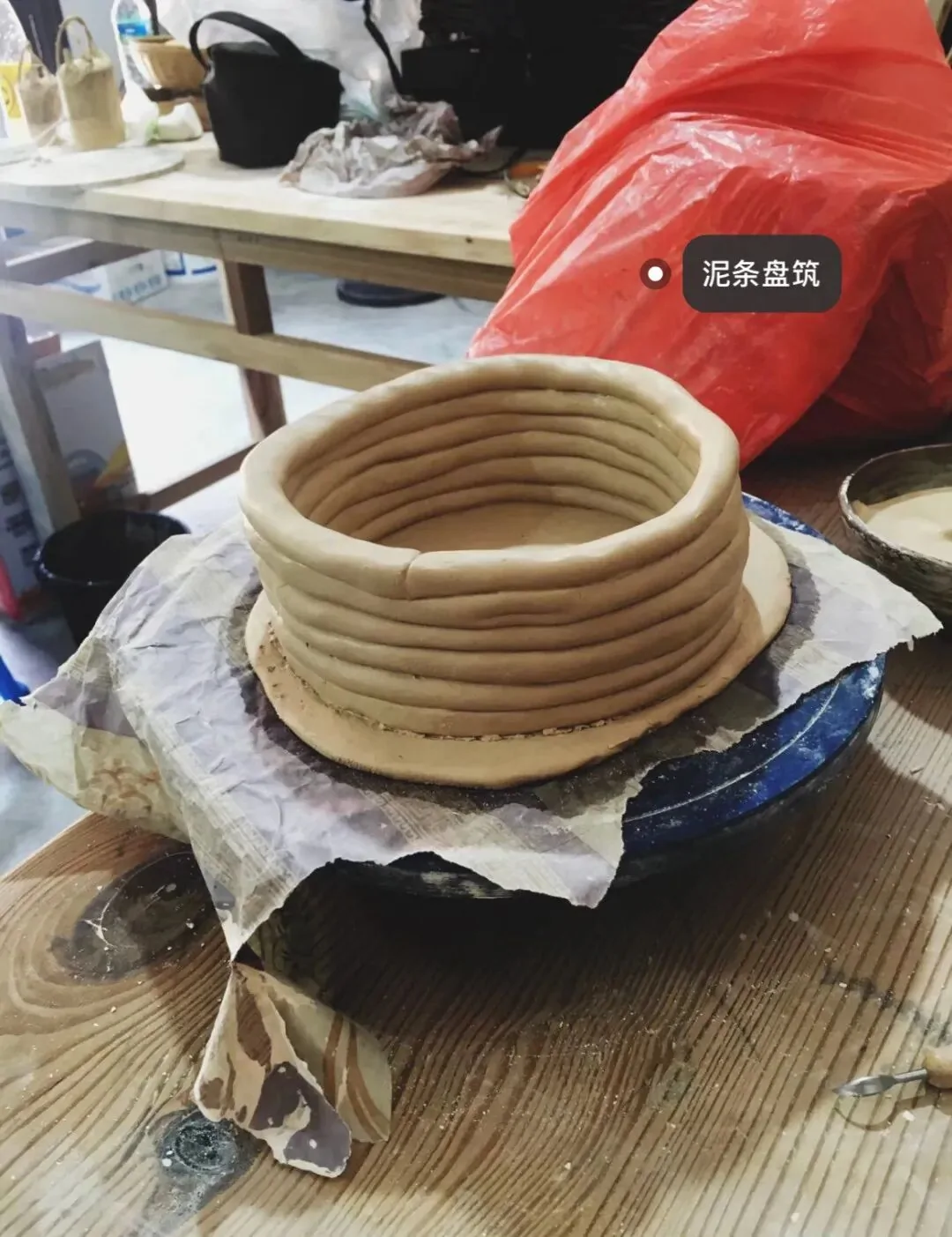
A meiping of 40 cm is close to the limit of what a potter can throw in one pull. Most are thrown in two sections u2014 lower body, then shoulder and neck u2014 joined at leather-hard stage, with the join smoothed so thoroughly that it is invisible on the finished piece. The joint is nonetheless the weakest point, and it is where a firing failure usually shows.
| Stage | Risk | What a good piece shows |
|---|---|---|
| Throwing the shoulder | Clay slumps under its own weight above c. 35 cm | Continuous curve, no flattening at the widest point |
| Joining two sections | Trapped air or uneven wall thickness | Even wall when tapped; no shadow line at the join |
| Drying | Differential shrinkage across the shoulder | No drying crack, no oval distortion at the mouth |
| Firing | Shoulder deformation at 1280 u00b0C+ | Mouth still circular; silhouette symmetrical from both sides |
| Glazing | Glaze pooling at the foot, thinning on the shoulder | Even colour, no bare patches on high points |
This is why the shoulder is the first place an experienced buyer looks. A mouth that has gone oval, a shoulder that has sunk half a centimetre on one side, or a ring of pooling glaze at the foot are all evidence of a firing that just got away.
Reading a Meiping: Five Checks
- Silhouette from both sides. A thrown piece is rarely perfectly symmetrical; a cast piece is. Slight asymmetry on one axis is acceptable, a matching distortion on both is not.
- The mouth ring. Look across it: it should be a true circle, with an unglazed or lightly glazed inner rim where the original potter cleaned it.
- The join. Hold the piece to a light source. A faint horizontal line at mid-body is normal; a visible ridge is a repaired or badly joined piece.
- The foot. A recessed base with a clean, slightly darker unglazed ring; the foot should be proportionally small, not widened to stop the piece tipping.
- Decoration logic. On a blue-and-white meiping, the bands should follow the form: a narrow band at the neck, a broad field on the shoulder, a secondary band at the waist. Decoration that ignores the curve usually indicates a copied design applied without adjustment.
Meiping or Something Else?
Confusion is common because three shapes share the same family of curves.
| Shape | Distinguishing feature | Usual use |
|---|---|---|
| Meiping u6885u74f6 | Small mouth, short neck, shoulder at about two-thirds height, narrow foot | Wine jar, then display |
| Yuhuchunping u7389u58f6u6625u74f6 | Flared mouth, slender neck, pear-shaped body, wider foot | Wine ewer, decoration |
| Tianqiuping u5929u7403u74f6 | Small mouth, long neck, near-spherical body, no taper to the foot | Imperial display, Yongleu2013Qianlong |
The practical test is the foot. A meiping narrows; a yuhuchun ping widens into a splayed foot; a tianqiuping sits on a foot nearly as wide as the sphere above it.
Where the Decoration Sits
Because the body is a single continuous curve, a meiping cannot be decorated like a cylinder. The convention that developed on Yuan and Ming blue-and-white pieces divides the height into bands that follow the anatomy of the vessel:
- a narrow collar band at the neck u2014 plantain leaf, wave or key-fret;
- a shoulder band, the widest field, carrying the principal motif: dragon, phoenix, peony scroll or figures;
- a waist band of lotus petals or a contrasting scroll;
- a foot band, usually a stylised lappet or wave, kept simple so the taper reads clearly.
This is a design decision as much as a decorative one. The shoulder is the only place where a viewer, looking at the jar from slightly above u2014 the way it would have stood on a table u2014 sees a wide, undistorted field. Placing the main motif there is what makes a meiping legible across a room. On later famille rose pieces the bands often dissolve into a single continuous scene, which works because the painting is finer and meant to be read close up.
A practical consequence for buyers: banded decoration that has been squeezed or stretched to fit a badly proportioned body is a reliable sign of a copy made from a photograph rather than from the form.
Three Price Levels
The market divides fairly cleanly, and knowing which tier a piece belongs to prevents most expensive mistakes.
Under a few hundred pounds. Modern Jingdezhen revival, usually 35u201345 cm, mechanically consistent, painted by workshop hands. Good if you want the silhouette in a room; not an investment.
Low thousands. Late Qing and Republican meiping with competent painting, or well-made contemporary studio work with a named maker. This is the band where condition and proportion matter more than age, and where a distorted firing is the main thing to reject.
Auction level. Yuan and early Ming pieces with dated decoration, and imperial Qing examples with a reign mark. At this tier the object should come with a documented provenance, and the shape itself is only the beginning of the examination.
Age does not settle the question on its own. A well-proportioned modern meiping with a clean join, an even glaze and disciplined painting is a better object than a distorted eighteenth-century one.
Frequently Asked Questions
Why is it called a plum vase?
Because the narrow mouth was said to hold a single branch of flowering plum. The form existed earlier as a wine jar; the name comes from the later use as a flower vessel.
Should I put water in an antique meiping?
No. Unglazed interior surfaces and old joins absorb water, and the salts in tap water will stain and eventually crack the body. Use a dry display or an inner glass liner.
What is a typical size?
Most are 30u201345 cm. Anything much over 50 cm is unusual and is either an imperial-scale piece or a modern display object.
How can I tell a modern revival from an older piece?
Three signals: the base (modern pieces often show a very clean, evenly sanded foot), the weight (revival bodies are usually denser and heavier), and the decoration (modern painting is often more uniform in line weight than eighteenth-century work).
Related Reading
For the specific problem of the sloping Yongzheng shoulder, read Why Does a Meiping Vase Have Sloping Shoulders? For how decoration changed across the dynasties, see How Did Blue and White Porcelain Evolve? And for the body materials that make a 45 cm shoulder possible at all, see How the Jingdezhen Porcelain Body Is Made.
To see meiping and other forms from our studio, browse the collection, or email us. We also answer questions on WhatsApp.