
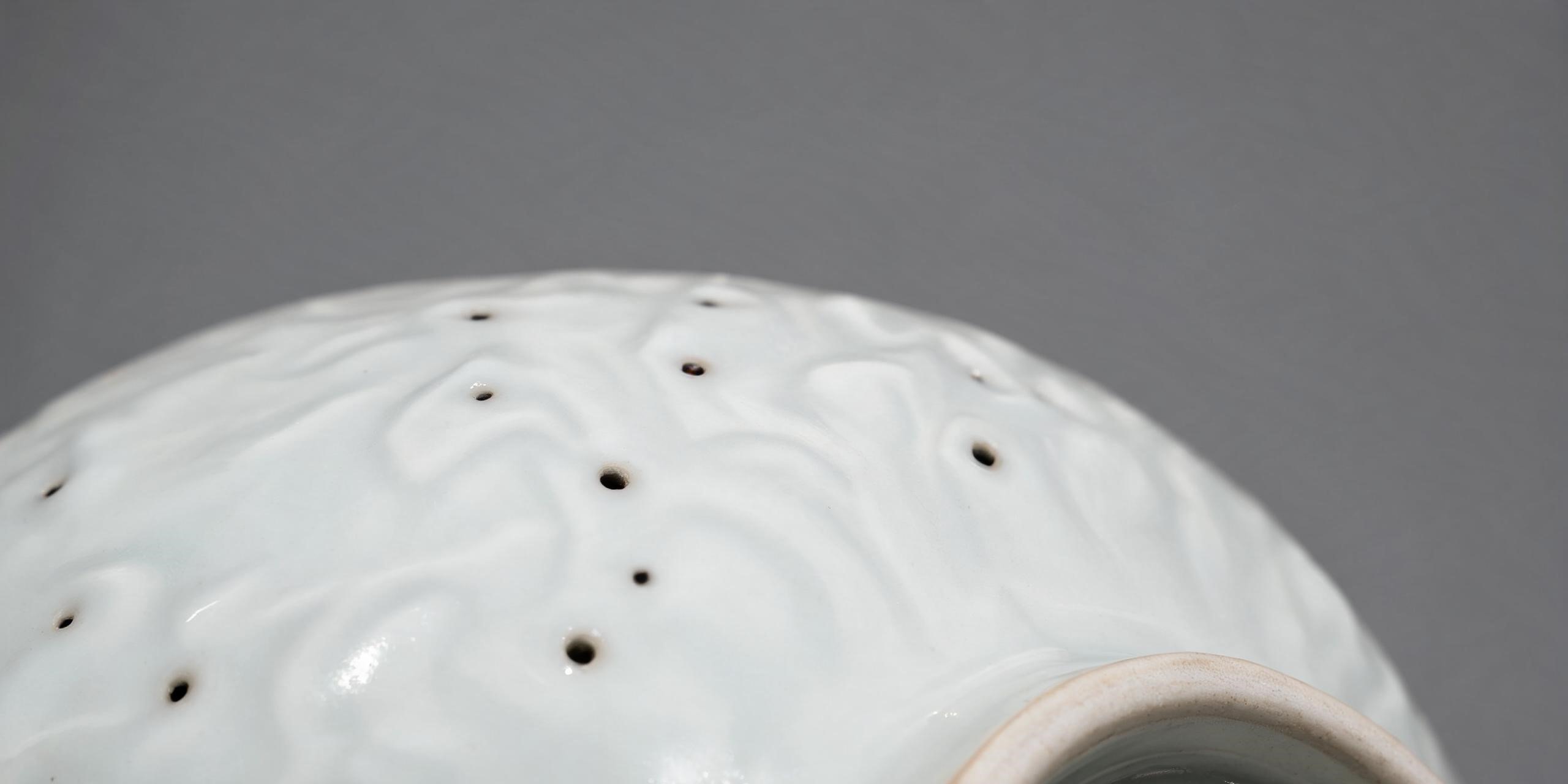
In a Jingdezhen showroom, two plates can look identical from a metre away and be worlds apart in quality. The difference is usually not the design or the glaze but the cast underneath: whether the slip was properly prepared and de-aired, whether the mould was drawn at the right rate, and whether anyone inspected the piece before it went into the kiln. This buyer’s guide is about reading those signs.
It covers what a casting slip has to do, how the two production routes used in China leave different defect signatures, and how to inspect a cast piece before you pay for it. For how the piece should have been made, read the slip casting process step by step. For which method a given shape needs, see the four casting methods compared.
What a Casting Slip Must Do
Every defect downstream begins upstream, in the slip. A production casting slip in Jingdezhen is judged against six requirements, and a failure in any one of them shows up directly in the fired ware.
First, fluidity: the slip must pour freely and fill every recess of the mould without being coaxed. Second, stability: the clay particles must stay in suspension rather than settling into a hard layer at the bottom of the tank between casts. Third, appropriate thixotropy u2014 the slip should thicken slightly at rest so the cast layer holds its shape, yet liquefy again the moment it is stirred or poured. Fourth, low water content: every litre of water in the slip must eventually leave through the mould or the dryer, so less water means faster casting and less drying shrinkage. Fifth, good filterability: the deposited layer must let water pass through it, or casting slows to a crawl as the layer builds. Sixth, no bubbles: trapped air becomes pinholes and pits in the fired surface, the most common visible defect in cast ware.
| Requirement | What it means | If it fails |
|---|---|---|
| Fluidity | Pours and fills the mould freely | Misruns, thin patches |
| Stability | Particles stay suspended | Uneven casts, clogged detail |
| Thixotropy | Thickens at rest, flows when moved | Sagging walls or poor coverage |
| Low water content | More clay per litre of slip | Slow casting, high shrinkage, cracks |
| Filterability | Water passes through the cast layer | Casting stalls as the layer builds |
| No bubbles | Fully de-aired slip | Pinholes and pits in the surface |
Two Routes, Two Defect Signatures in China
Chinese daily-use porcelain is cast by one of two routes, and knowing which one produced a piece tells you which defects are likely and which are unlikely. Platform casting is ordinary atmospheric casting on a bench, with plaster moulds that draw water by capillary action. High-pressure casting forces slip into porous synthetic resin moulds by machine, and drives the water out in minutes.
The defect signatures differ accordingly. Platform casting is hand-controlled, so its typical faults are human: a drain left a moment too long, a wall uneven across one side, a rim scuffed on the bench. High-pressure casting is machine-controlled, so its typical faults are systemic: a pressure cycle set slightly wrong across a whole run, or a mould beginning to clog late in its service life. A pressure-cast piece is far less likely to have a wild wall variation and far more likely to share a small flaw with every other piece from the same shift. If you are buying a set, that is worth checking u2014 a set that fails together was cast together.
| Platform casting | High-pressure casting | |
|---|---|---|
| Pressure | Atmospheric | Elevated, machine-driven |
| Mould | Plaster, consumable | Porous synthetic resin, long-life |
| Typical products | Teapots, vases, tea caddies | Spoons, plates, bowls |
| Likely defect origin | Individual handling error | Batch-wide process setting |
| Likely defect shape | Local, one-off, irregular | Uniform, repeated across a run |
How to Inspect a Cast Piece
Inspection needs no equipment and about a minute. Five checks cover almost everything visible on a cast body, and each maps to a specific cause. Do them in this order, because the earlier checks are easier to see under good light.
| Check | Where to look | What it indicates |
|---|---|---|
| Ripples | Inside of bowl or cup, felt with a finger | Slip too thick or poured too fast |
| Pinholes | Glaze surface under raking light | Trapped air or iron not removed from the slip |
| Seams | Where mould sections met | Trimming skipped or rushed |
| Foot | Underside of base ring | Bubble or incomplete fill at the base |
| Ring sound | Tap the rim lightly | A dull note can mean a crack under the glaze |
The Foot Ring Question
A question that comes up constantly among collectors: is a small hole or pit in the foot of a plate normal? Sellers often answer that every piece has one and that it is simply how the ware is made. It is not. A pit at the foot ring is a casting defect u2014 a bubble that survived in the slip, or a spot where the slip failed to fill the mould u2014 and it means the piece escaped a quality control step that should have caught it. On well-made cast porcelain the foot is as clean and closed as any other surface.
The same logic applies to the seam lines. On good work the seams where the mould sections met are trimmed flush and are invisible after glazing. On careless work they stand proud as a sharp ridge, and a ridge under a glaze is a place where the glaze thins and eventually crazes. None of these flaws affect whether a plate holds soup. They mark the difference between a factory that controls its slip and one that ships whatever comes out of the mould.
Five Questions to Ask a Seller
Most of what matters is not visible in a photograph, so ask. A seller who casts in Jingdezhen should be able to answer all five without consulting anyone.
Is the body cast or thrown, and by which method? Was the slip de-aired, and is it aged before use? How many casts is the mould asked to make before it is retired? Are seconds sold as firsts anywhere in the range? And what happens if a piece arrives with a pinhole or a foot defect?
The answers do not need to be ideal. They need to be specific. A seller who says the slip is de-aired and the moulds are rotated through a drying rack is describing a process they actually know; a seller who answers every question with a variant of it is made by hand is describing a label rather than a practice. Studios that take on custom ceramic sculpture commissions in China will usually show clients cast surfaces before glazing precisely because that is the stage where quality is still fixable.
Seen from the buyer’s side of the counter, slip casting deserves more respect than it gets. The method is not a shortcut around skill but a different application of it, measured in the discipline of slip preparation, the accuracy of dwell times and the honesty of quality control. When those are right, cast porcelain is indistinguishable in quality from any hand-thrown piece, and the small pit in the foot of a plate is not a quirk of the craft but a sign that somewhere upstream, someone was not paying attention.
Frequently Asked Questions
Is a small hole in the foot of a plate normal?
No. A pit at the foot ring is a casting defect caused by a trapped bubble or an incomplete fill. Well-made cast porcelain has a clean, closed foot, and pitted pieces should be returned.
What causes pinholes in cast porcelain?
Trapped air in the slip, or iron particles that were not removed before casting. Both are slip preparation faults, so pinholes usually appear across a batch rather than on a single piece.
What do ripples inside a bowl tell you?
That the slip was too thick or was poured too fast, so it did not level before the shell set. They are a handling and consistency fault, not a decorative effect.
How can you check a cast piece quickly in a shop?
Run a finger inside for ripples, tilt the glaze into raking light for pinholes, look along the seams, examine the foot ring, and tap the rim to listen for a dull note.
Related Reading
For the full production sequence, read The Slip Casting Process Step by Step. For wall thickness and hollow casting control, see Hollow Slip Casting in Jingdezhen. For the four methods and when each is used, read Slip Casting Methods Compared.
We cast Jingdezhen porcelain by platform and pressure methods alike, from single commissions to full tableware runs. Browse the collection, see our custom ceramic sculpture commissions, or email us. We also answer questions on WhatsApp.
Published 31 October 2026 by Jingdezhen Heritage, a porcelain studio in Jingdezhen, Jiangxi, China.