
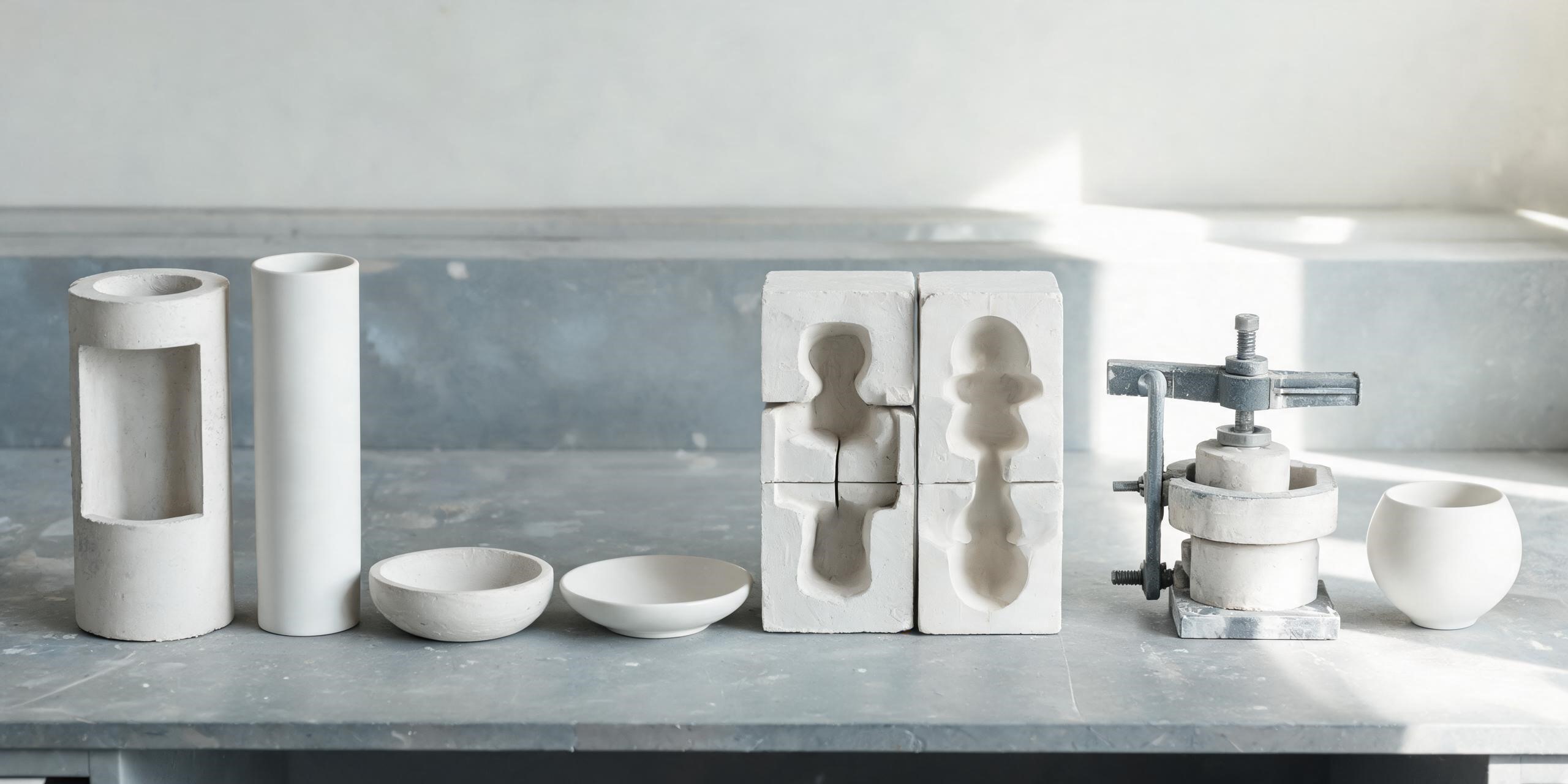
Slip casting is not a single method but a family of forming techniques united by one idea: that liquid clay, poured or forced into a mould, can be turned into a solid object through the removal of water. In Jingdezhen, where slip casting accounts for a large share of porcelain production, four variants dominate u2014 hollow, centrifugal, solid and pressure casting u2014 each suited to a different kind of object and a different scale of making.
This guide explains how each of the four slip casting methods works, where it is used in Jingdezhen, and how to choose between them. Understanding the range is essential for anyone designing tableware, architectural ceramics or sculptural editions in porcelain. Together they cover almost every hollow or solid form that can be made from liquid clay, and most Jingdezhen workshops master at least two.
The Four Slip Casting Methods in Jingdezhen
All four methods begin with the same material u2014 a deflocculated slip of clay and water u2014 and the same principle, that a porous mould draws water from the slip to deposit clay. They differ in how the slip is delivered to the mould and how the water is removed, which in turn determines the wall thickness, surface quality and production speed of the finished piece. The choice is rarely aesthetic: it is a question of what the object’s geometry demands and how many of them need to be made. A single workshop may move between several methods in a single day, depending on what is on the bench.
| Method | How it works | Best for |
|---|---|---|
| Hollow casting | Slip poured into plaster mould; shell builds, excess drained | Hollow tableware, vases, bottles |
| Centrifugal casting | Slip poured into a rotating mould; centrifugal force throws it outward | Symmetrical vessels, even thin walls |
| Solid casting | Slip fills a mould with a core; the whole volume becomes clay | Solid sculptural forms, handles, knobs |
| Pressure casting | Slip forced under pressure into a porous resin mould | High-volume tableware, fast production |
Hollow Casting: The Standard Method
Hollow casting is the everyday method of Jingdezhen tableware. Slip is poured into a plaster mould, where capillary action builds a clay shell against the mould wall. When the shell reaches the target thickness, the remaining liquid slip is poured out, leaving a hollow object. It is versatile, low-tech and forgiving, but it requires careful control of dwell time to get an even wall. For objects of moderate size u2014 cups, bowls, teapots, vases u2014 it remains the default. It is also the method most visitors to Jingdezhen get to try, because it needs no equipment beyond a plaster mould and a bucket of slip.
Centrifugal Casting: Force for Symmetry
Centrifugal casting adds rotation. The mould spins on a vertical or horizontal axis as the slip is poured, and centrifugal force throws the clay particles outward against the mould surface. The result is an exceptionally even wall thickness, even for pieces that are tall or awkwardly shaped, and a surface free of the settling streaks that can appear in static hollow casting. Jingdezhen makers use it for symmetrical vessels where wall uniformity matters u2014 large vases, lamps and some sculptural forms. The trade-off is the machinery: a spinning rig and balanced moulds are needed, so it is less common in small studios. The rotation also affects the slip itself, pressing heavier particles to the outside, which can slightly change the fired colour and density across the wall u2014 an effect some artists exploit deliberately.
Solid Casting: When the Object Is Not Hollow
Solid casting is used when the piece should be filled, not hollow. A mould with an internal core defines the outer and inner surfaces simultaneously, and the whole volume between them fills with clay as the mould absorbs water. It is the method for solid sculptural components u2014 handles, finials, knobs, small figures u2014 and for parts that need structural strength. Because the clay has to set through its full thickness rather than just against the mould wall, solid casting takes longer than hollow casting and uses more slip, but it produces a dense, robust piece. It is also the natural choice for sculptural elements that will be carved or assembled after demoulding, where a solid blank gives the maker material to work into.
Pressure Casting: Speed for Volume
Pressure casting is the industrial answer to plaster’s limits. Instead of waiting for capillary action to draw water slowly, the slip is forced into a porous resin mould under pressure, driving water out through the mould in minutes rather than tens of minutes. The moulds are made of synthetic porous materials, not plaster, so they last far longer and cast hundreds of pieces without losing performance. In Jingdezhen’s larger tableware factories, pressure casting produces the bulk of daily output u2014 cups, plates, bowls u2014 at a speed and consistency that hand pouring cannot match. It requires capital investment, which is why it lives in factories rather than studios, but it is the reason mass-produced Jingdezhen porcelain is so uniform. The same technology is now scaling down, with smaller semi-automatic pressure machines entering mid-range workshops and bringing factory consistency to smaller runs.
Choosing the Right Method
The choice between methods is a question of geometry, volume and surface. Hollow casting suits most hollow forms and is the most flexible in a studio. Centrifugal casting improves uniformity for symmetrical pieces. Solid casting handles parts that cannot be hollow. Pressure casting wins when quantity and consistency matter more than the maker’s hand. In practice, a single production run may use several methods: a teapot body cast hollow, its spout and handle cast solid, the whole assembled and finished by hand.
| Method | Speed | Wall uniformity | Capital cost | Typical scale |
|---|---|---|---|---|
| Hollow casting | Medium | Good, depends on dwell time | Low (plaster moulds) | Studio, small batches |
| Centrifugal casting | Medium | Excellent | Medium (spinning rig) | Studio, specialised runs |
| Solid casting | Slow | Not applicable (solid) | Low | Components and sculpture |
| Pressure casting | Fast | Excellent | High (synthetic moulds, press) | Factory, large volume |
For designers and clients working with Jingdezhen studios, this matters because the method shapes what is possible. A form that is trivial to pressure-cast in a factory may be expensive and slow by hand hollow casting; a one-off sculptural piece that needs the maker’s touch will always be better cast slowly in plaster. Knowing which method the studio uses u2014 and why u2014 is the first step in judging whether a design can be made, and at what cost. Studios that take on custom ceramic commissions will usually advise on the method before the first mould is cut. A good studio treats the casting method as part of the design, not a production detail to be decided later.
Looking across the four methods, the real insight is that slip casting is far more flexible than its reputation suggests. It is not only the route to identical mass-produced tableware; it is also the route to one-off sculpture, architectural surfaces and experimental forms that no other technique can achieve. In Jingdezhen, where all four methods exist side by side, the question is never whether a form can be cast, but which casting route will give it its best life in clay.
Frequently Asked Questions
What are the four main slip casting methods?
Hollow casting (excess slip drained), centrifugal casting (slip thrown outward in a spinning mould), solid casting (the whole volume filled) and pressure casting (slip forced under pressure into a synthetic mould).
Which method is most common in Jingdezhen?
Hollow casting is the studio standard for tableware and small sculpture, while pressure casting dominates large-scale factory production of cups, plates and bowls.
What is pressure casting used for?
High-volume, high-consistency tableware production. Pressure casting forces water out of the slip quickly through a synthetic porous mould, producing uniform pieces in minutes.
When is solid casting needed?
For parts that should be filled rather than hollow u2014 handles, knobs, finials, small sculptural elements u2014 and for any component that needs structural strength across its full cross-section.
Related Reading
For a deep dive into the most common method, read Hollow Slip Casting in Jingdezhen. For the full five-stage sequence, see The Slip Casting Process Step by Step, and for slip quality and what defects reveal, read Slip Quality and Casting Defects. For the material itself, see How the Jingdezhen Porcelain Body Is Made.
We produce high-fired Jingdezhen porcelain by every slip casting method, from single sculptural pieces to full tableware editions. Browse the collection, see our custom ceramic sculpture commissions, or email us. We also answer questions on WhatsApp.
Published 31 October 2026 by Jingdezhen Heritage, a porcelain studio in Jingdezhen, Jiangxi, China.