
Blue and white porcelain is made in five stages: refining the clay, forming the body, painting the design in cobalt, glazing, and a single firing at about 1300 u00b0C. Each stage carries techniques that Jingdezhen craftsmen have refined over seven centuries, and each is explained below.
What is blue and white porcelain?
Blue and white porcelain is underglaze-painted porcelain: a design brushed in cobalt pigment onto the dried, unfired body, sealed beneath a transparent glaze and matured in a single firing at roughly 1300 u00b0C. Because the colour sits under the glaze, it cannot wear away and survives burial, shipwreck and centuries of use.
The technique matured at Jingdezhen in the mid-to-late Yuan dynasty (fourteenth century), building on a Chinese porcelain-making tradition that stretches back some 1,300 years to the Tang. Ming dynasty pieces won fame for their fine bodies, vivid blue and varied forms, and the Kangxi reign (1662u20131722) of the Qing brought another peak of achievement. In 1743 the imperial kiln supervisor Tang Ying compiled the Taoye Tushuo, an illustrated manual that codified cobalt preparation, painting and glazing; it remained the reference for potters for generations. That continuity is one strand of Jingdezhen’s thousand-year history as China’s porcelain capital.
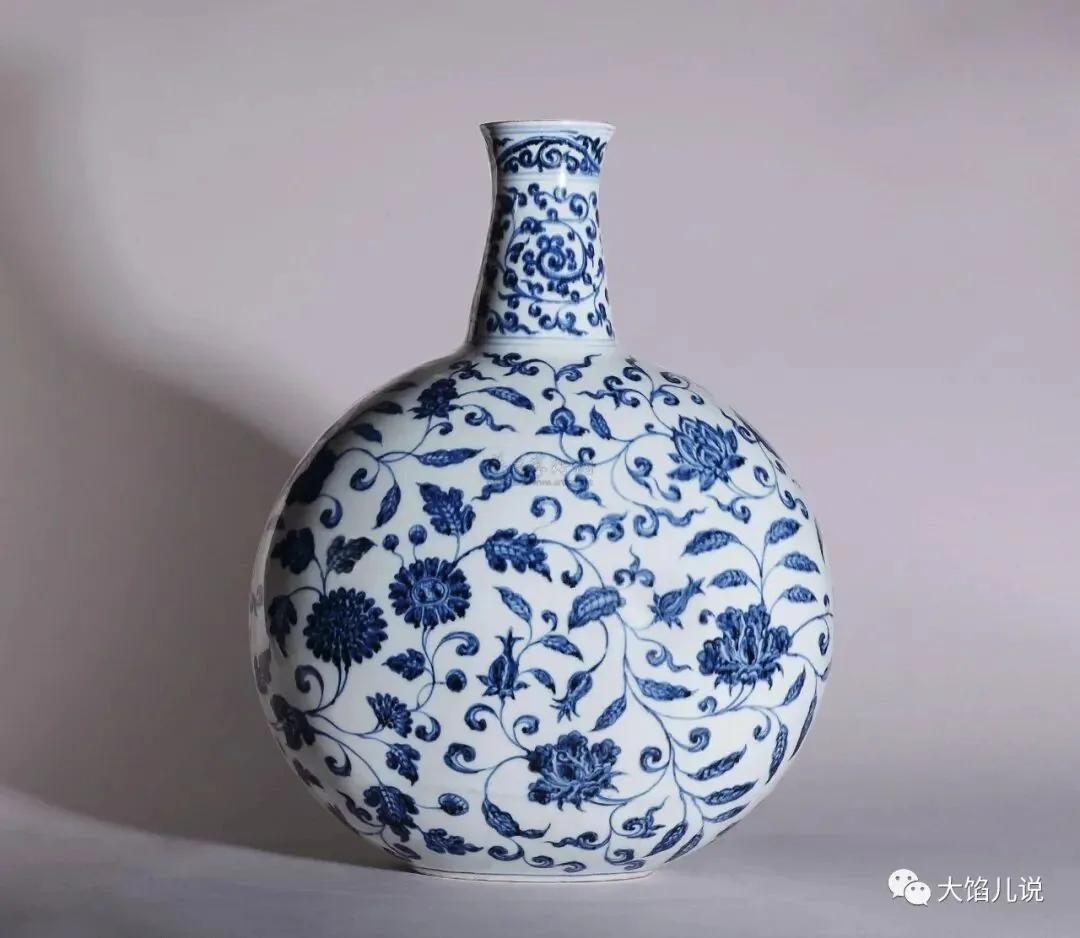
According to the Taoye Tushuo, production falls into five stages: refining the clay, forming the body, painting, glazing and firing. Each is treated in turn below.
1. Refining the clay and forming the body
The body is made from porcelain stone and kaolin rather than ordinary clay. The quarried material is pulverised by water-powered tilt-hammers, washed in settling ponds until only a fine white slip remains, then dewatered and kneaded into standardised bricks that Jingdezhen potters call buzi. This raw-material preparation is covered in detail in our feature on how the Jingdezhen porcelain body is made, so we will not repeat it here.
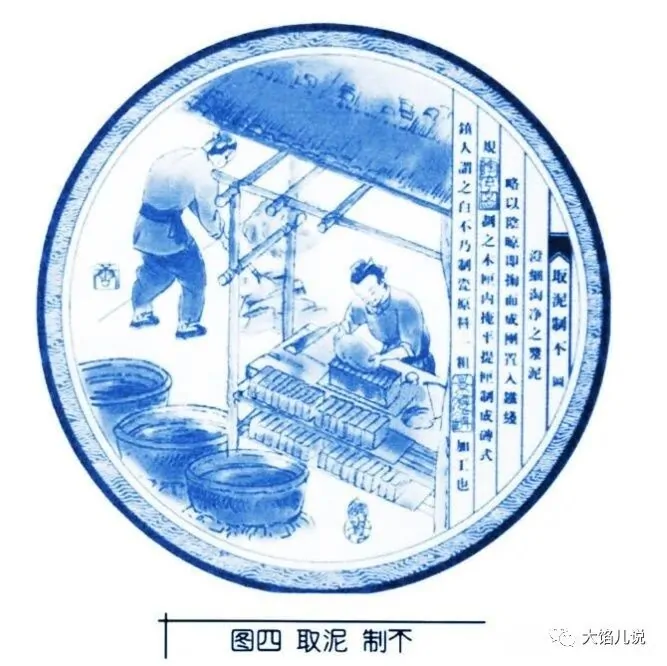
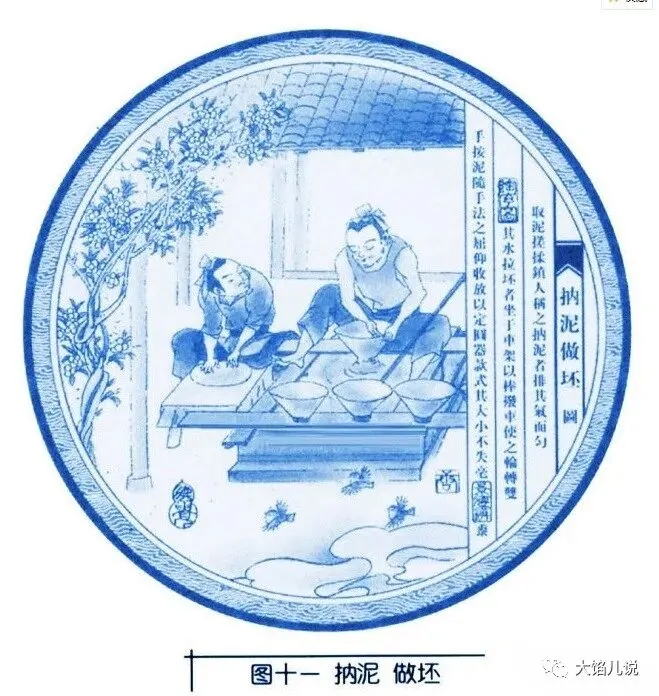
Forming turns the prepared clay into bowls, dishes, vases, jars and ewers. Three methods were traditional:
- Mould-wheel throwing: the clay is shaped on a fast-turning wheel against a mould u2014 quick, even and suited to batch production of regular forms.
- Hand throwing: slower, and reserved for large pieces such as vases, jars and ewers, which are thrown in two sections and joined with slip.
- Press-moulding: clay is pressed into a mould with the fingers and finished by hand, used for asymmetrical wares such as spoons and square boxes.
The rough body is then trimmed (lipi) until its walls are smooth and of even thickness, and the foot ring is cut (wazu). Finally the piece is dried u2014 in air or in a warming room u2014 so that it holds its shape for painting.
2. The cobalt: seven pigments that shaped blue and white porcelain
The character of Chinese blue and white porcelain rests on its cobalt. Seven pigments have mattered most, and each is tied to a period, so the blue alone often helps date a piece.
- Sumali blue (Sumaliqing). An imported Persian cobalt, said to take its name from the village near Kashan where it was mined u2014 or from a Persian word for blue glass. High in iron and low in manganese, it fires to an intense sapphire blue, and its iron content leaves dark, almost metallic spots in the painted surface. Far from being faults, these “iron spots” are a prized hallmark of Yongle and Xuande imperial wares.
- Pingdeng blue (Pingdengqing). Mined at Leping in Jiangxi and used from the Chenghua reign into early Zhengde. It fires a soft, pale, even blue u2014 the refined, quiet tone that made Chenghua pieces famous.
- Shizi blue (Shiziqing). From Gao’an, Yifeng and Shanggao in Jiangxi. Used alone it fires grey and dark, even blackish; Ming and Qing folk kilns relied on it, while imperial workshops blended it with huiqing.
- Huiqing. Its source is debated u2014 the Western Regions, Xinjiang and Yunnan are all cited. It fires a deep blue with a violet cast, but on its own the colour bleeds and will not hold a line, so it was mixed with shizi blue: ten per cent shizi for filling washes (shangqing, a bright blue), forty per cent for outlining (zhongqing, with crisp brush definition). It dominated from the Jiajing reign to the early Wanli period.
- Zhejiang blue (zheliao). From the Shaoxingu2013Jinhua area of Zhejiang, and the finest of the domestic pigments, firing a fresh emerald blue. Jingdezhen’s imperial kilns used it from the mid-Wanli period through the Qing dynasty.
- Zhuming blue (zhumingliao). Mined in Yunnan at Xuanwei, Huize and Yiliang, with Xuanwei material rated best. It fires bright, pure and true u2014 the brilliant blue of Kangxi porcelain.
- Chemical cobalt. Modern cobalt-oxide pigment: inexpensive, strong and a pure violet-blue, but the colour sits flat, lacks adhesion and cannot match the depth of natural cobalt.
3. Painting: design, transfer, outlining and colour-washing
Decoration is painted on the dried, unfired body in four steps.
Design. The painter composes the scheme for the exact form and size of the vessel. The layout is first sketched directly on the body in pale bamboo-charcoal ash, which rubs away cleanly and survives neither glazing nor firing; after corrections the drawing is re-traced in darker ash.
Transfer (guogao). To repeat a design across many pieces, thin cotton paper or raw xuan paper is laid over the traced body and rubbed so the drawing prints onto the paper; the paper is re-inked, dried and rubbed onto the next body. A second method uses wax paper pricked along the design with a needle; ash dabbed through the pinholes leaves a dotted outline on the body, and the stencil can be reused until it tears.
Outlining (gouxian). The painter traces the ornament in cobalt of the right consistency. The stroke must be natural, fluent and forceful, the line continuous, and a broad line must keep an even thickness from end to end.
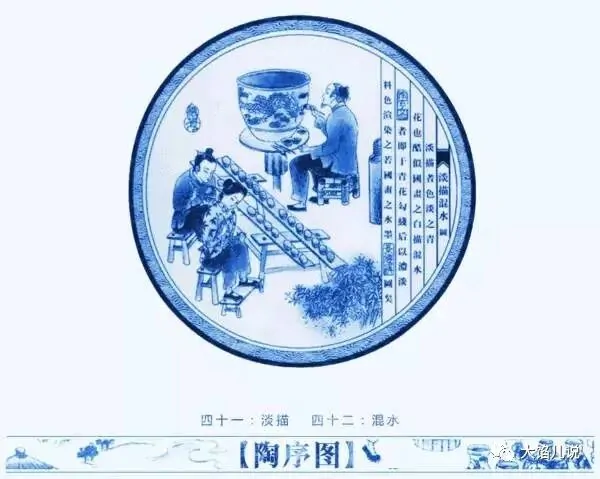
Colour-washing (fenshui). The outlined areas are then filled with cobalt wash graded into five tones u2014 head-dark, full-dark, half-dark, light and shadow-light u2014 applied in a free, splash-ink handling. Some painters wash first and outline afterwards, escaping the constraint of the contour for a livelier, more spontaneous result suited to the xieyi (sketching-the-idea) manner. The craft lies in the brushwork: flat washes, graded washes, colour-joining, overlaying and dabbing each demand a different loading of the brush, judged against the thickness of the body, and each area should be finished in one continuous movement.
4. Glazing: four traditional methods
Glazing veils the painted body in a glassy coat that gives the finished porcelain its smoothness and lustre. Traditional blue and white uses three glazes: a white glaze, which brightens the body but can mute the blue; a qing or ash glaze, made from burnt fern; and u2014 most common u2014 the qingbai or lime-alkali glaze, fluxed with calcium, potassium and sodium oxides. This last is viscous at high temperature, runs little, and fires so transparent that the blue gains depth while the body shows a faint jade-green tinge: the celebrated “white as jade” effect.
Four application methods were used:
- Dipping (jinyou): the vessel is held and plunged into the glaze slurry; the porous body draws up an even coat.
- Blowing (chuiyou): a bamboo tube is covered at one end with fine gauze, dipped in the slurry and blown through from the other end; the spray is repeated until a uniform layer builds up.
- Brushing (tuoyou): the glaze is painted onto the surface with a brush.
- Swirling (dangyou): slurry is poured inside a vessel, which is rocked so the interior is coated, and the excess poured out.
The quality of this stage is written on the face of the finished ware: a poor glaze cannot be hidden.
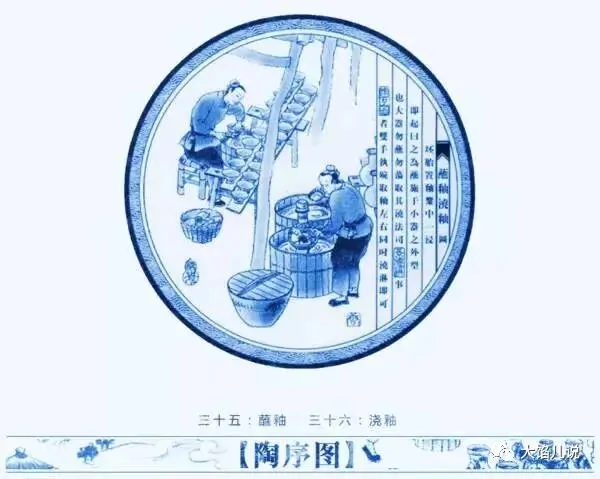
5. Firing: stacking methods and kiln types
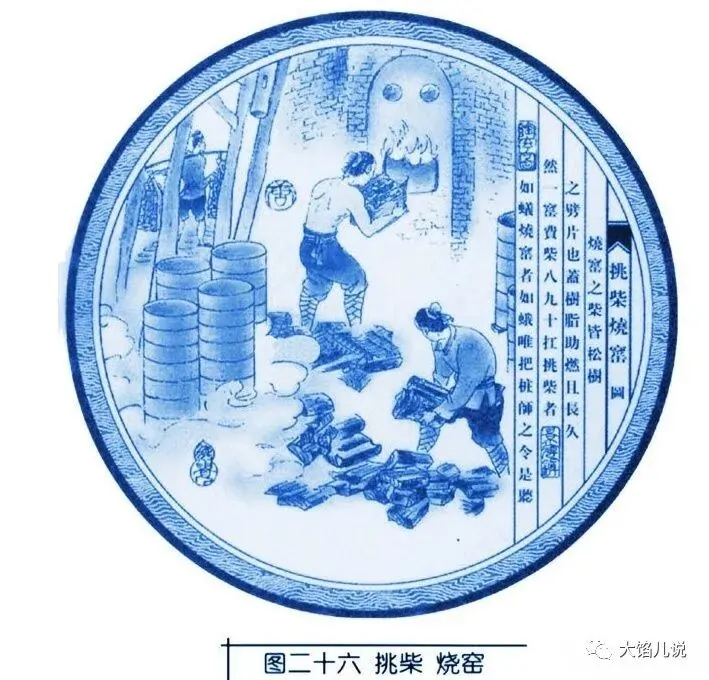
Firing is the final act: the glazed pieces are set in the kiln and matured once, at about 1300 u00b0C. Fuels have changed u2014 wood gave way to coal, then to heavy oil, coal gas and liquefied gas, and yields rose accordingly u2014 but control of the heat remains decisive. A misjudged firing means underfired, yellowed or dull ware, and every earlier stage is wasted.
How the pieces are set in the kiln matters as much. Three arrangements were standard:
- Upside-down firing (fushao): bowls and dishes are inverted for the firing. The rim must be left unglazed u2014 the so-called “mang” mouth u2014 but output rises and costs fall, which is why the method spread. It began at the Ding kilns of the Northern Song and remained common into the Yuan.
- Right-side-up firing (yangshao): the opposite arrangement: the piece stands upright on a setter inside a protective saggar.
- Stack firing (dieshao): several pieces are piled together with spacers between them u2014 again a practice first seen at the Northern Song Ding kilns.
The kilns themselves took several forms: the long, climbing dragon kiln; the stepped kiln; the domed mantou (“bread”) kiln; and Jingdezhen‘s own egg-shaped kiln.
Why does blue and white porcelain matter today?
Blue and white marked China’s passage from plain, single-colour ceramics to painted porcelain, and it set the taste of the world for half a millennium u2014 from Yuan export wares to the Kangxi pieces that crowded European cabinets. The five stages described above are not a museum reconstruction: in Jingdezhen’s studios the same discipline of clay, cobalt, glaze and fire still governs every piece of hand-painted porcelain that leaves the kiln.
Explore Jingdezhen craftsmanship
Our collections carry this tradition forward: plates, bowls, cups, teapots and art porcelain made in Jingdezhen by hand, painted in cobalt and fired in the manner described in this article. Browse the collections on our site to see current pieces.
Contact Jingdezhen Heritage
For enquiries about specific pieces, custom orders or wholesale, contact us directly: Email Jingdezhen Heritage u00b7 Message us on WhatsApp.
Images courtesy of the original WeChat article; historical plates are from Tang Ying’s Taoye Tushuo (1743).