
By Lucyan, ceramic artist at Jingdezhen Heritage.
A ceramic edition rarely fails at the kiln. It fails earlier, at one of seven points between an approved prototype and a repeatable run, and most of them are decided before the first mould is poured. This guide works through each failure in the order it bites, with the thresholds that predict it and the control that prevents it.
Ceramic editions fail after the prototype for seven recurring reasons: unmeasured clay shrinkage, kiln warping, undercuts that cannot release from a rigid mould, uneven wall thickness, glaze fit mismatch, colour shift between firings, and mould wear that changes dimensions across the run. Each one is predictable, measurable, and mostly avoidable at the quotation stage rather than at the inspection stage.
Why does a fired copy come back smaller than the prototype?
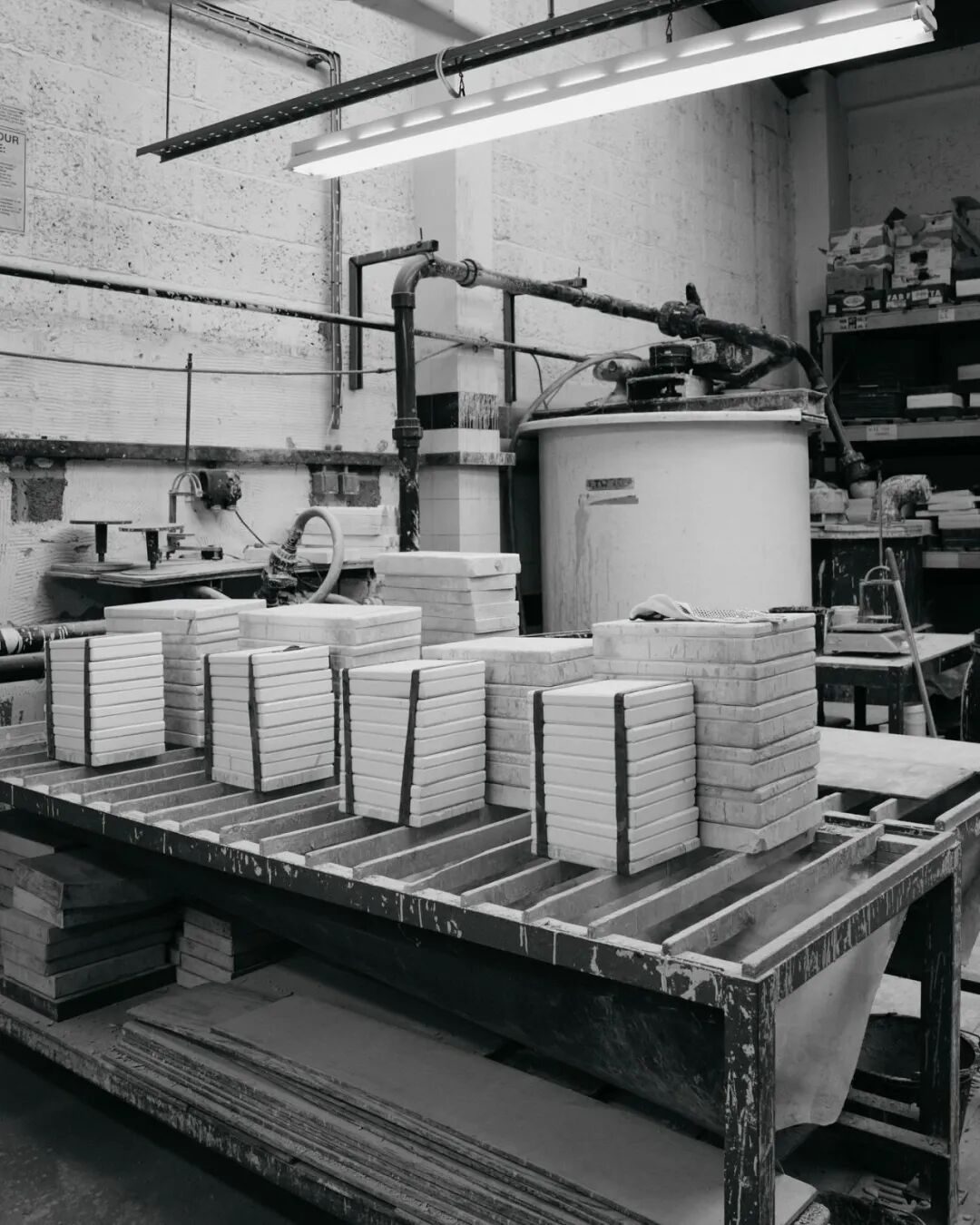
Fired porcelain is smaller than the wet clay it was made from, because chemically bound water and organic material leave the body during firing. High-temperature porcelain bodies typically shrink 12–18% linearly from wet clay to fired state, and Jingdezhen porcelain bodies usually sit at the higher end of that range. A 300 mm wet form commonly finishes near 250–264 mm.
The practical consequence is that a prototype’s dimensions cannot be used as the edition’s dimensions. Shrinkage has to be measured on the actual body, in the actual kiln, in the actual firing cycle, because it changes with the kaolin-to-porcelain-stone ratio, with forming method, and with firing temperature. Slip-cast and press-moulded parts drawn from the same body can differ by one to two percentage points. When an edition is specified in finished millimetres, that measurement is the first deliverable, not the last.
Why do flat and thin forms deform in the firing?
Porcelain softens enough to move under its own weight at peak temperature. The risk climbs sharply on flat forms wider than roughly 300 mm with walls under 5 mm, and on tall forms with uneven mass distribution. Warping is a function of geometry and kiln support, not of the artist’s skill.
Three controls reduce it. First, fire flat pieces on a refractory sett or a bed of alumina powder so the base is supported across its whole area rather than at three points. Second, orient the piece so the heaviest section is not cantilevered. Third, slow the cooling curve through the 600–700 °C range, where quartz inversion makes thin sections move fastest. A form that warps in one studio’s kiln may fire flat in another, which is why warping advice transferred between workshops without the kiln data behind it is unreliable.
Why can’t a rigid plaster mould reproduce an undercut?
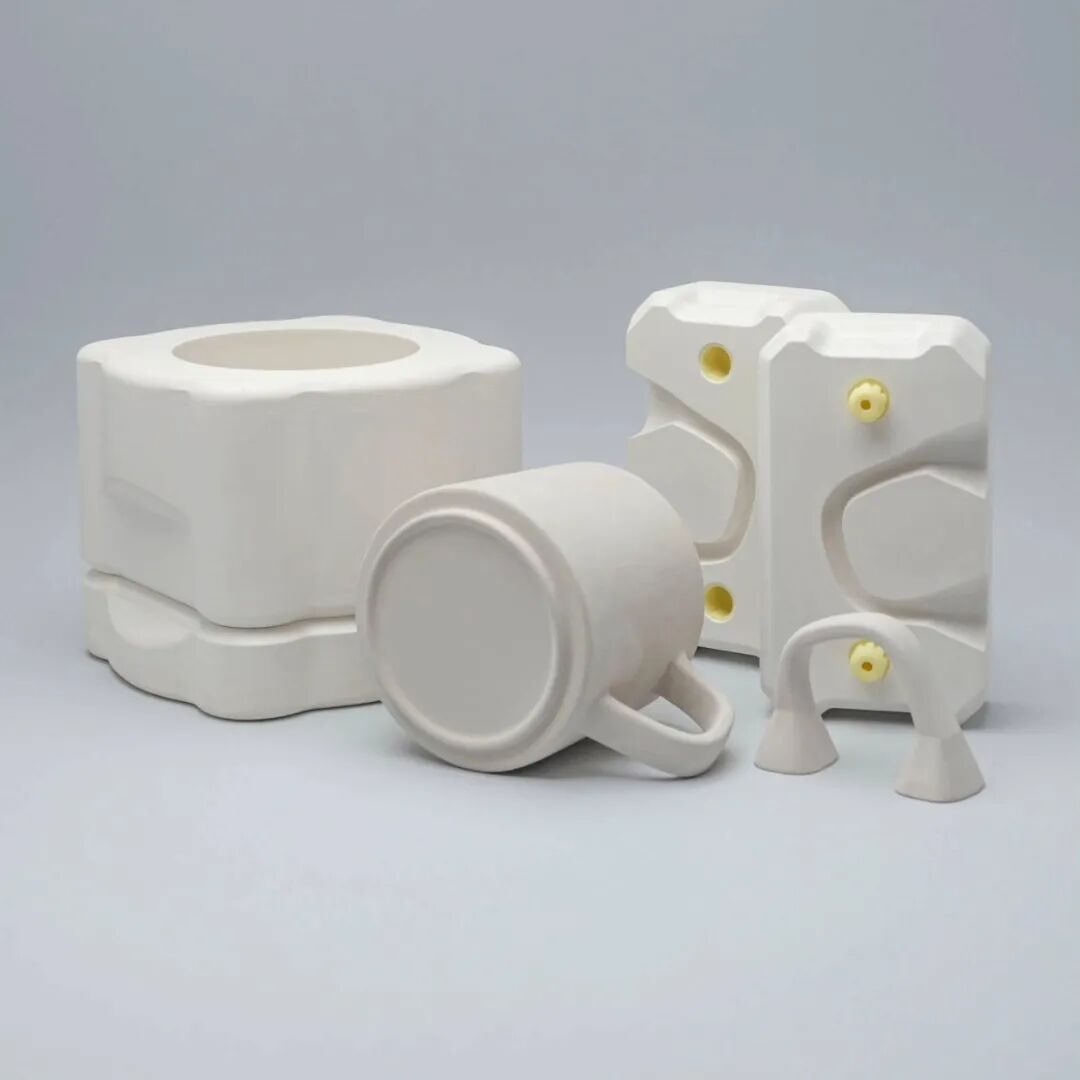
A rigid plaster mould releases only along one direction. Any undercut — a lip that overhangs, a hollow that re-enters, a handle that curls back toward the body — locks the casting in the mould, and forcing it out tears the greenware. This is a geometry constraint, not a skill constraint.
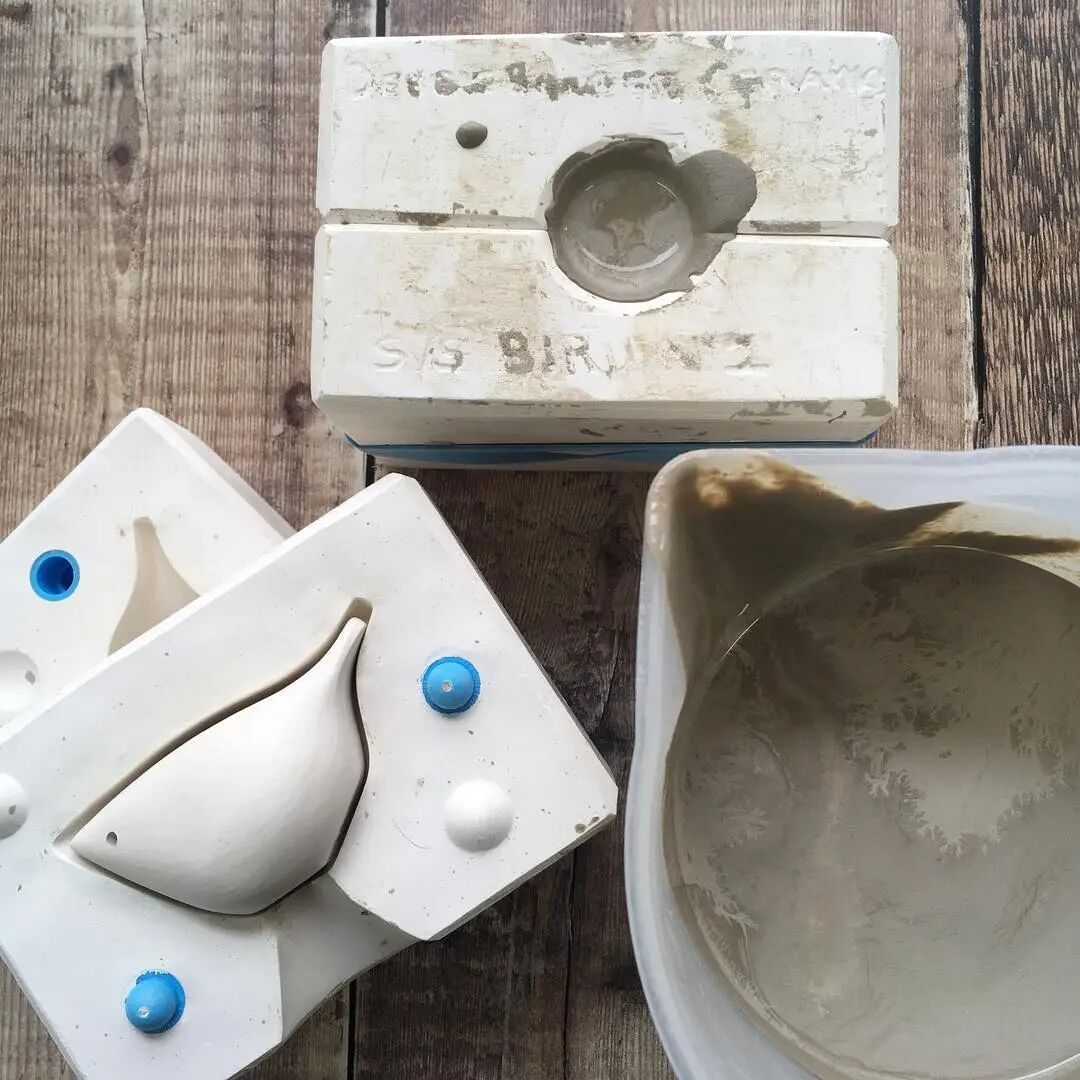
Undercuts are solved in mould design rather than in casting. Common answers are a two- to four-part mould with a defined parting line, a flexible master with a plaster case, or casting the form hollow in sections and joining them in the leather-hard state. Each carries a cost that belongs in the quote: multi-part moulds cost more to develop, and joined sections introduce a seam that must be dressed by hand and a joint that can reopen in the glaze firing if the two parts shrank differently.
Why does wall thickness decide whether a casting survives?
Slip casting builds wall thickness by leaving liquid clay against the mould surface for a set dwell time. Walls of 3–6 mm are the practical working range for porcelain tableware and sculptural shells: thin enough to dry evenly, thick enough to survive handling and glaze. Below about 3 mm, handling loss and warping rise; above roughly 12 mm of solid section, the outside dries and shrinks before the core does, and the piece cracks from differential stress.
The failure is usually local, not global. A form with a 4 mm wall and one 15 mm foot ring cracks at the foot ring. Thickness maps drawn from the 3D file before mould making turn this from a trial-and-error problem into a design change made on screen.
Why does glaze craze, flake, or crawl on a finished piece?
Glaze and body expand and contract at different rates as they cool. If the glaze contracts more than the body, it is held in tension and crazes into a fine network. If it contracts less, it goes into compression and can shiver or flake off at edges. Fit is a materials property, tested on the actual body, not a visual judgement.
Crazing that appears weeks after firing is the more damaging case commercially, because the piece leaves the studio intact and fails in the collector’s hands. Crawling — where glaze pulls away and exposes bare body — is usually a surface-preparation or application-thickness problem, and it appears most often where the glaze was sprayed over dust or over a carved edge. Both are reasons a new body-glaze pairing is tested on tiles and on a small pilot batch before a full edition is committed.
Why does the same glaze fire differently between batches?
Firing is a chemical process with several variables that drift. In reduction firing at 1300–1350 °C, the point at which reduction begins, the gas-to-air ratio, and the position of the piece in the kiln all change the result. Copper reds are the extreme case: the same recipe can produce deep oxblood, a muddy grey, or nothing at all within one firing. Cobalt blues are far more stable.
Overglaze enamels — famille rose, falangcai-style work, gold — are applied and fired again at roughly 700–800 °C, which adds a second source of variation and, with gold, a second source of wear risk. For editions, the consequence is that colour cannot be guaranteed to a Pantone reference. It can be controlled to a signed master sample, kept in the studio and matched by eye at inspection, which is the standard the trade actually works to.
Why do later pieces in an edition differ from the first?
Plaster moulds wear. Each cast draws moisture and fine detail out of the mould face, so a working mould stops producing identical pieces long before it stops producing pieces at all: on a detail-critical form, edges soften and cavity dimensions drift within tens of casts. An edition of 50 run on a single mould is therefore working past the point where its pieces still match, and an edition of 100 needs at least two moulds, made from the same master but not dimensionally identical.
This is the failure most often missed at planning, because it shows up as inconsistency across a run rather than as a reject. The arithmetic behind it — how many identical casts a mould can honestly carry, how many moulds an edition therefore needs, and how to measure the drift before it spoils a set — is worked through in plaster mould life and edition size. The controls here are to make moulds in matched sets, number castings to their mould, keep the master in stable conditions, and agree in writing what dimensional tolerance defines “the same edition” — a tolerance that has to be wider than most artists expect when every piece is hand-finished.
How can an artist de-risk an edition before committing?
Test the four variables that cannot be fixed later: measured shrinkage on the real body, a thickness map of the 3D file, a mould design that resolves every undercut, and a body-glaze fit test. Then agree three numbers in writing: edition size against mould life, dimensional tolerance for hand-finished pieces, and an acceptable loss rate for the firing.
Everything else is manageable during production. These four are decisions, and once a mould is cut and a kiln run is scheduled, reversing them costs a new mould and a new pilot batch. Studios that quote before these are settled tend to quote twice. For the full sequence from file review to final inspection, see the production process; to discuss a specific form, see custom ceramic sculpture and small-batch production, and for editions made for galleries rather than for retail, gallery-grade art fabrication. The casting stage itself, from master to finished piece, is set out in the slip casting workflow.
FAQ
Can a ceramic edition be produced from a 3D file?
Yes. STL, OBJ, and STEP files are used to plan mould parting lines, check wall thickness, and predict undercut problems before a master is made. A file suitable for printing is not automatically suitable for mould making: the model needs walls of at least 3 mm, resolved parting lines, and no trapped volumes.
What is the smallest edition a studio will normally accept?
Small editions are viable in Jingdezhen because production is organised around specialist workshops rather than assembly lines. Edition size is limited less by tooling than by mould life and by how much hand finishing each piece needs. The practical floor differs by studio and by form complexity.
Why is the second casting slightly larger than the first?
Plaster moulds absorb water and lose surface detail as they are used, so cavity dimensions drift across a run. Numbering castings to their mould, and replacing moulds at a defined cast count, keeps that drift inside an agreed tolerance.
Does a fired porcelain piece always shrink by the same percentage?
No. Shrinkage depends on the body recipe, forming method, and firing cycle. The same studio can see a one to two percentage point difference between slip-cast and press-moulded parts of the same body. Shrinkage is measured per body and per process, never assumed from a general figure.
Limits of this guidance
The figures above are normal working ranges for high-temperature porcelain as produced in Jingdezhen workshops, not guarantees for a specific body or kiln. Shrinkage, warping thresholds, mould life, and firing loss all move with the clay recipe, kiln type, firing schedule, and the geometry of the individual form. Any edition should be planned against measurements taken on the actual body and the actual kiln, which is why a prototype and a pilot batch precede a production run.