
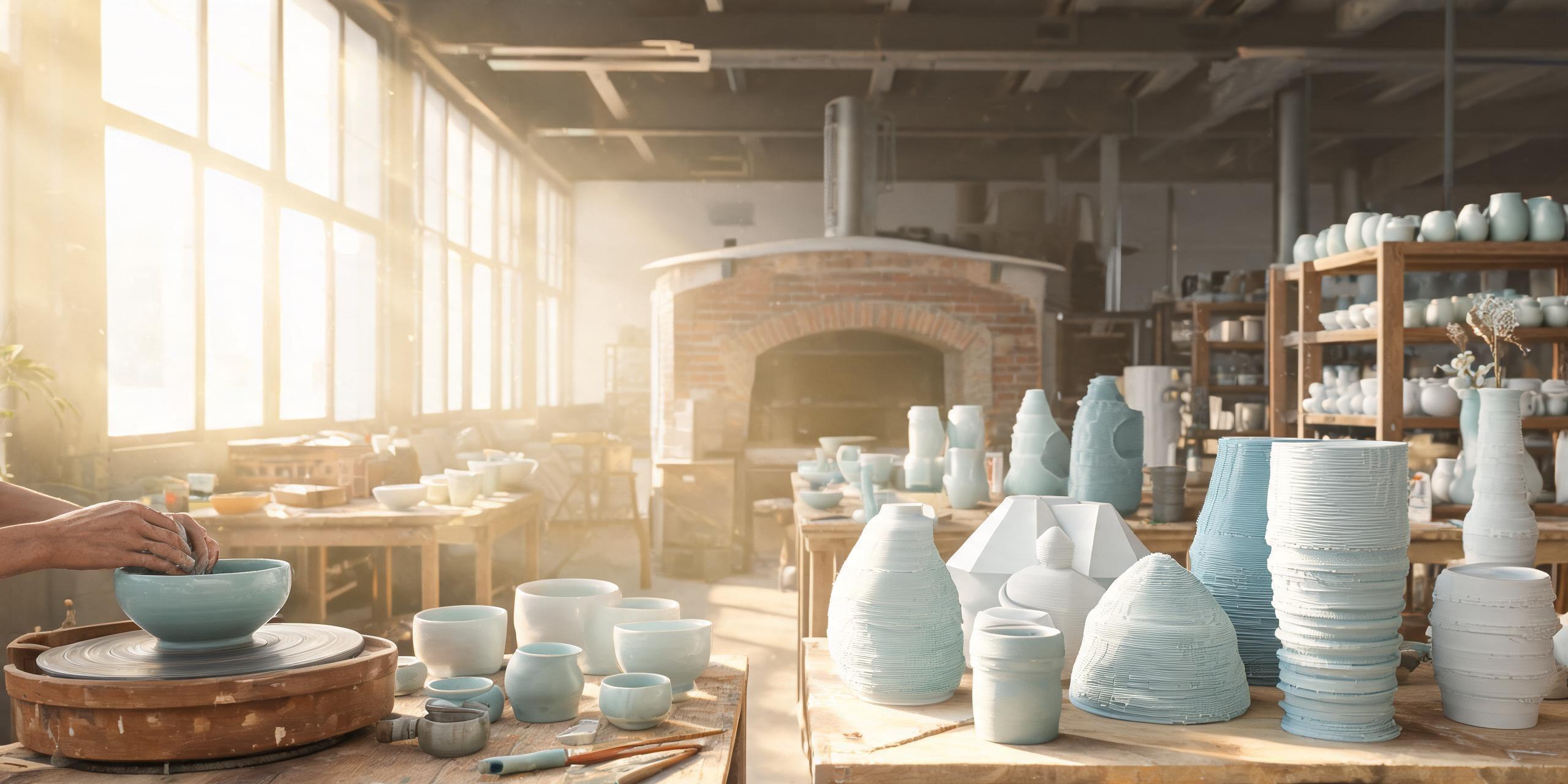
For artists, makers and creative studios, Jingdezhen is not only a shopping destination. It is a fabrication ecosystem where traditional workshops, 3D printing labs and environmental philosophy sit side by side, offering every maker a path from concept to object.
Why come to Jingdezhen for ceramic fabrication?
A generation ago, Jingdezhen was synonymous with fine porcelain: imperial wares, antique shapes and hand-painted underglaze blue. The city still makes all of those, but what draws artists today is a less advertised fact. Jingdezhen supports the full making chain under one roof. A sculptor can design a form on a tablet, have the body 3D printed by a workshop next door, source a custom glaze from a kiln master two lanes over, and test a fired colour batch within three days. The density of specialist workshops is what matters. You do not need a single large factory. You need ten small specialists within a twenty-minute walk, which is exactly what Jingdezhen has become.
Three fabrication routes artists use today
Jingdezhen offers more than one path from sketch to object. Most professional makers now work across three overlapping approaches, choosing whichever route suits the piece rather than committing to a single tradition.
| Route | Best for | Workshops to look for |
|---|---|---|
| Hand forming: throwing, coiling, pinching | One-off sculptural pieces, vessels with hand texture | Old Town kilns, Tao Xichuan back alleys, workshop collectives |
| 3D printing + CNC milling | Complex curved forms, repeatable sculptural components | 3D print studios in Tao Xichuan, design-school spin-offs |
| Slip casting + traditional moulds | Short runs and commercial product ranges | Commercial mould makers in Changjiang District |
None of these is more “authentic” than the others. An artist might sculpt a face by hand, have it scanned and 3D printed at scale for a commission, then use slip casting for the reproduction series. That hybridity is the normal way of making here now.
Traditional decoration as a contemporary tool
Two decorative traditions keep appearing in contemporary Jingdezhen work, adapted for a younger audience. Guocai, or polychrome overglaze enamel, was developed in the late Qing dynasty and reached its peak under the Qianlong emperor. The glaze is applied after the body has been bisque-fired, then fired again at a lower temperature of roughly 700 degrees Celsius. That lower opening means more colour can survive, and the artist can layer freely. What a traditional studio might call “fragile and old-fashioned,” a young maker calls “exactly what I want for a scented lamp or an incense holder.” The low fire also works beautifully for functional lighting pieces, where the translucent glaze lets a tea candle glow through the body. The scented lamps sold in Tao Xichuan at night are often guocai-finished: the body is handmade, the guocai layers are painted by a specialist, and the candle heat diffuses through the glazed shell.
Another route is the rubbing or pressing technique, which is exactly the opposite of painting. Instead of a brush, the studio uses a small stippling tool or a stamp to build up the pattern dot by dot. The result is an all-over texture with a different rhythm from brushed line work. It is slow, meditative and ideal for relief surfaces where the texture itself is what matters.
Recycled ceramic: a fast-growing fabrication route
Jingdezhen generates a great deal of broken porcelain every year. Conventional factories reject pieces with the smallest flaw: a tiny air bubble, a millimetre of glaze deviation, a warped foot ring. Until recently those were broken up and discarded. A new generation of studios now collects the fragments, grinds them into mixed body clay, and fires new pieces where the original fragments show through as coloured specks in the wall. The resulting mugs, bowls and planters carry the history of the broken pieces inside them. For an artist, recycled ceramic offers two advantages. The material is cheaper than virgin white kaolin, and the speckled inclusions give every piece a natural, irregular pattern that cannot be reproduced. The fabrication process is straightforward: collect fragments, break them to roughly five-millimetre chips, mix into a 10 to 20 per cent ratio with new slip, and cast or throw as normal. The recycled pieces fire at the same high temperature and can take the same glazes.
3D printing ceramic in Jingdezhen: what it actually solves
3D ceramic printing arrived in Jingdezhen in the last five years and has become a reliable fabrication tool for sculptors and designers. The workshop stacks high-white kaolin clay in thin coils, layer by layer, to build a form. A friction glaze is usually applied before firing, which smooths the stepped surface. Pieces typically fire at 1240 degrees Celsius, right in the middle of Jingdezhen’s standard stoneware range. The method solves two very old problems that hand forming cannot. It reproduces complex, deep-curved surfaces without the risk of cracking during drying, and it lets a designer scale a one-off sculpture into a commissionable range without hand-wasting time on a mould. The key constraint is the layer height. Most Jingdezhen printers currently work at 0.5 to 1 millimetre per layer, which produces a visible stepped texture that some makers accept as a visual feature and others sand smooth.
The fabrication loop: what a visitor can commission today
Tao Xichuan, once the site of the Yuzhou Porcelain Factory, is now the main creative district. The old kiln chimneys remain, surrounded by red-brick warehouses converted into galleries, studios and weekend markets. The district is where you will find the three fabrication routes operating side by side: hand makers in the back alleys, 3D print studios on the main strip, and recycled ceramic pop-ups at the weekend market. On a single day, a client might brief a sculptor on a memorial vessel, visit a 3D print studio for a form study, discuss glaze firing with a kiln master, and collect a slip-cast sample from a mould maker. That density is what makes Jingdezhen different from any other ceramic city.
Those same workshops accept international commissions. Tell us what you want to make, and we will put you in touch with the right route. Whether your project needs bespoke ceramic sculpture, a run of vessels, or a one-off artwork, the workflow starts the same way: a brief, a reference, and a sample. For larger pieces, the team at Jingdezhen Heritage also advises on kiln temperature and body recipe and on how technology and tradition can sit in the same piece.
If you are researching ceramic fabrication for artists, also read our guide to the evolution of Chinese ceramic art, which explains how each of the three routes above emerged historically.
Frequently Asked Questions
How much does it cost to commission fabrication in Jingdezhen?
Prices vary enormously. A simple throw-and-fire workshop visit starts at a few hundred yuan. A 3D-printed sculptural commission for a single piece is a few thousand yuan. A small commercial run of slip-cast vessels begins at around fifty pieces. Always ask for a sample first.
What is the typical turnaround time?
A single hand-formed piece usually takes two to three weeks. A 3D-printed prototype can be ready in three to five days. A production run of slip-cast vessels takes around four weeks, plus two more for glazing and firing.
Can I mix traditional and modern fabrication methods?
Yes, and many Jingdezhen artists do. A hand-shaped sculpture might be scanned and 3D printed for commission, then painted with traditional guocai or famille rose enamel.
Do you need to travel to Jingdezhen to commission?
No. Jingdezhen Heritage works with artists and clients worldwide. Share your drawings or references and we will coordinate the fabrication route for you from our base in Jiangxi.
Commission ceramic fabrication with Jingdezhen Heritage
Jingdezhen Heritage is a porcelain studio in Jingdezhen, Jiangxi, China. We work with artists, designers and private clients on sculpture, vessels, murals and one-off artworks using any of the three fabrication routes described above. Share your brief and we will advise on the most suitable route and give you a sample plan: start a ceramic commission with our studio.
Email service@jingdezhenheritage.com or message us on WhatsApp at Contact on WhatsApp.
Published 4 November 2026 by Jingdezhen Heritage, a porcelain studio in Jingdezhen, Jiangxi, China.