Two sculptors working in Jingdezhen stand at opposite ends of the same argument about Chinese ceramic sculpture. One reaches back to the Song dynasty for his glazes and forward to the present for his subject; the other starts from industrial design and arrives at clay. Between them they map the two routes that tradition and innovation actually take in contemporary Chinese ceramic art.
This article looks at the work of Yao Yongkang and Wu Haoyu in detail u2014 what each makes, how each handles material, and what a collector or client should look for in work that descends from this lineage. For the wider picture of how the field developed, where it stands now and where it is going, read our companion piece on the wider state of modern ceramic art in China.
Two Routes Through Chinese Ceramic Sculpture
The argument is old and simple. If clay is a medium of contemporary art, where should the artist stand: inside the kiln tradition, drawing on its glazes, its firing intelligence and its imagery, or outside it, treating clay as one material among many in a design-led practice? Most Chinese ceramic sculpture takes a position somewhere between the two, but the clearest work tends to commit to one end.
Yao Yongkang commits to the kiln. His forms are modern, but the glazes and motifs are inherited and understood from the inside. Wu Haoyu commits to design. He begins with a proposition about how an object should behave in a room, then works back to the material that can deliver it. Neither position is a rejection of tradition; both are ways of putting tradition back to work.
Yao Yongkang: Returning to Human Nature
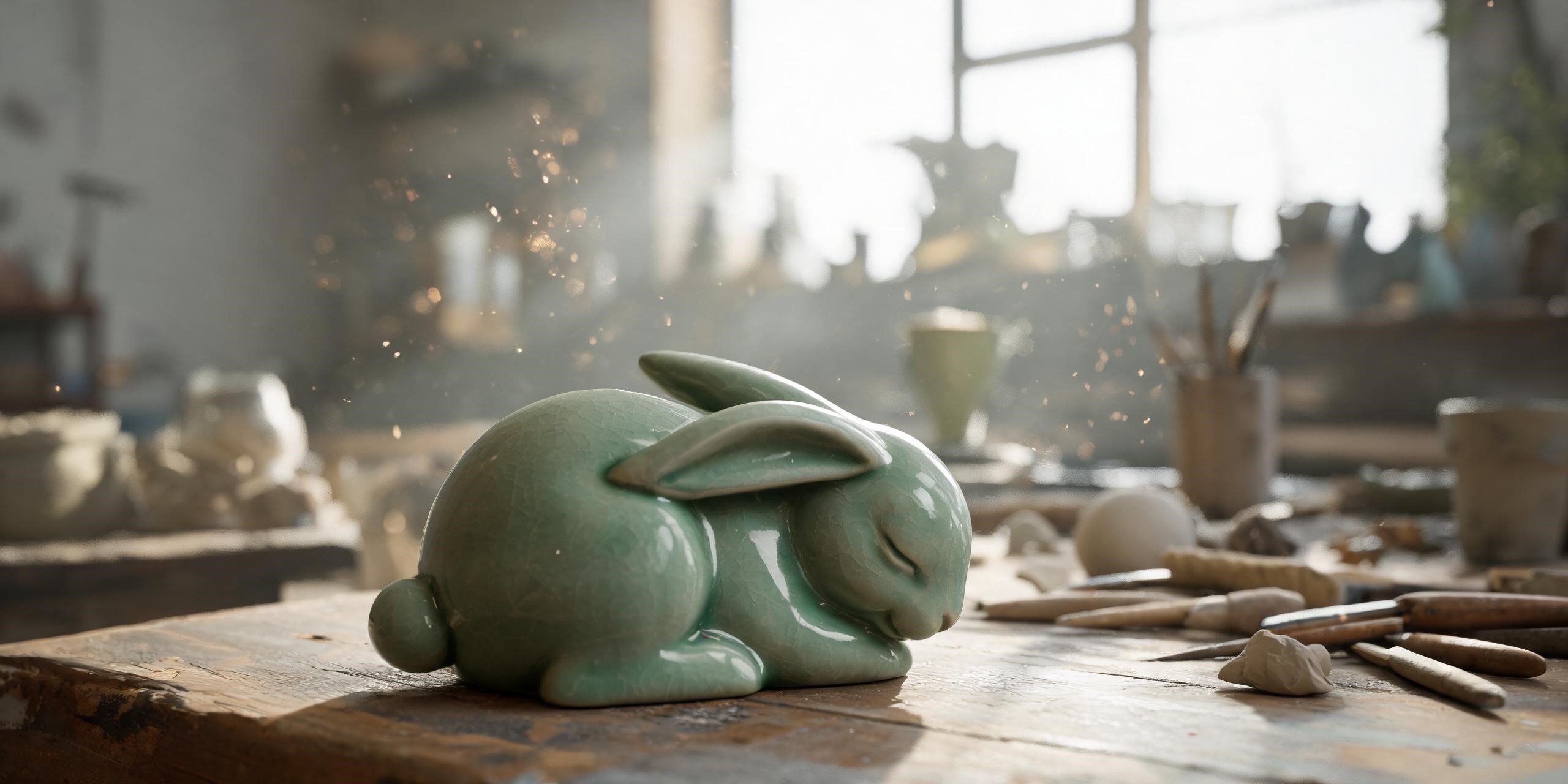
Yao Yongkang, one of China’s leading sculptors and ceramic artists, is the clearer case of the tradition-led route. His Century Child and Water series dress a contemporary sensibility in inherited imagery, and his Gazing at the Moon shows how far that method can be pushed. The subject comes from the incised infant-at-play scenes found inside Song dynasty shadow-green porcelain bowls, the qingbai ware that the Hutian kiln in Jingdezhen made in enormous quantity. The glaze answers the imagery with a plum-green celadon, the deep, soft green associated with the finest Song celadons.
Getting that green is a technical feat in itself. A celadon of this depth depends on an iron-bearing glaze fired in reduction, where the kiln atmosphere must starve the glaze of oxygen at the right moment and then hold it there. The window is narrow: too much reduction and the colour turns muddy or grey, too little and the iron stays yellow. On a sculpture with an irregular surface, every fold and hollow fires slightly differently, so a uniform plum-green across a modelled form is far harder than on a round bowl. The colour is not decoration applied at the end; it is a record of how well the firing was controlled.
The rabbit in Gazing at the Moon u2014 long ears, short tail, curled asleep and glancing back with a startled charm u2014 carries the rest of the argument. It breaks the static limits of sculpture and starts a quiet conversation with the viewer, which is exactly what the children painted inside those Song bowls were doing a thousand years earlier.
Yao’s working motto explains the method: return to the original nature of human beings and of nature itself, cast off technique, drop your worries, keep a calm mind, and when inspiration strikes, take the clay and shape it in one breath. It is a philosophy of freedom in which traditional culture and contemporary spirit dissolve into a single gesture, and it is why his work never reads as quotation.
| Work | Source of imagery | Glaze and firing |
|---|---|---|
| Gazing at the Moon | Infant-at-play scenes incised inside Song qingbai bowls | Plum-green celadon, reduction fired |
| Century Child | Contemporary childhood, traditional figure modelling | High-fired porcelain, modelled and carved |
| Water | Movement and flow as sculptural subject | Celadon family, surface led by form |
Wu Haoyu: Making and Using, Together
Wu Haoyu, associate professor at the Academy of Arts and Design of Tsinghua University, works from the opposite direction. His series Neolithic, Encounter and Break | Stand combine the natural forms of raw material with deliberate artistic reconstruction. The clay is not asked to imitate a historical object; it is asked to hold an idea about how a person and an object meet.
His two principles do the heavy lifting. Form follows the idea, and shape follows use. The first is a designer’s discipline: the silhouette must answer to a proposition, not to a stylistic habit. The second refuses the old split between art and utility, insisting that a designed object should live in everyday life rather than behind glass. In practice this means his work often sits at the boundary of sculpture and vessel, closer to the table than a gallery plinth but never merely functional.
For a collector, the useful consequence is that Wu’s pieces can be handled. They are made to be lived with, and the passage of use u2014 pouring, holding, washing u2014 is part of the design rather than a compromise of it. That is a very different ambition from Yao’s, and the fact that both are counted as Chinese ceramic sculpture is the best evidence that the field is broader than any single definition of it.
| Yao Yongkang | Wu Haoyu | |
|---|---|---|
| Starting point | The kiln and its inherited glazes | A proposition about use and behaviour |
| Material strategy | Glaze as content; firing as expression | Form as argument; material as solution |
| Relation to use | Sculptural, contemplative, viewed | Designed to be handled and lived with |
| Tradition used as | A lineage to work from inside | A reservoir of form to be re-solved |
What the Two Artists Share
Different as they are, both treat the material as the centre of the work rather than as a support for an image. Neither uses clay to reproduce a painting or a design drawing. Both accept that the kiln has its own say: in Yao’s case through reduction and glaze depth, in Wu’s through the deformation and surface that high-temperature firing imposes on a designed profile.
Both also share an idea that runs through Chinese art more broadly u2014 dao, the underlying way of things. For Yao it appears as a refusal to force the material; for Wu as a refusal to force the object’s behaviour. In each case the artist sets the conditions and then lets the material complete the sentence. This is the quiet strength of the Chinese scene: fire is not merely a tool for hardening clay but an aesthetic force in its own right, and kiln accidents such as flame marks, smoke stains and glaze runs are read as part of the work rather than as faults.
The innate character of the material is brought forward in the same spirit. Texture, weight, porosity and shrinkage become expressive vocabulary rather than technical constraints to be hidden. In the hands of the best makers in Jingdezhen, a modern ceramic sculpture carries the accumulated intelligence of a thousand years of kiln practice even when its form looks nothing like a Ming vase.
How to Read Work in This Lineage
Because both routes borrow from tradition, both can be faked. The difference between a genuine descendant and a pastiche is usually visible in five places, and none of them requires expertise in glaze chemistry to check.
| What to check | Genuine | Pastiche |
|---|---|---|
| Glaze | Depth varies with form; colour reads as fired, not painted | Flat, even tone; surface looks sprayed on |
| Form | Silhouette answers to the idea, not to a known shape | Copies a recognised antique profile |
| Surface evidence | Modelling marks, seams and kiln effects left visible | Smoothed until all making evidence disappears |
| Motif | Imagery integrated into the sculptural argument | Symbols added as decoration on top |
| Use | A clear position, either sculptural or designed for living | Neither use nor conviction; an object for a shelf |
The last row is the one collectors most often miss. Work that has no position on use tends to have no position on anything, and it is usually the work that looks most like a photograph of tradition rather than a continuation of it. The best defence against pastiche is the same one that applies across the field: ask what the object is for, and whether the answer could have been arrived at without any knowledge of clay at all.
For clients, this is also the practical reason to commission rather than buy off a shelf. A Jingdezhen studio that works in this lineage can deliver a sculptural piece that is unmistakably contemporary and unmistakably Chinese at once: the glaze comes from a lineage refined over centuries, and the form answers to the present. When clients commission a custom ceramic sculpture, they are not copying the past but continuing it, and the conversation about glaze, form and use is where that continuation actually happens.
Frequently Asked Questions
What is Yao Yongkang best known for?
Sculptural series such as Century Child and Water, and for Gazing at the Moon, which takes the infant-at-play imagery of Song qingbai bowls and reworks it in a plum-green celadon. His work is admired for using inherited glazes and motifs as living material rather than as quotation.
What does Wu Haoyu mean by shape follows use?
That an object’s form should be accountable to how it is actually handled and lived with, not to a stylistic convention. Combined with his other principle, form follows the idea, it refuses the split between sculpture and everyday design.
How can you tell tradition-led ceramic sculpture from pastiche?
Look at the glaze depth, the silhouette, the surface evidence and the motif. In genuine work the glaze varies with the form and the imagery is part of the sculptural argument. In pastiche the tone is flat, the profile copies a known antique, and symbols sit on the surface as decoration.
Why commission work in this lineage rather than buy a reproduction?
Because a commission is a conversation about glaze, form and use, and the result answers to a client’s space and purpose. A reproduction answers only to the original, which is why it carries no position on how it should be lived with.
Related Reading
For how the field as a whole developed, read Modern Ceramic Art in China: Hybridity and the Social Turn. For a method of looking at this work, see How to Read Modern Ceramic Art. For the kiln tradition these artists inherit, see Song Ceramics and the Five Great Wares.
We make high-fired Jingdezhen porcelain to order, from vessels to large sculptural work. Browse the collection, see our custom ceramic sculpture commissions, or email us. We also answer questions on WhatsApp.
Published 31 October 2026 by Jingdezhen Heritage, a porcelain studio in Jingdezhen, Jiangxi, China.