
No. A Yongzheng mark on porcelain does not, by itself, establish that the object was made during the Yongzheng reign, 1723–1735. The inscription needs to be considered alongside the whole object and its documented history. Later works can carry marks referring to earlier reigns.
This matters when reading a product title, museum record or auction catalogue. A description of the mark and an attribution of the object’s date are two separate statements.
What is a reign mark?
A reign mark is an inscription referring to an emperor’s reign. A common six-character Yongzheng formula is 大清雍正年製, conventionally translated as “Made in the Yongzheng reign of the Great Qing.” Marks vary in script, layout and method of application.
Translating that wording explains what the inscription says. It does not independently confirm when the vessel was made. Christie’s collecting guide discusses both reign-mark formats and later use of earlier marks. Read the specialist guide.
Three descriptions with different meanings
“Bearing a Yongzheng mark” describes an inscription. It needs a separate dating statement.
“Yongzheng mark and period” is an attribution that both the mark and the object belong to that reign. It carries a much stronger claim than simply noting the presence of a mark.
“Yongzheng-style” identifies a design reference. It can describe a later or contemporary work drawing on historical forms or decoration. A clear listing should still state the actual known production date or range.
Why does an earlier reign name appear on later porcelain?
Later makers have reused earlier reign marks in different circumstances. Catalogues may call such a mark apocryphal: it refers to a reign other than the object’s attributed production period. The term describes a dating relationship; it does not establish the intention of a particular maker.
For a buyer, the useful question is whether the seller clearly states the object’s production period and the evidence supporting it. A historical-looking mark should be explained rather than allowed to stand in for that information.
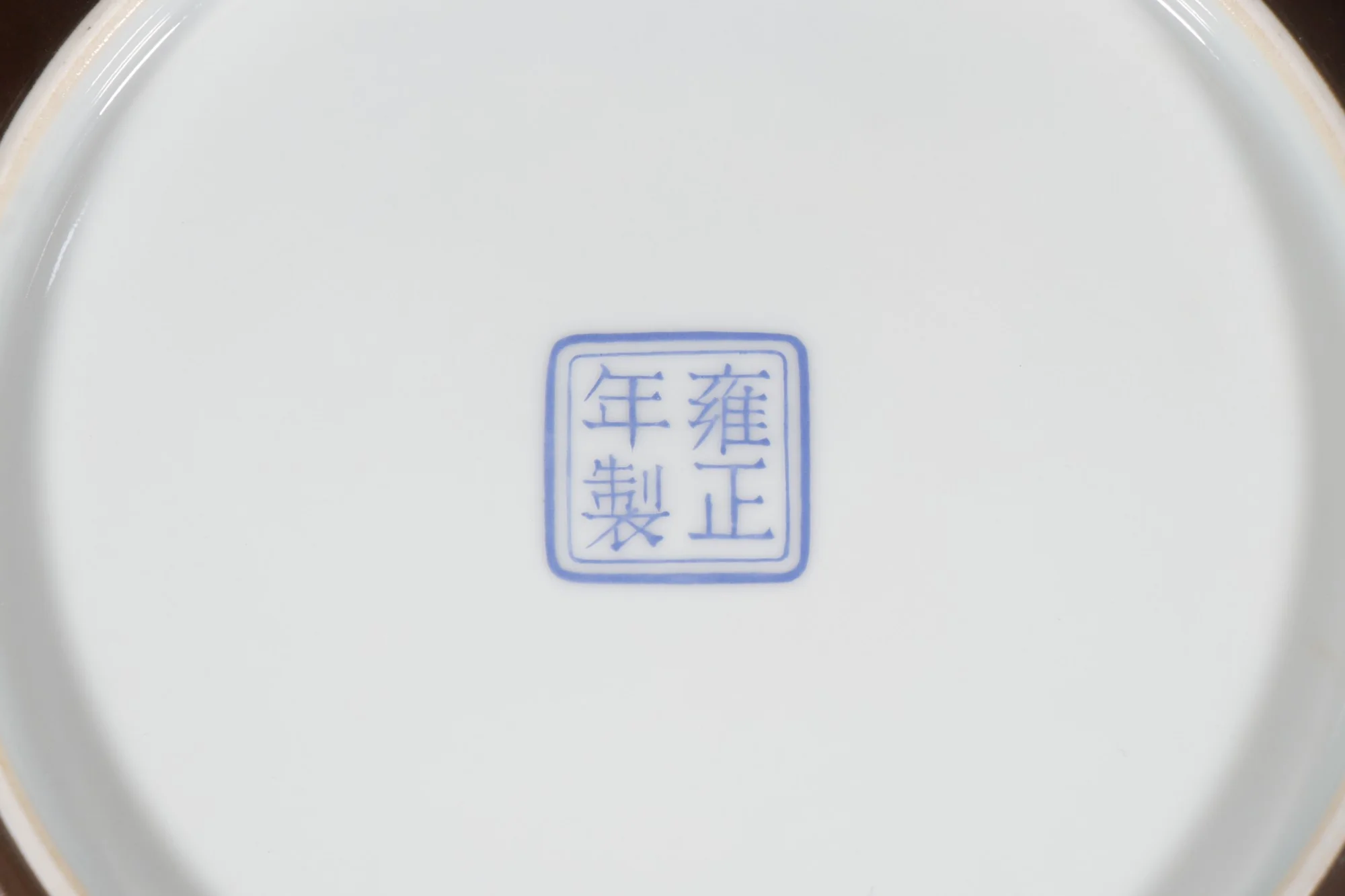
A modern example from Jingdezhen Heritage
CQSP-027 is listed as a Yongzheng-style dragon and hundred-flowers teapot stand made in a family craft workshop, with a stated production range of 1949–present. The underside bears a blue seal-style mark, confirmed by the workshop as 乾隆年制 (Qianlong nian zhi), conventionally translated as “Made in the Qianlong reign.” This is a four-character Qianlong reference, even though the product is described as Yongzheng-style.
This example separates three facts: the design is described as Yongzheng-style, the mark reads “Qianlong nian zhi,” and the stated production range is 1949–present. The mark is recorded as an inscription, rather than treated as proof of age. The modern production statement remains the dating information for this work. Neither the title’s historical style reference nor the photographed mark changes it into an eighteenth-century antique. The broad range 1949–present should also not be mistaken for a precise year of manufacture.
Can a style name differ from the reign named on the base?
Yes. A style description records a design reference; a transcription records the characters on the object. They need not name the same reign. In a transparent modern listing, both can be stated alongside the actual known production period. Neither wording should be silently changed to make the two appear to match.
What evidence is useful when assessing a piece?
Keep full photographs of the front, profile, underside and foot, as well as a sharp close-up of the mark. Preserve invoices, maker’s records, previous catalogues and other provenance documents. A specialist can consider construction, glaze, decoration, condition and the mark together.
For modern workshop porcelain, a record of the maker, production period, materials, dimensions and product number is especially helpful. Jingdezhen Heritage’s product certificate records the described work and its workshop source; it should not be read as an independent antique-authentication report.
Frequently asked questions
Can I date porcelain using only a photograph of the mark?
A mark photograph may help with reading an inscription, but it is insufficient for a secure date or authentication of the entire object.
Does a later reign mark make a piece worthless?
No. A modern object can be appreciated for its design and workmanship. Its description and price should be assessed on its actual identity and condition.
Does handmade mean antique?
No. Handmade describes a method of production. Contemporary makers continue to form and decorate porcelain by hand.
Ask about a particular work
For the stated production period, underside photographs or certificate information for a Jingdezhen Heritage piece, contact us by email or WhatsApp. Please include its product number.
Sources and further reading
- Christie’s: A guide to reign marks on Chinese ceramics — mark formats and the need to assess marks in context.
- Jingdezhen Heritage: CQSP-027 — the modern work and workshop information used in this article.