The hundred flowers pattern is a dense floral composition in which blossoms and foliage cover a decorated area with little visible background. In Chinese descriptions, baihua bu ludi (百花不落地) conveys the idea of flowers filling the ground. Related ceramic designs are often described in English as millefleurs, or “thousand flowers.”
These names describe an abundant visual effect. They do not require a literal count of one hundred or one thousand flowers, and the pattern alone does not establish a porcelain object’s age.
How to recognise the composition
Start at one large blossom and follow the surrounding shapes. Petals overlap leaves, smaller flowers fill the spaces between larger blooms, and different colours help separate neighbouring forms. The eye moves across the surface rather than resting on a single isolated spray.
A border may still have its own ground colour or open areas. “Without exposed ground” usually describes the main floral field; it should not be read as a rule that every part of a vessel must be covered.
Historical examples across different periods
The Cleveland Museum of Art holds a bottle-shaped vase dated to the Jiaqing reign, 1796–1820, with a continuous millefleurs composition. The museum identifies a range of flowers and describes the dense design as part of the Qing ceramic tradition. Explore the Cleveland example.
The Metropolitan Museum of Art records a Jingdezhen vase with millefleurs decoration dated to the 1920s–1940s. These two documented objects demonstrate why the same broad decorative vocabulary cannot be used as a date on its own. Explore the Met example.
Pattern and painting technique describe different things
“Hundred flowers” describes the arrangement of the imagery. “Famille rose” describes an enamel palette. A porcelain work can combine both, but the presence of dense flowers does not by itself prove a particular recipe, production workshop or historical attribution.
When describing a piece, identify the visible composition first. Record the enamel technique only as specifically as the maker’s information or other reliable evidence allows. This keeps a useful visual description separate from claims about manufacture.
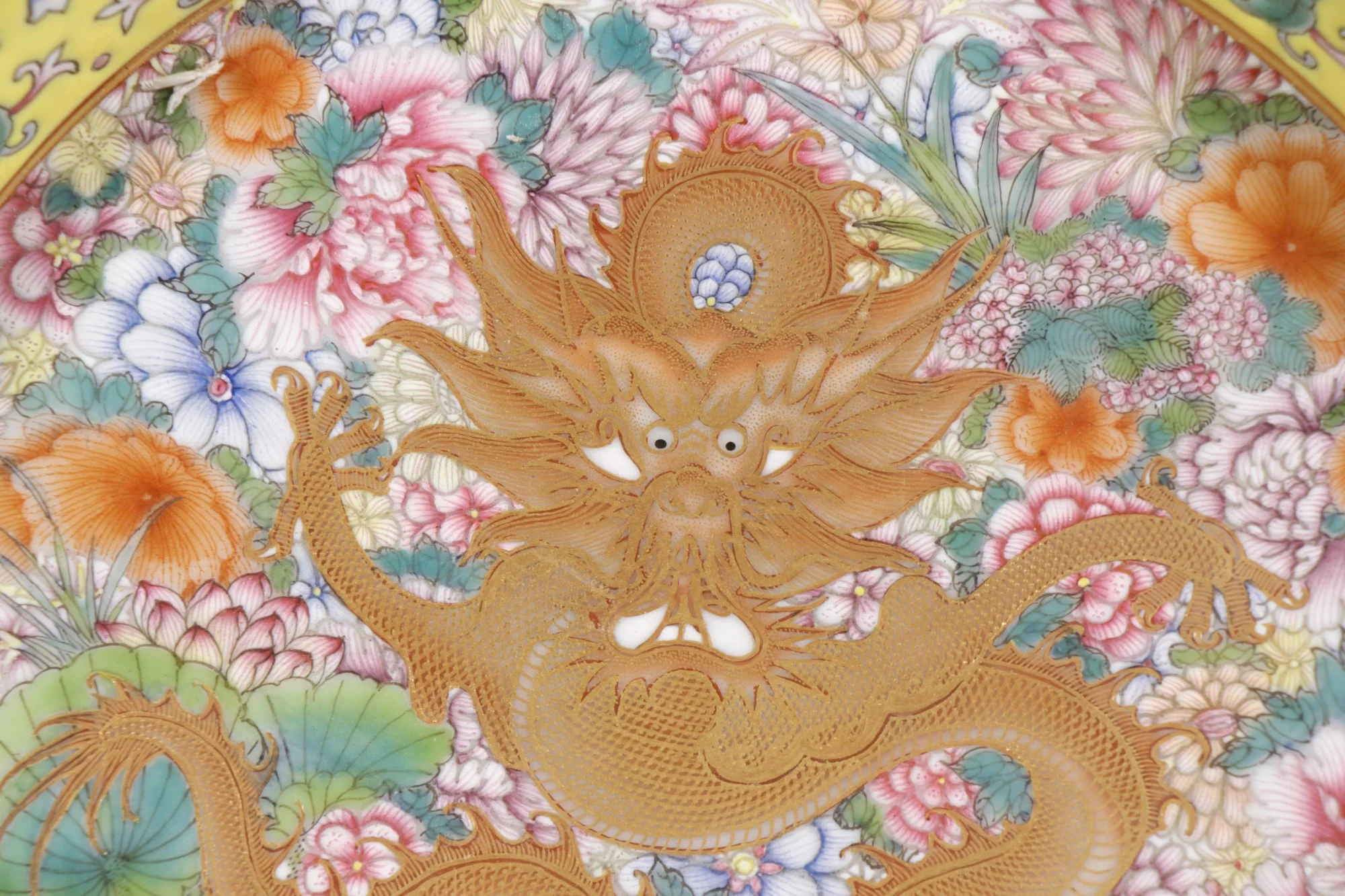
A dragon within the flowers: CQSP-027
On CQSP-027, a gilt iron-red dragon moves through the flower-filled interior of a small porcelain teapot stand. The yellow floral rim frames the central field, while the dragon provides a larger shape for the eye to follow through the overlapping blossoms.
This is a contemporary family-workshop example listed by Jingdezhen Heritage within the production range 1949–present. It measures 19.2 cm in diameter and 4.2 cm high. Its Yongzheng-style description refers to artistic inspiration, rather than a claim of manufacture during that reign.
How to appreciate a dense floral surface
First look at the entire object: does the floral field work with the rim and silhouette? Then examine a small area. Notice how neighbouring petals remain legible and how colour changes guide your eye. Finally, compare the centre with the edges, where the painter must bring the composition to a convincing finish.
A lush floral field can suggest abundance and flourishing life. More specific symbolic readings depend on the flowers actually represented and their context. A small or stylised blossom should not be assigned a botanical name or fixed meaning without sufficient visual evidence.
Frequently asked questions
Does hundred flowers mean exactly one hundred blooms?
No. In this decorative description, the number expresses multiplicity and fullness rather than an inventory of flowers.
Is every floral porcelain piece millefleurs?
No. A single branch, scattered sprays or an open floral scroll has a different arrangement. Dense coverage is the characteristic to look for.
Does this pattern prove a Yongzheng or Qianlong date?
No. Historical examples and later interpretations exist. The date needs evidence beyond the motif.
Explore related works
For the broader making sequence behind painted porcelain, read our guide to Jingdezhen’s traditional porcelain-making operations, including the preparation and firing of overglaze colours.
View the dragon and hundred-flowers teapot stand, or contact Jingdezhen Heritage for additional photographs and information about a particular work.
Sources and further reading
- Cleveland Museum of Art: Bottle-Shaped Vase, 1944.151 — Jiaqing-period floral example.
- The Metropolitan Museum of Art: Vase with millefleurs decoration, 50.145.322 — Jingdezhen example dated to the 1920s–1940s.