
Famille rose is a palette of overglaze enamels used to decorate Chinese porcelain, recognised especially for pink tones and softly shaded colour. The term describes decoration, rather than a vessel shape or a guarantee of age. It appears on historical ceramics and on porcelain made today.
For someone looking closely at a Jingdezhen plate, vase or tea accessory, understanding this distinction makes the description much more useful: the palette explains how the surface looks, while the production date tells you when the object was made.
What does famille rose mean?
The French name means “pink family.” In Chinese ceramic descriptions, fencai (粉彩) is commonly associated with this soft, shaded enamel decoration. Pink is an identifying part of the vocabulary, but a work can also contain greens, blues, yellows, purples and white.
A useful way to look at the decoration is to follow a single petal. Does its colour move gradually from a darker edge to a pale centre? Are neighbouring petals separated by careful outlines? These observations help explain the visual effect without relying on the name alone.
A palette with an eighteenth-century history
The Montreal Museum of Fine Arts describes famille rose as a technique developed in China around 1720. Its collection includes a vase made at Jingdezhen with a Yongzheng reign mark. This provides a documented historical reference for the palette, rather than a date for every later object decorated in similar colours. See the museum’s vase record.
The Metropolitan Museum of Art also catalogues an eighteenth-century Chinese plate as porcelain painted in overglaze famille rose enamels. Together, these records show how the term is used in museum descriptions. View the Met’s plate.
How is overglaze enamel decoration made?
In the general sequence, a glazed porcelain surface is fired before the overglaze decoration is applied. The decorated vessel receives a further firing at a temperature suited to the enamel system. This separates the firing of the porcelain body and glaze from the firing used to fix the enamel decoration.
The precise sequence can vary with the colours, gold decoration and workshop practice. A particular object may require more than one decorative firing. Its exact kiln temperature, enamel composition and firing count should come from the maker’s record; appearance alone cannot establish them.
Follow the process in our craft journal
Our guide to the 72 traditional porcelain-making operations places overglaze painting after the initial porcelain firing. Its overglaze section follows colour preparation, design planning, brushwork, shading and the firing that fixes the decoration. The account describes a craft tradition, rather than an identical checklist for every contemporary workshop.
For a related introduction, read The Falangcai Making Process. That article surveys several enamel traditions, and its main step-by-step demonstration follows metal-bodied cloisonné. Bending wire, filling cells and polishing the metal-enamel surface belong to that process; they should not be presented as the standard steps for painting famille rose porcelain.
What should you look for in a finished work?
Look at the relationship between line and colour. An outline gives a leaf its structure; shading gives it volume. Then step back and consider the whole surface. A dense floral design needs a different balance from a branch painted across a large area of white glaze.
Gold decoration can add another visual layer, but gold is not a requirement for calling a palette famille rose. Likewise, a floral subject alone does not establish which enamel technique was used.
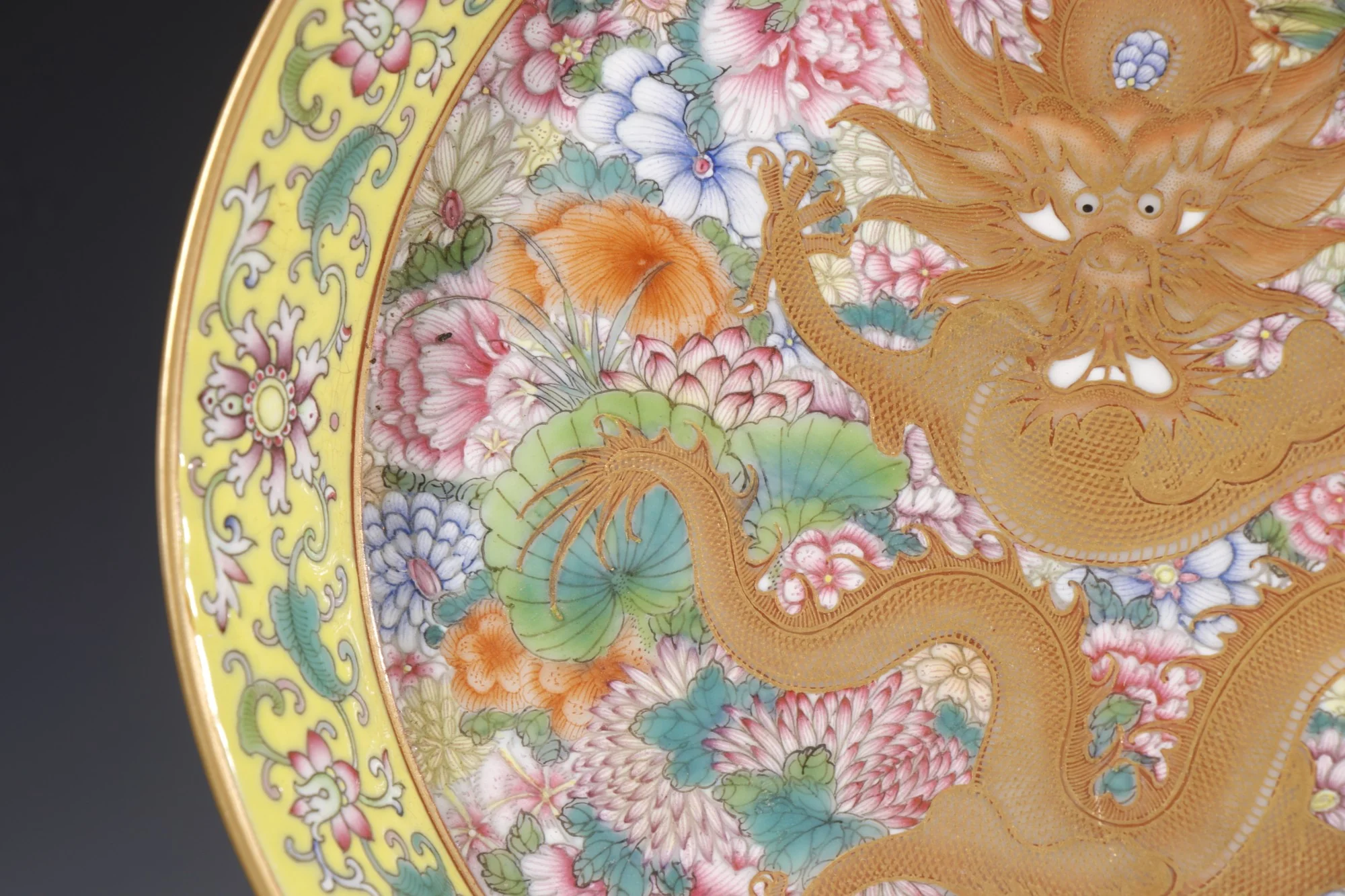
A contemporary Jingdezhen example
Jingdezhen Heritage’s CQSP-027 dragon and hundred-flowers teapot stand combines shaded floral decoration, a gilt iron-red dragon and a yellow floral rim. Its listed dimensions are 4.2 cm high and 19.2 cm in diameter, with a base diameter of 14.2 cm.
The work is documented by Jingdezhen Heritage as family-workshop production within the stated range 1949–present. “Yongzheng-style” identifies the design reference; it does not make this work an eighteenth-century object. The photographs here illustrate the contemporary piece.
Frequently asked questions
Is famille rose the same as pink glaze?
No. Famille rose describes an enamel palette and its use in decoration. A pink ground or glaze is a separate feature that should be described specifically.
Are famille rose and falangcai interchangeable?
They should not be used as automatic substitutes. These terms can carry different technical and historical meanings. A modern work needs a description grounded in its actual materials and making process.
Does famille rose mean antique?
No. The palette has a historical tradition, and it continues to be used in later and contemporary porcelain. Date, provenance and decoration should be recorded separately.
Explore Jingdezhen porcelain
For the materials, making information and availability of a particular work, contact Jingdezhen Heritage. Enquiries are welcome by email or WhatsApp.
Sources and further reading
- Montreal Museum of Fine Arts: Famille rose Vase — historical technique and collection example.
- The Metropolitan Museum of Art: Plate — historical overglaze famille rose porcelain.