
By Lucyan, ceramic artist at Jingdezhen Heritage.
Ceramic sculpture rarely breaks because the crate was too thin. It breaks because the piece was allowed to move two millimetres inside a crate that was dropped thirty centimetres. The same logic runs through the paperwork: a shipment rarely stalls because the invoice was missing, but because one field — usually the HS code — described the work as something it is not. This guide covers both halves of the journey, the physical and the documentary, for work leaving Jingdezhen for Europe or North America.
Five ways ceramic work fails between the kiln and the gallery
Breakage is not one event. It is five different failure modes, and each one is defeated by a different part of the packing.
1. Impact. A crate dropped from 30 cm onto a concrete floor generates peak decelerations in the range of 20 to 40 g at the moment of contact. Vitrified porcelain is stiff and brittle: it absorbs almost none of that energy, so the stress concentrates at the thinnest section. On a figure, that is usually the wrist, the fingers, a raised arm, or the junction between a base and a robe. On a vessel, it is the rim.
2. Vibration fatigue. Sea freight exposes a crate to four to six weeks of low-frequency vibration from the ship’s engine and propeller. This does not shatter work; it opens hairline cracks at joins and loosens the fittings of a display stand. The trap is that foam has a compression set — closed-cell PE foam loses roughly a fifth of its thickness after two weeks under load. A crate packed correctly for a five-day air shipment is under-packed for a thirty-five-day sea shipment.
3. Moisture. A container crossing from a humid subtropical port into a cold northern one condenses water on every surface that crosses the dew point. Organic fillers — straw, paper wadding, loose peanuts — hold that moisture against the glaze for weeks. The visible result is mould on the packing and, later, efflorescence: white salt bloom leaching out of the body through micro-crazing in the glaze.
4. Thermal shock. A container sitting on deck in the Arabian Sea can reach 60 °C inside; the same container discharged in Rotterdam in February can drop below freezing within days. Glaze and body have different coefficients of expansion, so the glaze is always slightly in compression or tension. Rapid cycling works that difference until a crazed network appears — invisible in raking light, obvious under a lens, and permanent.
5. Pressure change. Air freight cargo holds are typically pressurised to around 0.75 atmospheres, not to sea level. A hollow form sealed with tape or a tight stopper carries a pressure differential across the wall for the whole flight. The failure appears at the weakest point, sometimes days after arrival. Hollow work either travels vented, or it travels with the opening deliberately left unsealed.
The five-layer pack, and the one number that matters
The rule that governs everything else: no point on the object may be able to move more than 5 mm when the sealed crate is shaken. If a corner moves 5 mm, it will move 20 mm after a forklift impact, and that is where the crack starts.
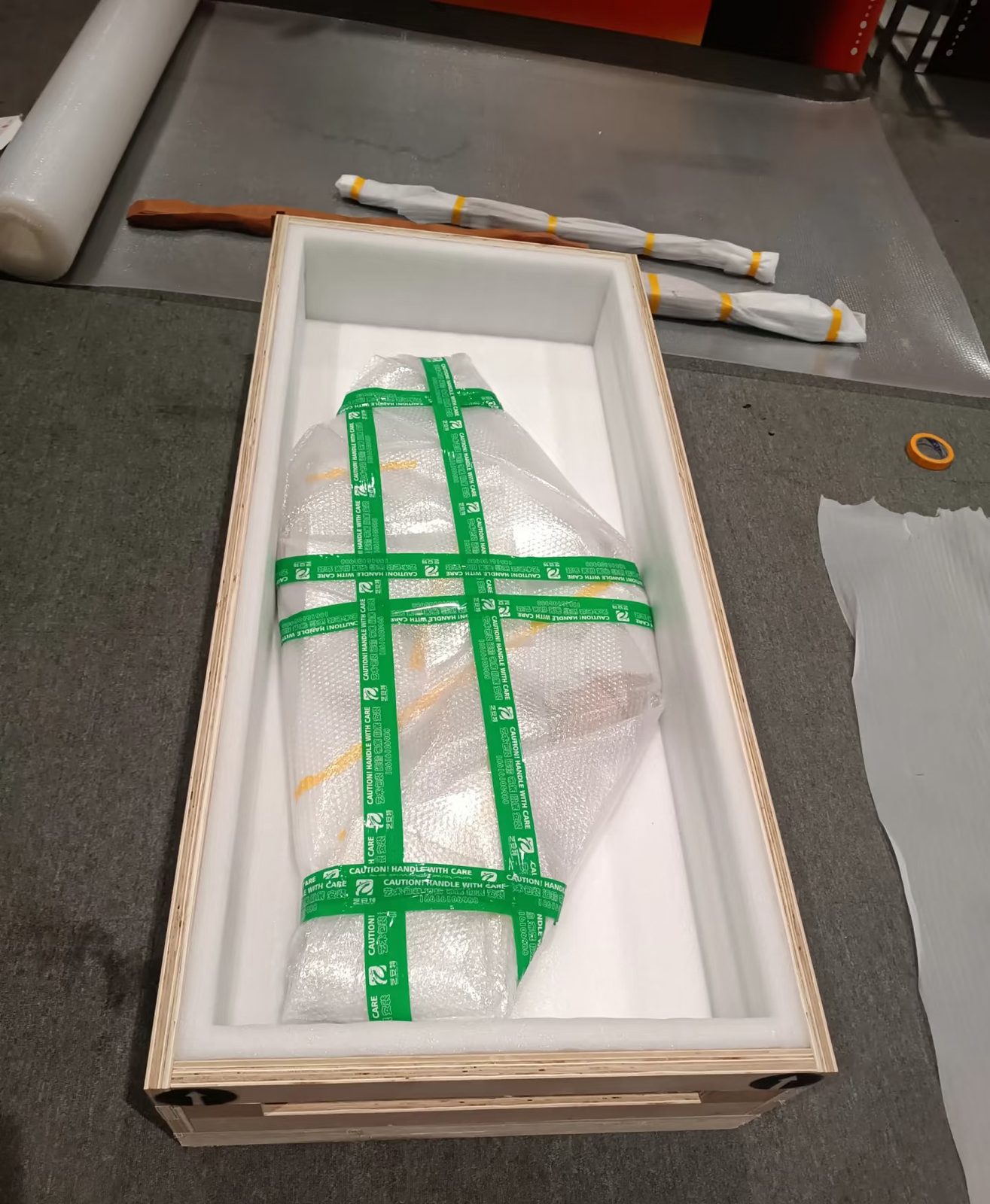
Layer 1 — surface. Acid-free tissue or 2 mm polyethylene foam directly against the glaze. Newspaper is not a substitute: the ink migrates into an unglazed foot within days and cannot be removed without abrasion.
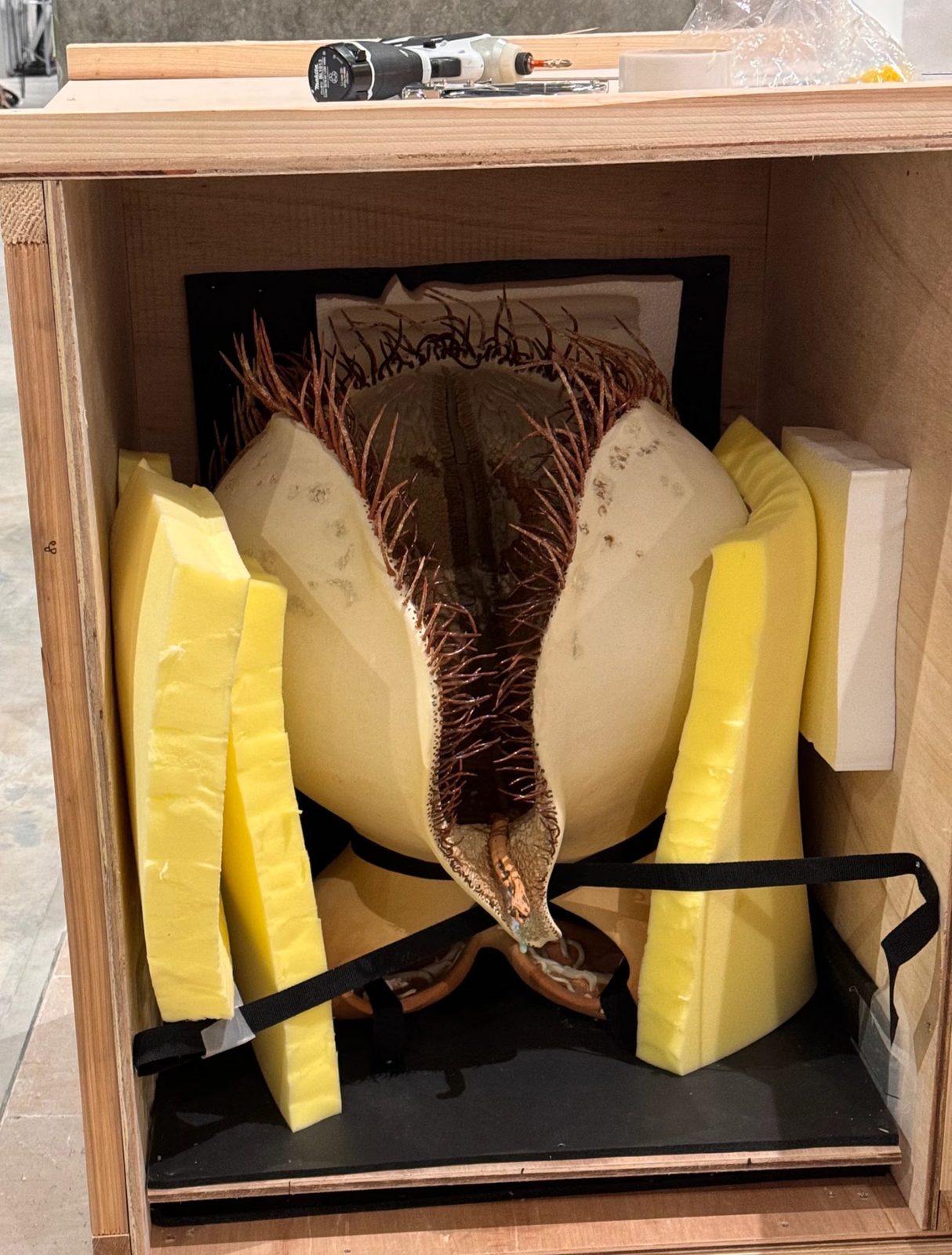
Layer 2 — cushion. Closed-cell polyethylene foam, 20 to 30 mm, at every point of contact with the crate. Polyurethane foam is softer and cheaper, but it crumbles under sustained load and leaves dust in the glaze.
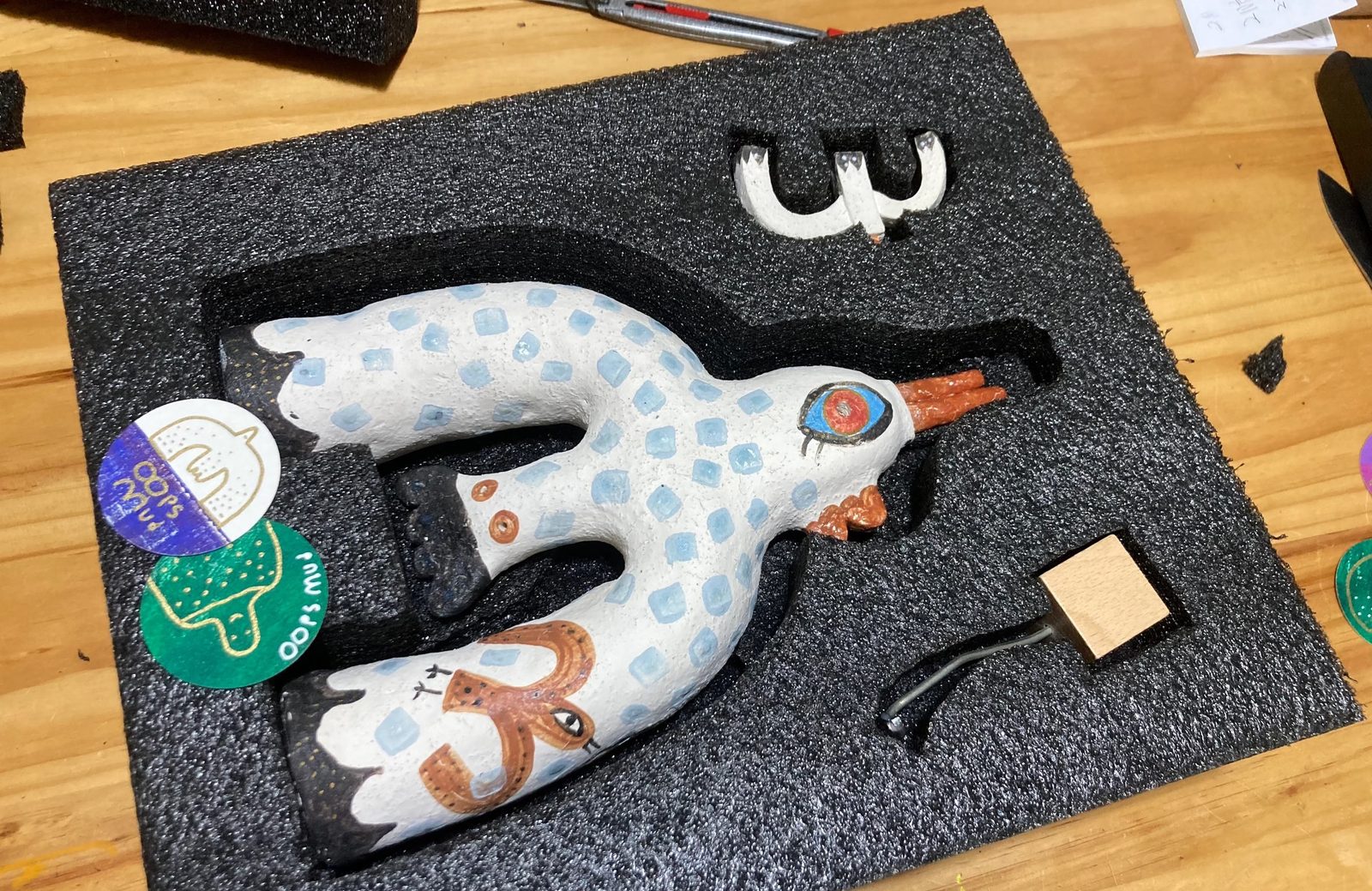
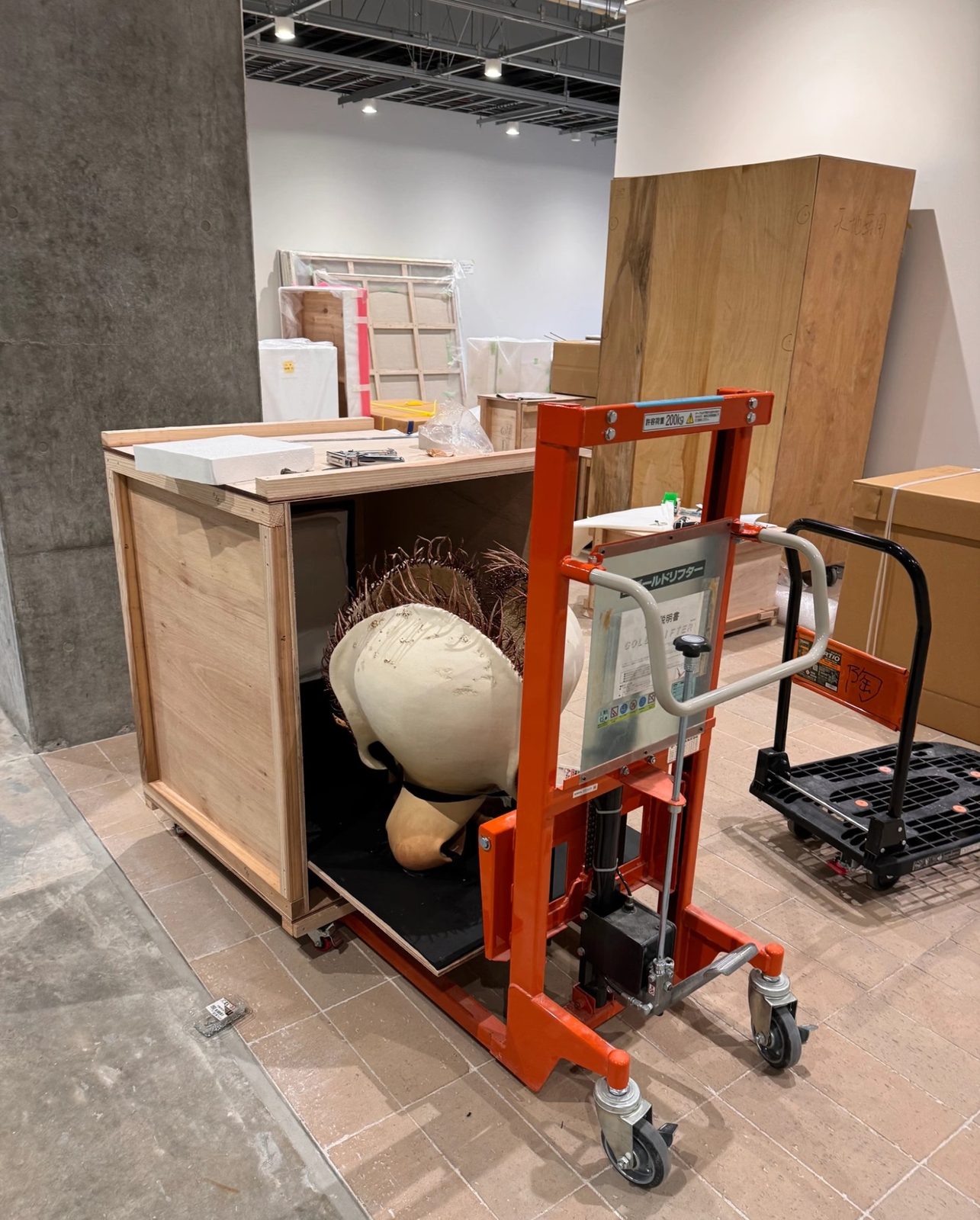
Layer 3 — suspension. The piece sits in a foam cradle cut to its own contour, so that load travels through the cradle into the crate floor rather than through the rim or an outstretched limb. This is the layer most often skipped, and it is the one that decides whether a figure arrives with its fingers intact.
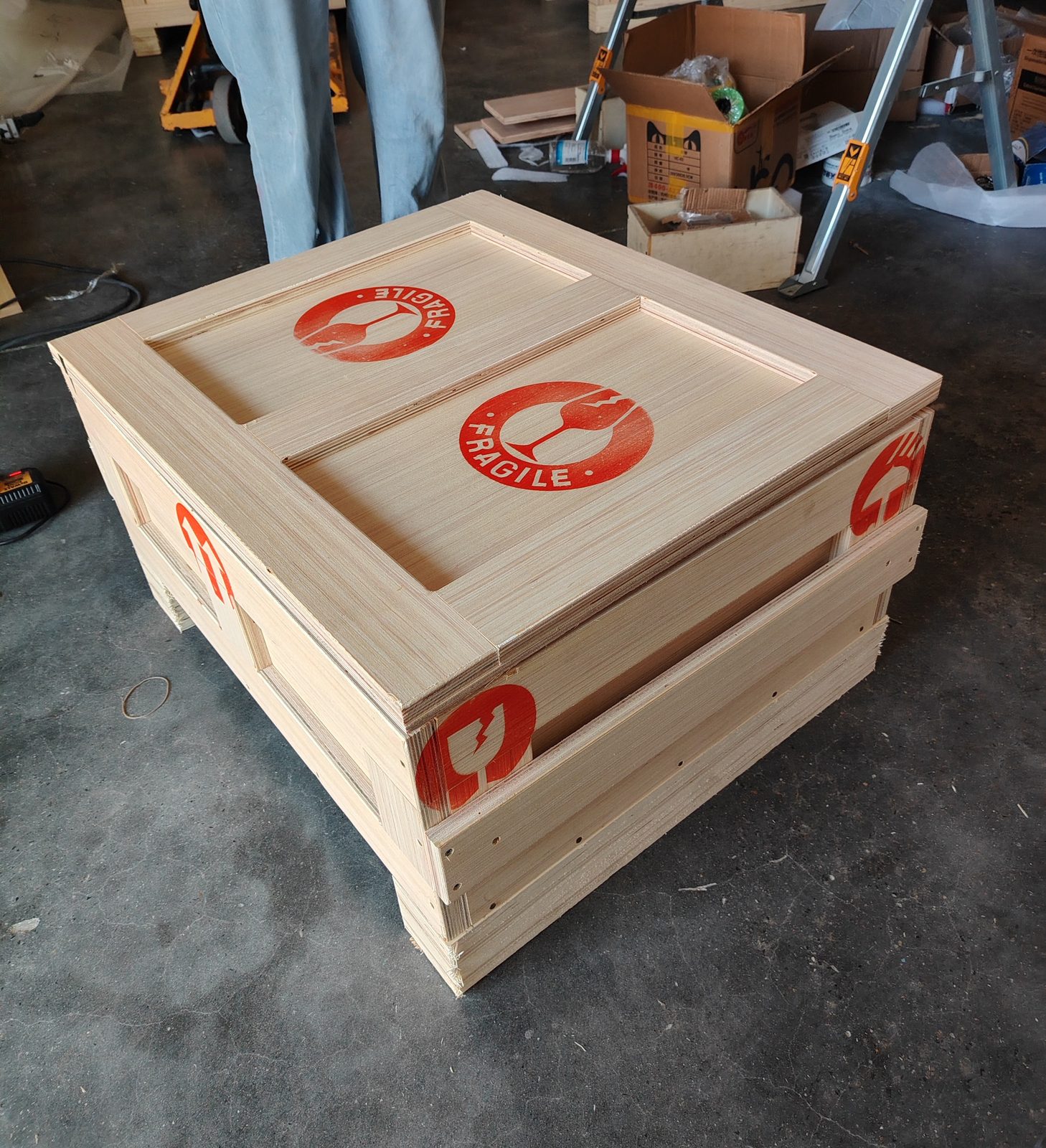
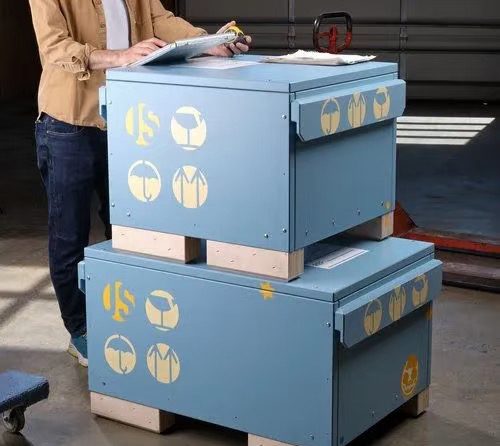
Layer 4 — crate. 12 mm plywood for pieces under about 30 kg, 18 mm above that. Plywood and MDF are exempt from wood-packaging treatment rules; solid timber bracing is not (see the ISPM 15 section below). Double-wall construction for sea freight, single-wall for air.
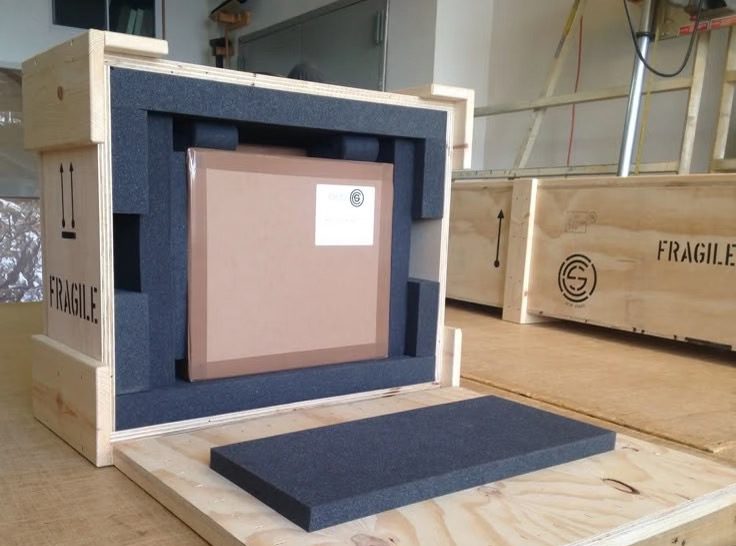
Layer 5 — the atmosphere inside. Desiccant at roughly 500 g to 1 kg per cubic metre for a 30 to 60 day transit, plus a humidity indicator card visible from outside so the receiving gallery can see at a glance whether the crate stayed dry. For sea freight, a vapour barrier inside the crate, not outside it.
Sea or air: the honest comparison
| Sea freight (LCL) | Air freight | |
|---|---|---|
| Door-to-door, Jingdezhen to Europe or US East Coast | 35–55 days | 5–9 days |
| Handling touches after leaving the workshop | 6–10 | 3–4 |
| Vibration exposure | Continuous, 4–6 weeks | Hours, plus road legs |
| Humidity risk | High, especially in LCL consolidated containers | Low |
| Relative cost for a 60 × 60 × 80 cm crate | Base rate | Typically 4–8× sea |
| Best for | Large, heavy, robust pieces; editions shipped together | Single irreplaceable works; deadline-driven gallery delivery |
The commercial calculation is not only freight cost. An LCL container is consolidated with other cargo, which means your crate is handled by people who did not pack it and have no stake in it. For a one-off piece where replacement is impossible, air freight is often the cheaper option once a single breakage is priced in.
Wood packaging: ISPM 15 is not optional
Any solid-wood component of the crate — pallet, bracing, skids — must be heat-treated to a 56 °C core temperature for at least 30 minutes, or fumigated, and stamped with the IPPC mark. Plywood, MDF and oriented strand board are processed and therefore exempt. A crate that arrives without the stamp is either refused entry, returned at the shipper’s cost, or fumigated at destination at the consignee’s cost and delay. This is one of the most common and most avoidable causes of a shipment sitting in a bonded warehouse.
The HS code that changes the duty
This is the single field where ceramic artwork is most often mis-described, and the cost of the error runs into thousands on a five-figure shipment.
Heading 9703 — original sculptures and statuary, in any material. The subheading 9703.90 covers works not more than 100 years old. In most jurisdictions this line carries nil or heavily reduced duty. It is available to genuine original sculpture, including limited editions — the internationally recognised convention allows up to twelve casts from the artist’s original model, produced under the artist’s authority.
Heading 6913 — statuettes and other ornamental ceramic articles. Duty applies, and it varies by national tariff line: historically in the range of a few percent to around seven percent ad valorem depending on body composition.
The dividing line is not beauty, and it is not price. Customs rulings have repeatedly classified aesthetically serious pottery under 6913 when the work could not be shown to be the original creation of an identified artist. In one published ruling, decorated vases and platters were held to be ornamental ceramic articles rather than sculpture, precisely because the importer could not establish the artistic origin of the pieces — the explanatory notes to 9703 exclude what they call conventional craftsmanship of a commercial character.
The practical consequence for a workshop shipping editions: the documentation that supports 9703 is the same documentation a serious collector expects anyway — a signed certificate naming the artist, the model, the edition size, and the cast number. A workshop that produces editions of eight or twelve, each numbered and certified, has a defensible 9703 position. A workshop shipping anonymous multiples does not, and should not try.
The five documents that travel with the crate
- Commercial invoice — per-piece value, HS code, country of origin, and a plain-language description that matches the HS code. “Ceramic sculpture, original work, edition 3/8” and “decorative ceramic vase” are different customs events.
- Packing list — dimensions and gross weight per crate, so the freight forwarder and the receiving gallery can plan handling.
- Certificate of origin — establishes Chinese origin for duty and preferential-rate purposes.
- Insurance certificate — arranged on an all-risks basis, with the insured value declared per piece rather than per crate.
- Artist’s certificate of authenticity — artist name, title, year, materials, edition size, cast number. This is the document that carries the 9703 argument.
Receiving: the 24-hour protocol
Damage discovered after the packing has been discarded is very hard to claim. The protocol that works:
- Photograph the closed crate from six angles before touching it, including the ISPM 15 stamp and any carrier damage.
- Open and inspect within 24 hours of delivery, with the carrier’s delivery record at hand.
- Photograph each layer as it comes off, not just the object at the end — this is what proves the packing was intact when it arrived.
- Keep all packing material until the piece has been inspected in raking light for crazing and hairline cracks, which are not visible in normal room lighting.
- Report concealed damage within the carrier’s window, typically 7 to 14 days, and in writing.
Questions artists ask before shipping
What does it actually cost to ship a ceramic sculpture from Jingdezhen?
For a crate of roughly 60 × 60 × 80 cm at 40 to 60 kg, sea freight door-to-door to Europe or the US typically runs in the low hundreds of US dollars for freight alone, and air freight several times that. Crating, insurance and destination charges are additional and often equal the freight line. Any quote that gives a single number without dimensions, weight, and Incoterm is not yet a quote.
What breakage rate should I expect?
Be sceptical of any percentage quoted without two numbers attached: total pieces shipped, and pieces damaged. A studio that has shipped forty pieces and lost one is at 2.5 percent on a sample too small to mean anything. The variables that actually move the rate are crate design, number of handling touches, and whether the receiving end inspects on arrival or weeks later.
Is shipping insurance worth it on ceramic work?
On a one-off piece, yes, on an all-risks basis with the value declared per piece. The common failure is not the premium but the claim: policies routinely require proof of professional packing standards, and an insurer will decline a claim where the crate shows no foam cradle or where the piece was loose inside the box.
Can very large pieces travel at all?
Yes, but the engineering changes. Above roughly 1.2 m, the piece is usually built in sections that assemble on site, or it travels in a purpose-built case with a rigid internal frame that carries the load and a foam interface that only locates the work. At that scale the crate stops being packaging and becomes a structure — which is why large-scale commissions are quoted with crating designed per piece.
Does the clay body or firing method change the packing?
Yes. Low-fired earthenware is softer and more porous, so it is more vulnerable to moisture and abrasion but less prone to a catastrophic brittle fracture. High-fired porcelain is the opposite: dense, glassy, and unforgiving of point loads. The firing stages a piece has been through tell you which failure mode to design against, and the cracking defects already present in a piece predict where it will fail first.
How this applies to commissioned work
For a commission made through our studio, crating is designed for the individual piece rather than chosen from a stock size — a figure with an outstretched arm and a vessel with a wide rim need different cradles, and the crate drawings are part of the production file. Pieces produced by slip casting in a numbered edition are packed as a matched set with a single certificate covering the edition. Shipping, insurance and documentation are quoted with the production cost rather than added afterwards. If you are planning a commission, the custom ceramic sculpture commissioning process sets out what information we need to quote crating and freight accurately.
Limits of this guidance
The figures above are industry-typical ranges for international ceramic freight, not measurements published by a carrier. Duty rates and the treatment of original art under HS 9703 vary by jurisdiction and change; the classification of any specific work is decided by the customs authority at the point of entry, and a binding ruling can be requested in advance in most major markets. Freight rates move with fuel and capacity. Treat this as the list of questions to put to your forwarder, not as a substitute for their quote.