
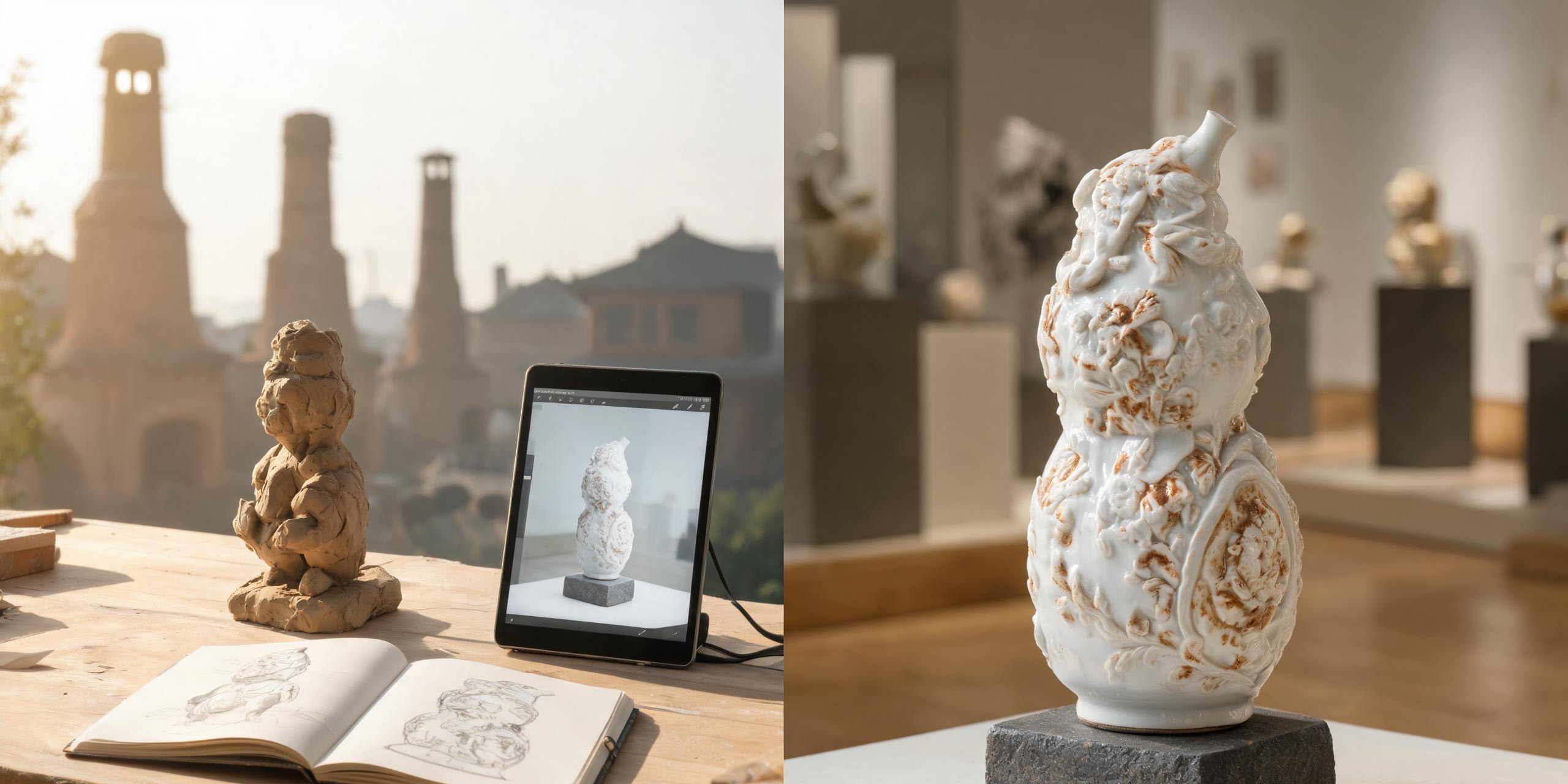
What white porcelain can carry, what clay insists on, what Jingdezhen workshop techniques make possible — this article bridges critical ideas about contemporary ceramic art and the commissions western artists can actually bring to a Jingdezhen studio.
Why contemporary ceramic art needs fabrication access
There is a gap between the ceramic art we admire in museums and galleries and the ceramic we can actually commission for ourselves. White Ming dynasty blue-and-white pieces feel distant; a contemporary installation by a western ceramic artist feels closer in intent; but both end up behind glass. The question an artist is left asking is practical: how do I move from admiring ceramic fabrication for artists Jingdezhen to commissioning work that speaks with my voice? This article connects the ideas behind contemporary Chinese and western ceramic practice with the commissions that are now possible.
Reading ceramic across time and space
When artists from different traditions make work that feels both alien and familiar, the first tool to unpack it is chronology. There is a striking coincidence most western ceramic programmes never mention: the Guangxu emperor of the Qing dynasty and Sigmund Freud were contemporaries. Walter Gropius founded the Bauhaus in 1919; Kandinsky was writing about abstraction in 1910. At that exact moment in China, most ceramic practice was still operating within the terms of Qing revivalism. That century-long lag is the reason why Jingdezhen artist studio commission work has a specific value: it places a western contemporary vision inside a workshop chain whose roots run back to the Longquan kiln of the Southern Song.
Consider Zhou Guozhen’s porcelain sculpture Persian Cat — seventeen centimetres high, hand-modelled, now in a collection outside China. The handling of fur texture, the poised body, the precision of the glaze, are the work of one studio. A piece exactly in that spirit is the kind of custom porcelain sculpture commission a western sculptor or gallery would be looking for.
Five ideas every contemporary ceramic artist should know before commissioning
A workshop visit or a studio commission should begin with shared vocabulary. Here are the five distinctions that matter most.
| Idea | Traditional expectation | Contemporary direction |
|---|---|---|
| Technique vs art | Mastery of historic kiln and glaze methods equals quality | Technique serves expression; the material’s voice takes priority over formula |
| Material vs expression | Clay is neutral, the artist gives it meaning | Clay has a language of its own — kaolin wants pure, stoneware wants rugged, slip-cast bodies want precision |
| Preservation vs innovation | Reproducing Song dynasty forms is the highest form of honouring tradition | The objects we call tradition were all revolutionary in their time; innovation is the only real inheritance |
| Method vs freedom | Discipline of craft produces quality | Discipline is necessary but freedom of the individual moment is what makes a work irreplaceable |
| Single object vs edition | Fine porcelain is one-off or small family of pieces | Galleries and collectors now demand small batch limited edition ceramic production that balances intimacy and reach |
The last row is particularly relevant. Wang Sisi, a graduate of Jingdezhen Ceramic University, makes series of hand-painted blue-and-white panels in editions of six to eight. These are not mass-produced. Each panel is fired three times for the deep underglaze colour, and each brushstroke is unique. That is exactly the gallery level ceramic art commission work that western galleries commission now — limited, hand-finished, affordable enough for a collector to live with, rare enough to have meaning.
Clay has a language of its own
A kiln master in Jingdezhen will tell you different bodies ask for different things. High-white kaolin becomes porcelain — pure, translucent, demanding of precision. Coarse stoneware clay wants a rugged surface and a slow firing schedule that lets the iron and feldspar speak. Slip-cast bodies love geometry but resist free-form texture. Understanding which clay you need is not a technical question alone; it is an expressive one. A sculpture in hand-modeled coarse stoneware says something different from the same sculpture in hand-carved fine porcelain. When you commission, you are not just ordering a shape; you are choosing a material voice. That choice is the reason you need access to a porcelain art fabrication studio where body choice, glaze choice and firing schedule are discussed together, not handed to you as a menu.
The workshop routes that open this up
Five workshop routes are now standard for artists visiting Jingdezhen. Each maps to a different kind of commission.
| Route | What it delivers | Example commission |
|---|---|---|
| Hand carving and incising | Relief and pierced decoration, fine surface modulation | A hand carved ceramic art commission in high-temperature celadon glaze |
| Underglaze painting | Blue-and-white, underglaze red, iron oxide decoration | A series of twelve panels by a western painter, fired in a Jingdezhen factory |
| Colour glaze | High-temperature celadon, red, crackle, oil drop | Large-format sculptural vessels by a Chinese master like Qiu Han |
| Slip casting + CNC | Geometric forms, exact repeatability, digital sculptural translation | A gallery edition translating a western sculptor’s digital file into porcelain |
| Mixed technique | Body variation, inlay, underglaze, overglaze, multiple firings | Large-scale installations combining relief carving and coloured glazes |
These routes are not mutually exclusive. Bai Ming, now at Tsinghua University and a regular exhibitor in Paris and New York, pairs brush-painted iron oxide decoration with rough, deliberately uneven hand-formed bodies. The hand is visible, the clay speaks, and the glaze is chosen to carry both. That kind of hybridity is what a western artist looking for Jingdezhen artist studio commission work should be able to expect.
How western artists have already used these routes
This is not speculative. The last five years have seen a steady stream of western artists and designers using Jingdezhen workshops for commissions that sit outside the souvenir economy. Here are three recent examples.
| Artist or client | Workshop route used | Commission type |
|---|---|---|
| British sculptor, Somerset studio | Hand carving + high-temperature colour glaze | Six one-off vessels for a private garden |
| US gallery, Brooklyn | Slip casting + CNC forms + underglaze blue | small batch limited edition ceramic production of ten wall panels |
| Design studio, Copenhagen | Hand-carved relief + celadon glaze | Twelve hand carved ceramic art commission vessels for a hotel public space |
All three of these started the same way: a brief, a sketch or a digital model, and a test firing of one piece before the batch. The Copenhagen commission in particular required the studio to work around kiln availability during the winter peak — a lead time of three months from approval to delivery. For a gallery level ceramic art commission on this scale, planning ahead matters more than speed.
What commissioning actually looks like today
To move from reading to making, you need a studio that talks to galleries, to artists and to each of the five workshop routes above. The commission page at Jingdezhen Heritage describes exactly this workflow: a brief, a sample, a firing schedule, a lead time, and a clear process for approvals. Three things change the dynamic. First, you can work directly with a Jingdezhen studio without a middleman or a broker. Second, you can request any of the five routes above. Third, the commission is for work that can end up in your studio, in a gallery, or in a private collection — not just for souvenir-scale pieces. Whether you need a single sculptural piece based on a western artist’s maquette, an edition of wall panels, or a custom porcelain sculpture commission that references Zhou Guozhen’s cat in a new material, the studio chain exists to make it real. For more on how Jingdezhen bridges workshop tradition and contemporary fabrication, read our longer piece on ceramic fabrication for artists in Jingdezhen and our background on what traditional technique and modern technology can do together.
Frequently Asked Questions
What is the lead time for a Jingdezhen commission?
A small batch of four to six pieces usually takes four weeks. A hand-carved sculpture takes six to eight weeks. A large gallery edition with multiple firings can take three months. Always confirm the schedule before agreeing the brief.
Can western ceramic artists work with Jingdezhen workshops remotely?
Yes. Most Western clients share sketches or digital files, approve a fired sample, and follow progress through photographs of each firing batch. Shipping can be arranged to any country.
What makes Jingdezhen different from other ceramic centres for commissions?
Access to every step of the chain under one roof: body preparation, mould making, carving, painting, glaze development, multiple kiln types, and the artisans who know how each step affects the next. Most other centres specialise in one step only.
Can a commission be genuinely contemporary and still Jingdezhen-made?
Yes. The last century of ceramic practice in Jingdezhen includes artists like Bai Ming, Qiu Han and Wang Sisi whose work is shown internationally. What makes it Jingdezhen is the material, the workshop chain, and the fact that every piece is fired in a kiln built and maintained for that piece.
Commission ceramic art with Jingdezhen Heritage
Jingdezhen Heritage is a porcelain studio in Jiangxi, China. We coordinate ceramic fabrication for artists Jingdezhen, from a single hand-carved piece to gallery level ceramic art commission editions. Share your sketch, digital file or reference and we will advise on body, technique, firing and lead time. This is how artists have been moving from museum admiration to commissioned work for the last decade.
Email service@jingdezhenheritage.com or message us on WhatsApp at Contact on WhatsApp.
Published 4 November 2026 by Jingdezhen Heritage, a porcelain studio in Jingdezhen, Jiangxi, China.