
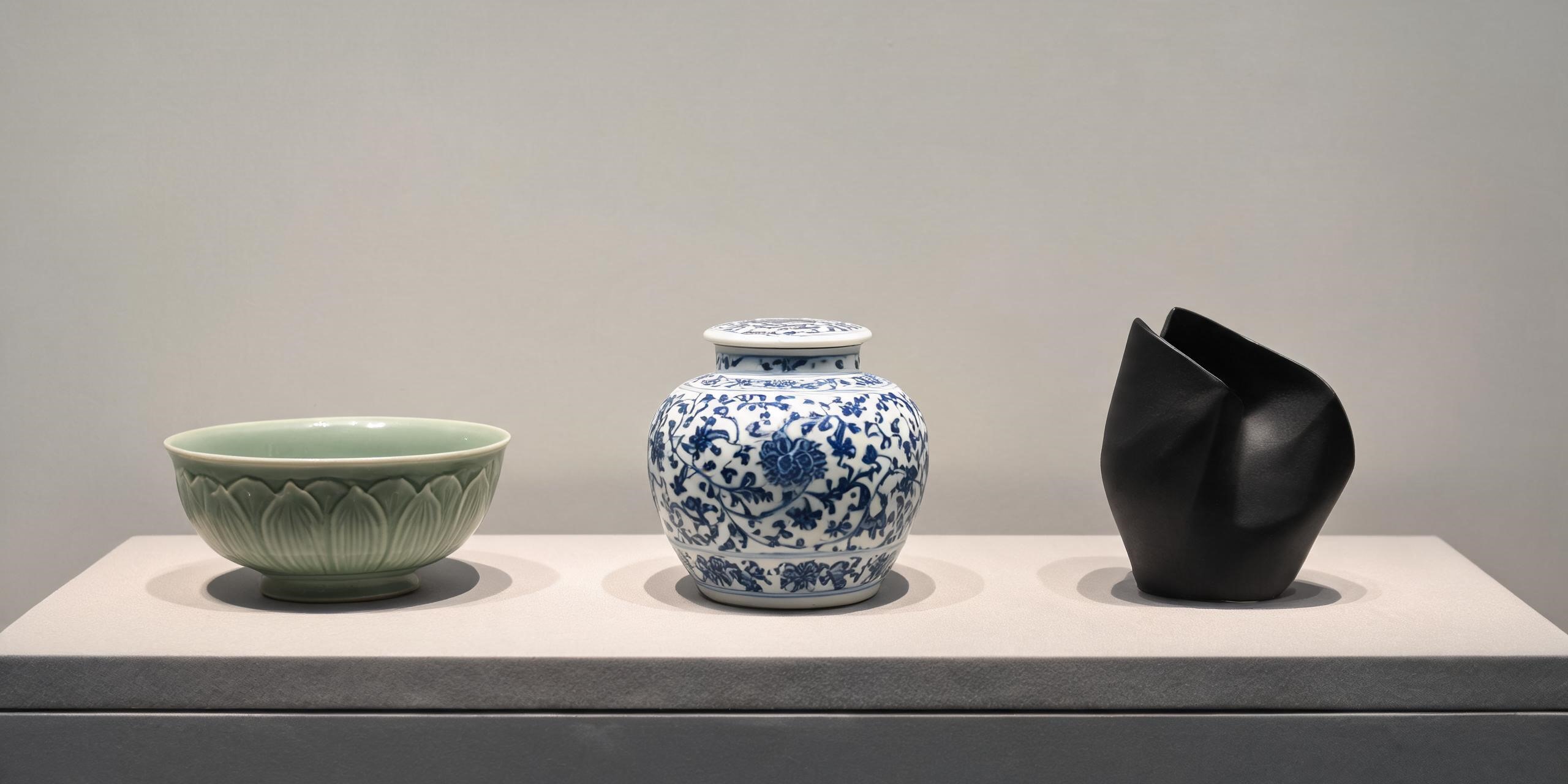
The evolution of Chinese ceramic art over the last forty years is one of the most striking stories in contemporary craft. From a field dominated by factory production and the reproduction of classical styles, Chinese modern ceramics has grown into a diverse, internationally visible practice in which clay carries ideas, installations, sculpture and design. This transformation did not happen overnight; it moved through three distinct phases, each building on the last, and it is still unfolding in studios across China, from Jingdezhen to the art schools of Beijing and Shanghai.
This guide maps that evolution in three stages, explains what makes the Chinese version distinctive, and considers where the field is heading next u2014 including the practical question of what it means for collectors and institutions working with Chinese studios today.
Phase One: The Western Opening (1980s)
When China reopened in the late 1970s, Chinese ceramic artists encountered Western modern and contemporary ceramics for the first time in a generation. The effect was electrifying. Work from American studio pottery, Japanese Sodeisha and European conceptual ceramics showed that clay could be sculpture, that a vessel could refuse to function, that the kiln accident could be the point. The 1980s were therefore a decade of absorption and imitation: young artists learned the grammar of international ceramics as quickly as they could, and the first exhibitions of modern ceramic art in China carried a strong foreign accent. Books, translated essays and visiting lecturers poured in, and for a while it felt as if the whole history of twentieth-century ceramics was arriving at once.
This was not a weakness but a necessary first step. Before a tradition can renew itself from inside, it needs to see itself from outside. The 1980s gave Chinese ceramics a mirror.
Phase Two: Finding a Native Voice (1990s)
By the 1990s the mood changed. A generation that had learned the international vocabulary began asking what was specifically Chinese about their work. The answer was not simply to paste traditional motifs onto modern forms u2014 a shallow route that produced decorative pastiche. The deeper answer was to recover the underlying logic of Chinese ceramics: the relationship between clay and the body, the intelligence of the kiln, the idea that form and function are not enemies but partners.
Artists began to draw on Song and Ming aesthetics not as styles to copy but as ways of thinking. They explored the expressive potential of porcelain, stoneware and slip; they re-examined the vessel; and they started to produce work that looked modern without looking Western. Themed exhibitions and a growing gallery system gave this new native language room to develop, and by the end of the decade Chinese modern ceramics had found a voice of its own.
Phase Three: Maturity and Multiplicity (2000s to today)
Since 2000 the field has matured and multiplied. Several features mark the current phase. First, a wide range of approaches now coexist: vessel, sculpture, installation, design, public art and mixed-media work are all legitimate. Second, the material has been re-examined u2014 fire, clay and glaze are treated as expressive media in their own right, not merely as means to an object. Third, Chinese ceramics is now part of global circulation: artists show abroad, international makers work in Jingdezhen, and the conversation runs in both directions. Fourth, technology has entered the studio: digital modelling, 3D printing and parametric design now sit beside throwing and hand-building, not as replacements but as additional tools in the same working life.
| Phase | Period | Character | Keywords |
|---|---|---|---|
| Opening | 1980s | Absorption of Western modern ceramics | Imitation, exposure, first exhibitions |
| Native voice | 1990s | Recovery of a specifically Chinese ceramic logic | Song and Ming aesthetics, the vessel, kiln intelligence |
| Maturity | 2000su2013present | Plural practice in global circulation | Installation, mixed media, public art, international exchange |
What Makes the Chinese Evolution Distinctive
Chinese modern ceramics grew from a base deeper and broader than almost any other country’s. No other nation has an unbroken ceramic tradition stretching back millennia, nor a production centre as complete as Jingdezhen, where every stage of porcelain making u2014 from clay mining to firing u2014 remains in daily use. This gives Chinese artists two advantages. First, material mastery: the technical range available in Jingdezhen alone is extraordinary, from imperial-style painting to the latest 3D printing. Second, cultural depth: the tradition is not a museum piece but a living resource, so an artist can quote the restraint of Song celadon one moment and embrace raw, expressive stoneware the next without contradiction.
There are tensions too. Commercial pressure can push work towards the safe and the repetitive. The speed of growth has at times outrun critical theory, leaving some practice under-analysed. And the very richness of the tradition can become a cage, tempting artists to rely on inheritance rather than invention. But these are the tensions of a healthy, expanding field, not the symptoms of decline.
One often-overlooked advantage is demographic. China’s art schools graduate more ceramic artists each year than the rest of the world combined, and many of them pass through Jingdezhen at some point in their training. This creates a constant supply of new hands, new ideas and new audiences, and it means the field regenerates faster than almost anywhere else. The risk is homogeneity; the reward is an energy that older ceramic cultures can only envy.
Where Chinese Ceramic Art Is Heading
The most promising direction is a deeper kind of internationalism u2014 one that does not dilute Chinese identity but expresses it through forms the world can read. This means standing on local ground while speaking a shared language: using the material intelligence of the Chinese kiln tradition to address universal questions of material, time, environment and the body. It also means the kind of cross-border collaboration that Jingdezhen’s open studio culture already supports, where a sculpture conceived in Europe and fired in Jiangxi becomes genuinely neither one nor the other, but something new.
For collectors and institutions, the implication is practical. A Chinese studio today can offer both ends of the spectrum u2014 the deep technical inheritance of Jingdezhen and the conceptual range of contemporary practice u2014 and the line between the two is increasingly the place where the most interesting work happens. When you commission a custom ceramic sculpture from a Chinese maker, you are not choosing between tradition and modernity; you are accessing a field that has spent forty years learning how to hold both at once. The result is work that could only have been made now, and only in China.
| Dimension | Strength | Ongoing challenge |
|---|---|---|
| Material and technique | Unrivalled depth, especially in Jingdezhen porcelain | Risk of relying on inherited skill rather than invention |
| Cultural identity | Millennia of tradition as a living resource | Pressure to reduce identity to surface motifs |
| International reach | Open studio culture, global exhibition circuits | Need for stronger critical and theoretical infrastructure |
| Market | Large domestic and international demand | Commercial pressure towards repetition |
Frequently Asked Questions
When did modern ceramic art begin in China?
It emerged in the 1980s, after the reform era opened Chinese artists to Western and Japanese modern ceramics. The 1990s saw the development of a distinct native voice, and the 2000s brought full maturity and international integration.
What makes Chinese modern ceramics different from Western studio pottery?
Its base: an unbroken ceramic tradition of millennia and the complete production ecosystem of Jingdezhen. This gives Chinese artists unmatched technical range and a cultural resource they can draw on while still working in contemporary forms.
Is Jingdezhen still important for modern ceramic art?
Yes. Jingdezhen offers the world’s most complete porcelain production chain and an open, international studio culture, making it both a centre of traditional mastery and a laboratory for contemporary experiment.
What is the biggest challenge facing Chinese ceramics today?
The tension between commercial pressure and artistic invention. A healthy market is an advantage, but it can push artists towards repetition. The field’s future depends on keeping invention, criticism and material exploration alive alongside production.
Related Reading
For the contemporary practice this evolution produced, read Modern Ceramic Art in China and Ceramics as Contemporary Art. For the kiln tradition at the heart of it all, see Song Ceramics and the Five Great Wares.
We make high-fired Jingdezhen porcelain to order, from vessels to large sculptural work. Browse the collection, see our custom ceramic sculpture commissions, or email us. We also answer questions on WhatsApp.
Published 31 October 2026 by Jingdezhen Heritage, a porcelain studio in Jingdezhen, Jiangxi, China.