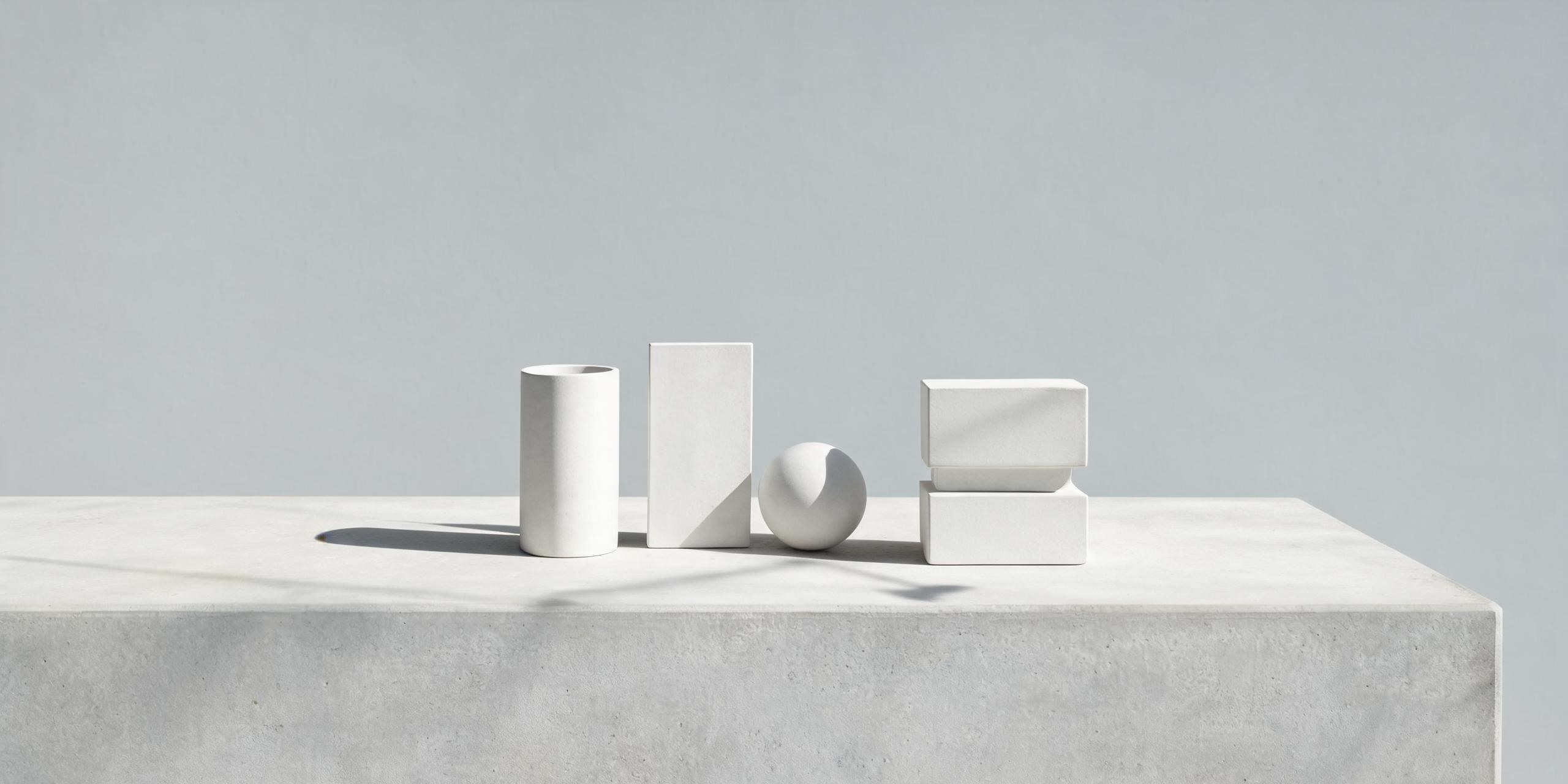
Geometric form is the hidden grammar of modernist ceramic art. When ceramic artists of the twentieth century broke with the decorated vessel and turned to pure shape u2014 cubes, cones, cylinders, spheres and their intersections u2014 they were not abandoning craft. They were joining the wider modernist project of reducing form to its essentials, letting geometry carry meaning where ornament once did. From the American abstract expressionism of Peter Voulkos to the Japanese avant-garde of Yagi Kazuo, and on into the work of contemporary Chinese sculptors in Jingdezhen, geometric elements have given ceramics a language of order, rhythm and intellectual weight.
This guide traces how solid geometry entered modernist ceramic art, what it allows makers to say, and why Jingdezhen studios still find it a powerful way to connect porcelain tradition with international sculpture.
What Solid Geometry Means in Clay
In formal terms, solid geometry is the study of three-dimensional objects u2014 forms defined by length, width and height, bounded by straight lines, curves, planes and curved surfaces. For a ceramic artist, this vocabulary is not abstract theory: it is the raw material of form. A thrown cylinder is a geometric solid; a press-moulded cone is one; a hand-built slab box is another. What modernist ceramics changed was the attitude towards these forms. Where traditional pottery used geometry invisibly u2014 as the underlying structure beneath decoration u2014 modernist ceramics brought it to the surface and made it the subject.
The result is work that feels rational, architectural and deliberate. Geometric elements bring order, rhythm and a sense of modernity. They also connect ceramics to the broader visual culture of the twentieth century u2014 to the Bauhaus, to constructivism, to minimalism u2014 and this is why a geometric ceramic sculpture can sit comfortably in a modern interior anywhere from Shanghai to Stockholm.
The Modernist Turn: From Voulkos to Sodeisha
The decisive break came in the 1950s. In the United States, Peter Voulkos, trained as a traditional potter, began treating clay as a sculptural medium rather than a vessel-making one. He cut, tore, assembled and deconstructed thrown forms, importing the gestures of abstract expressionism into ceramics. Geometry did not disappear in his work; it was pulled apart and reassembled, so that a cylinder might be opened, a slab bent, a cone inverted u2014 the order of the form made visible by being broken. Behind this shift stood the broader modernist inheritance from the Bauhaus, with its faith in functional form and its insistence that beauty could be built from simple, repeated volumes.
In Japan, Yagi Kazuo and the Sodeisha group took a different but parallel path. Rejecting both the functional vessel and the nostalgic return to folk pottery, they made non-functional sculptural objects in which pure geometric volumes carried emotional weight. Yagi’s Mr. Samsa’s Walk u2014 a small, absurd geometric form on legs u2014 announced that a ceramic object could be a philosophical statement, not a container. Across the world, the vessel had been dethroned; geometry was the new king.
| Artist / group | Country | Geometric contribution |
|---|---|---|
| Peter Voulkos | USA | Deconstructed thrown cylinders; abstract-expressionist gesture applied to geometric forms |
| Yagi Kazuo & Sodeisha | Japan | Pure non-functional geometric volumes; ceramics as philosophical object |
| Hans Coper | UK | Architectural, composed geometric forms; reduction to essential volumes |
| Dame Lucie Rie | UK | Refined geometric vessels with precise, modernist proportions |
| Zhu Legeng (Jingdezhen) | China | Large-scale environmental ceramics using geometric elements in architectural space |
Zhu Legeng and the Chinese Response
In China, the modernist geometric language arrived later but with particular force, because it met one of the world’s most sophisticated ceramic traditions. Zhu Legeng, a leading figure at the Jingdezhen Ceramic Institute, is best known for environmental ceramic works such as The Light of Life, in which repeated geometric units u2014 tiles, blocks, curved segments u2014 are assembled into large installations that activate an architectural space. Here geometry does two things at once: it gives the work its visual rhythm, and it solves the practical problem of scaling porcelain from a hand-held object to a wall or a plaza.
What makes the Chinese version distinctive is the way it marries modernist geometry with porcelain’s material character. The translucency of high-fired Jingdezhen porcelain, the depth of its glazes and the precision possible in a town where every stage of production is specialised, mean that a geometric form can be rendered with a clarity and finish unmatched elsewhere. Geometry and the kiln tradition reinforce each other: the form says modern, the material says Jingdezhen.
Why Geometry Works in Ceramic Sculpture
Geometric elements offer ceramic artists several distinct advantages. First, they provide a shared, legible vocabulary u2014 a sphere reads as a sphere in every culture, so the work communicates before any cultural explanation is needed. Second, geometry naturally produces order and rhythm: repeated units, modular constructions and serial forms hold the eye and give large work a structural logic. Third, pure form invites the viewer to notice the material itself u2014 the quality of the clay body, the behaviour of the glaze, the traces of fire u2014 because there is no decoration competing for attention.
| Geometric element | Ceramic effect | Typical use |
|---|---|---|
| Cylinder | Stability, verticality, the memory of the wheel | Vessels, columns, modular wall units |
| Cone / pyramid | Direction, elevation, tension | Sculptural spires, roof forms, tilted volumes |
| Sphere / ovoid | Completeness, softness, contained energy | Closed forms, figurative abstraction, hanging work |
| Cube / cuboid | Weight, architectural presence | Box forms, seating, public sculpture |
| Curved plane / shell | Lightness, surface, the suggestion of space | Wall reliefs, screens, architectural facings |
There is also an architectural dimension. A ceramic sculpture built from geometric modules can be scaled up for public space, and the same modular logic makes it feasible to produce sections in the studio and assemble them on site. For clients who commission a custom ceramic sculpture for a lobby, garden or facade, this is the practical reason geometry keeps returning: it is beautiful, and it builds.
Geometry and Craft: The Tension
It would be wrong to suggest that geometry simply replaces craft. In fact the two are in constant dialogue. A perfect cylinder is a geometric ideal, but a thrown cylinder is never perfectly cylindrical u2014 it carries the spiral of the wheel, the slight wobble of the hand. Modernist ceramics often exploits this gap, letting the geometric idea be inflected by the material’s resistance. The best work is not pure geometry nor pure expression, but the friction between them: a cone that leans, a sphere that is slightly flattened by firing, a cube whose edges are softened by glaze.
This is also why the legacy of the modernist turn remains alive. Younger artists in Jingdezhen and elsewhere continue to use geometric elements, but they do so with an awareness of their history u2014 not as a dogma of pure form, but as one vocabulary among many, to be mixed with narrative, decoration, colour and the accidental traces of the kiln. Geometry in contemporary Chinese ceramics is no longer a revolution; it is an inherited tool, available whenever the work calls for clarity, order and scale. The best studios know exactly when to reach for it.
Frequently Asked Questions
What is solid geometry in ceramic art?
The use of three-dimensional geometric forms u2014 cubes, cones, cylinders, spheres and their combinations u2014 as the primary visual language of a work, rather than as the hidden structure beneath decoration.
When did geometry become important in modern ceramics?
In the 1950s, through artists such as Peter Voulkos in the United States and Yagi Kazuo’s Sodeisha group in Japan, who broke with the functional vessel and used pure form to carry meaning.
Who are the key Chinese artists working with geometric ceramics?
Zhu Legeng is the most prominent figure, known for large-scale environmental ceramics that assemble modular geometric units in architectural space. Many younger Jingdezhen artists now work with geometric vocabularies too.
Why is geometry good for large ceramic sculpture?
Because it provides a modular, repeatable structure that can be produced in sections and assembled on site, while giving the finished work visual order and rhythm u2014 ideal for public and architectural spaces.
Related Reading
For the wider story of ceramics as contemporary art, read Ceramics as Contemporary Art and Modern Ceramic Art in China. For the material behind these forms, see How the Jingdezhen Porcelain Body Is Made.
We make high-fired Jingdezhen porcelain to order, from vessels to large geometric sculptural installations. Browse the collection, see our custom ceramic sculpture commissions, or email us. We also answer questions on WhatsApp.
Published 31 October 2026 by Jingdezhen Heritage, a porcelain studio in Jingdezhen, Jiangxi, China.