
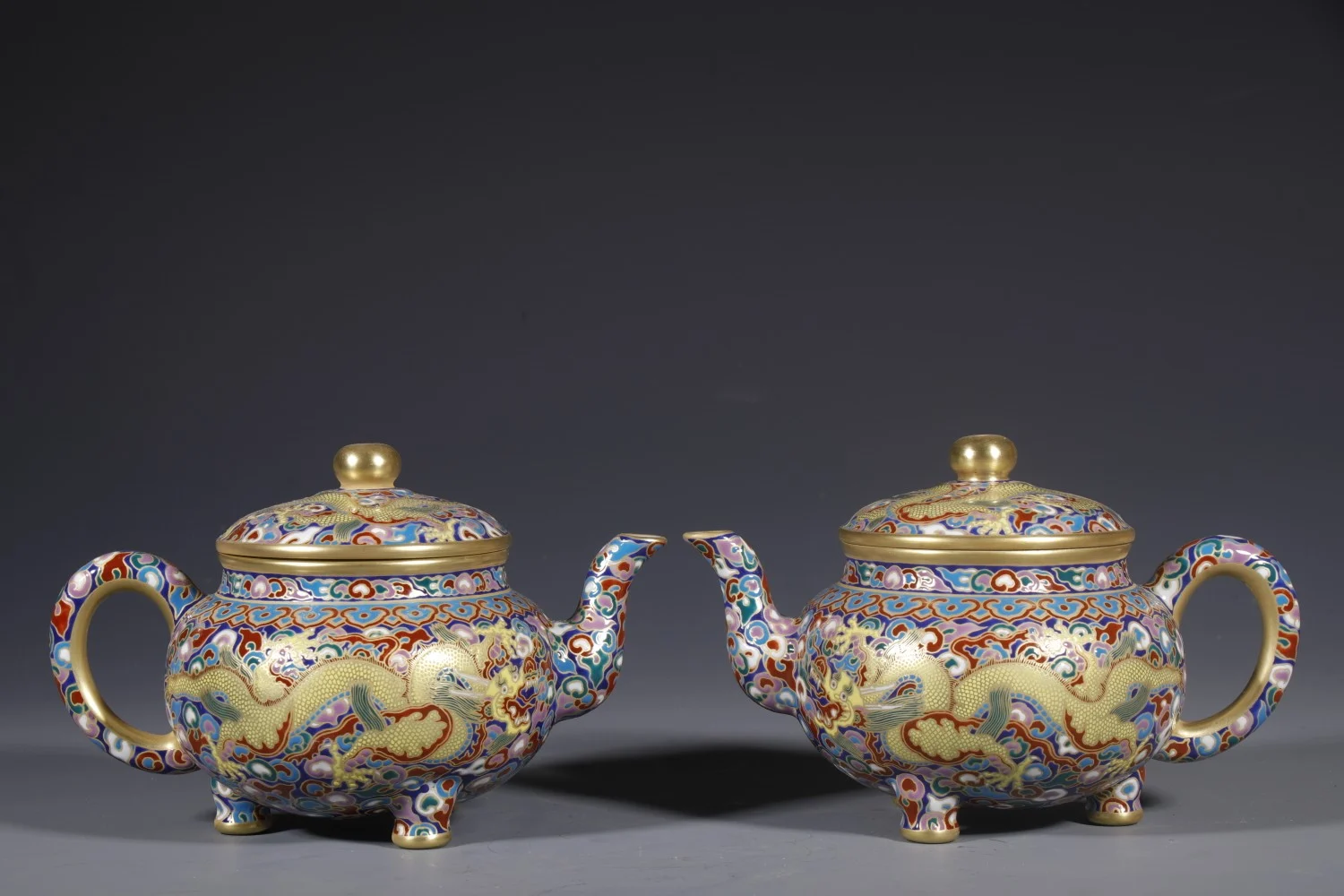
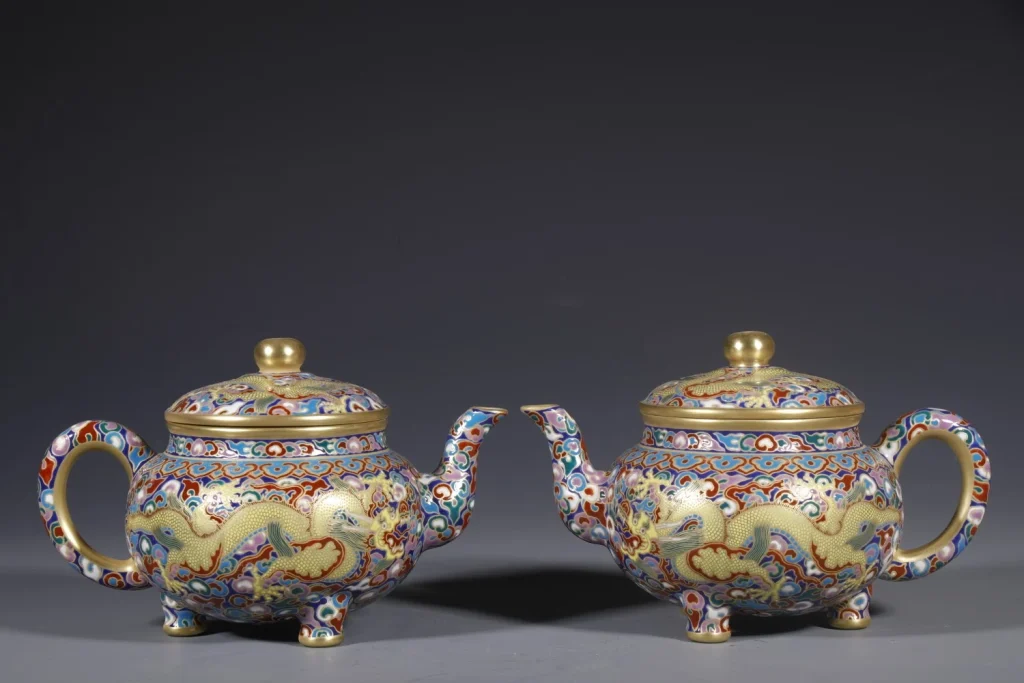
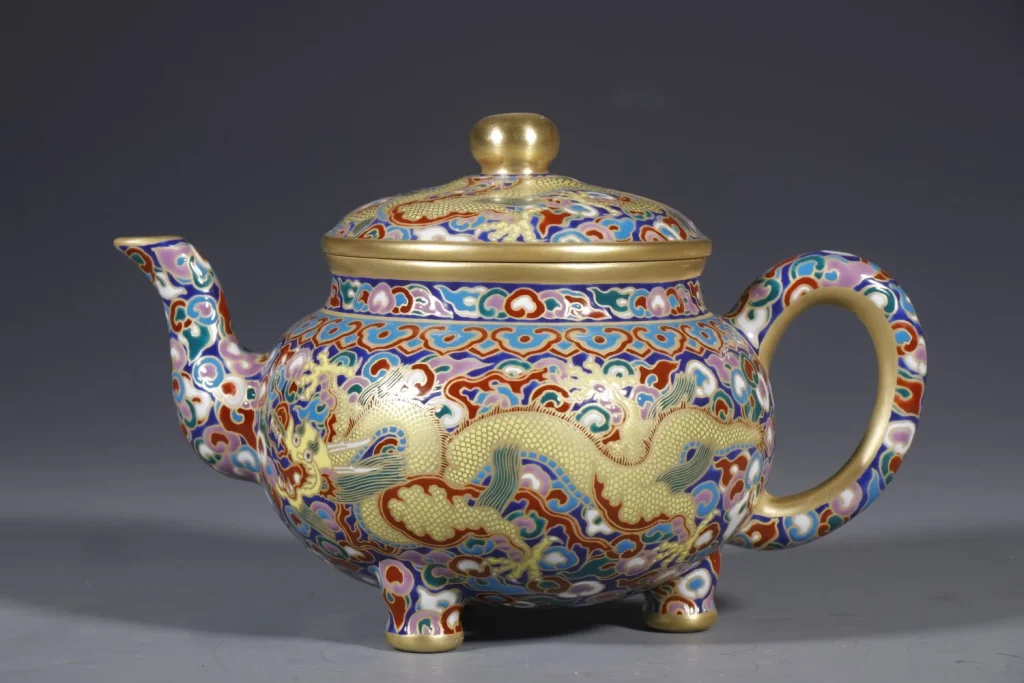
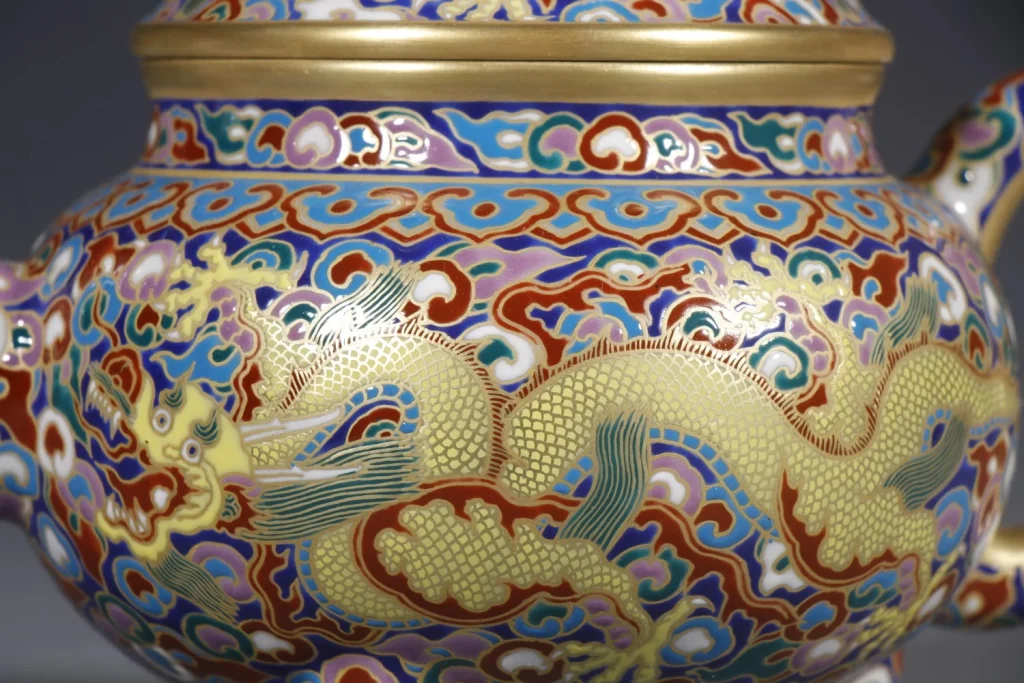
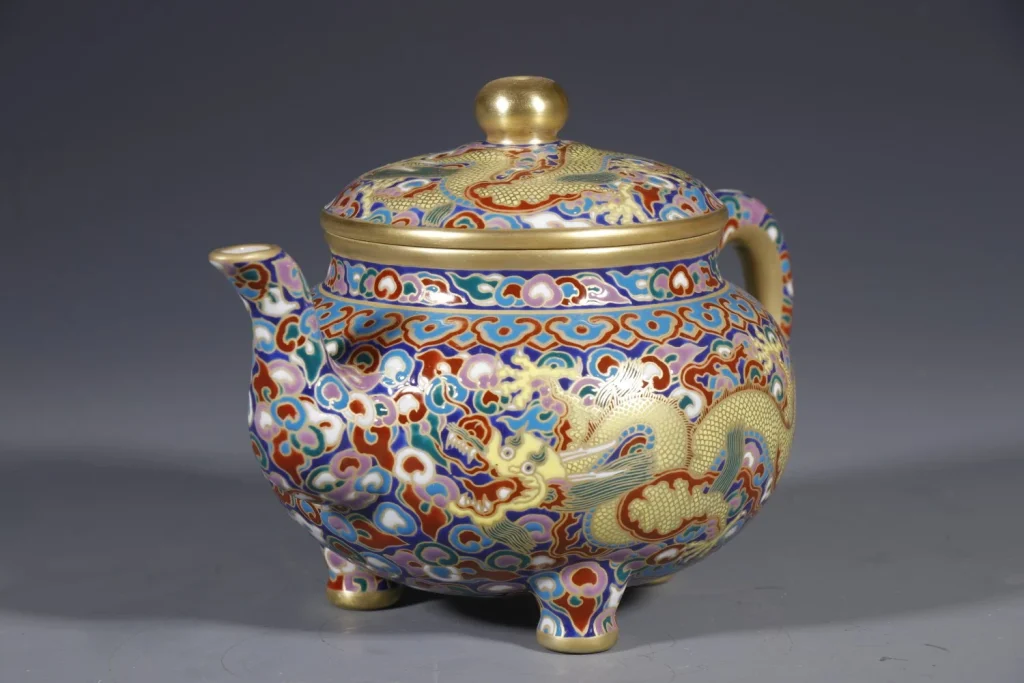
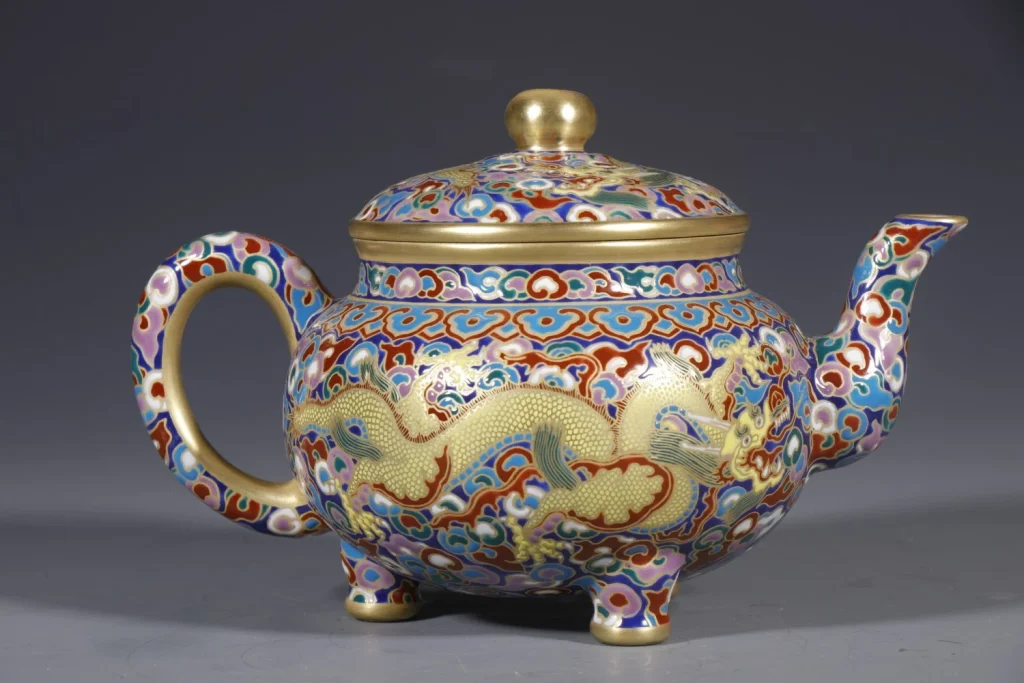
CQCH-011 is a contemporary Jingdezhen tripod porcelain teapot decorated with gilt dragons and polychrome cloud scrolls, made in a family craft workshop in the period 1949-present. Its rounded body stands on three small feet and is fitted with a curved spout, loop handle and domed cover. Fine gilt outlines divide the richly colored enamel fields, creating a cloisonne-style effect across the dragons, clouds and borders. The lead photograph presents two matching examples; this catalogue entry describes one teapot.
Form and Handwork
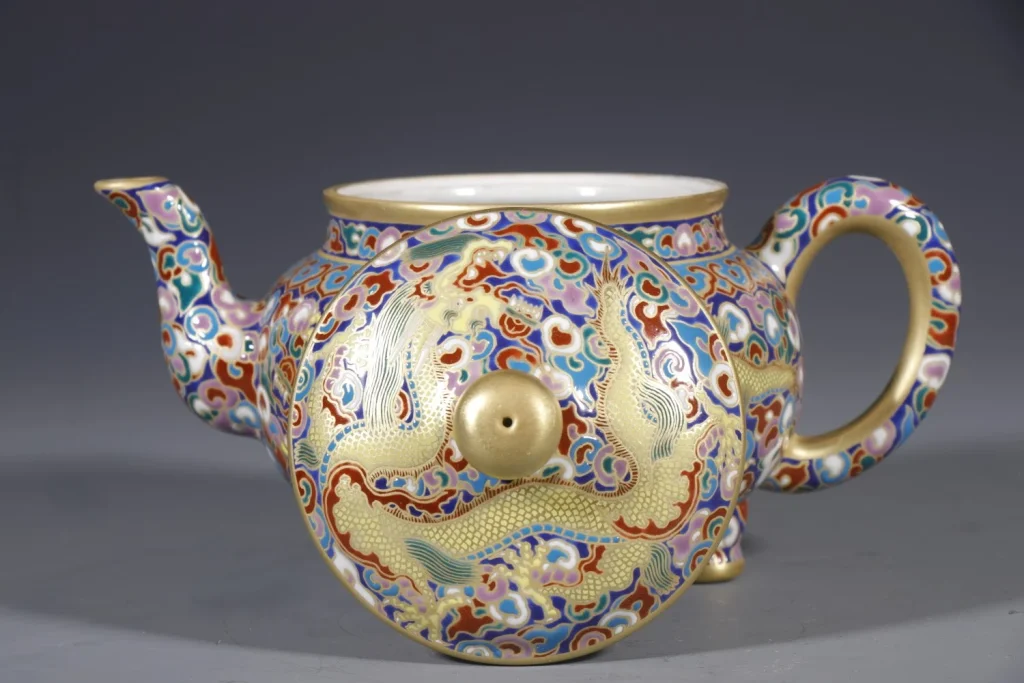
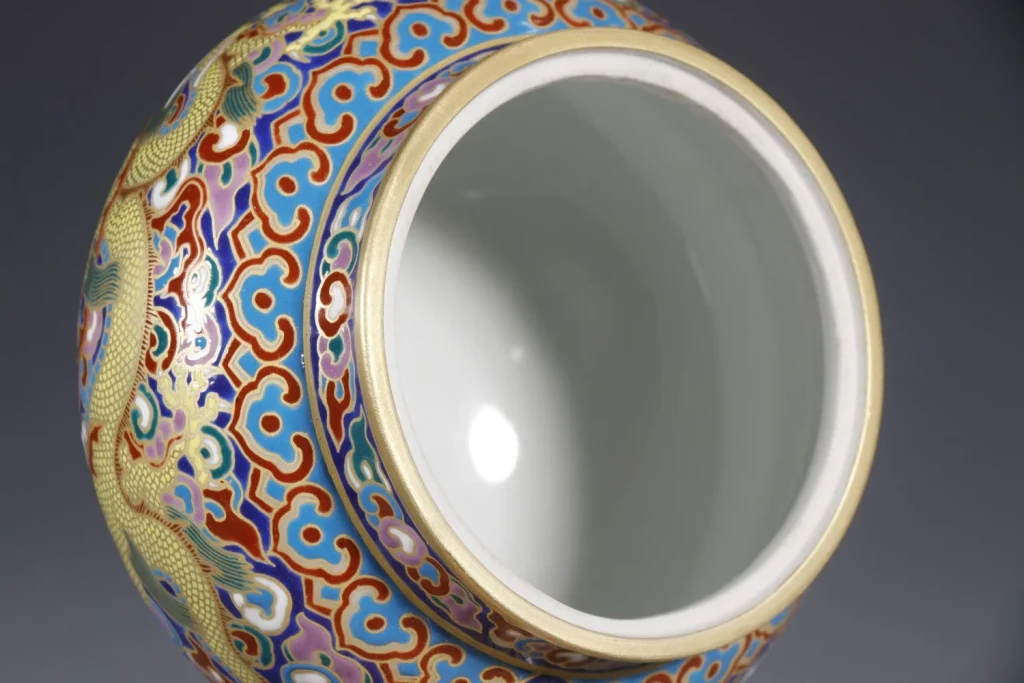
Made in Jingdezhen, the teapot is hand-formed with a rounded body, short neck, fitted cover, curved spout, loop handle and three separately modelled rounded feet. After the porcelain body is fired, blue, turquoise, red, violet, white and green overglaze enamels build the dense cloud-scroll ground. Dragons, scales, borders, rims and selected outlines are enriched with gilt decoration before a further low-temperature firing fixes the surface. The supplied description identifies the finish as gold-wire enamel; on this porcelain vessel the visible effect is best described as cloisonne-style enamel decoration defined by fine gilt outlines.
Materials and Dimensions
- Catalogue reference: CQCH-011
- Availability: enquire for availability
- Material: fine kaolin porcelain body, blue and polychrome overglaze enamels, gilt decoration
- Technique: hand forming, separately modelled tripod feet, overglaze enamelling with cloisonne-style gilt outlines and low-temperature refiring
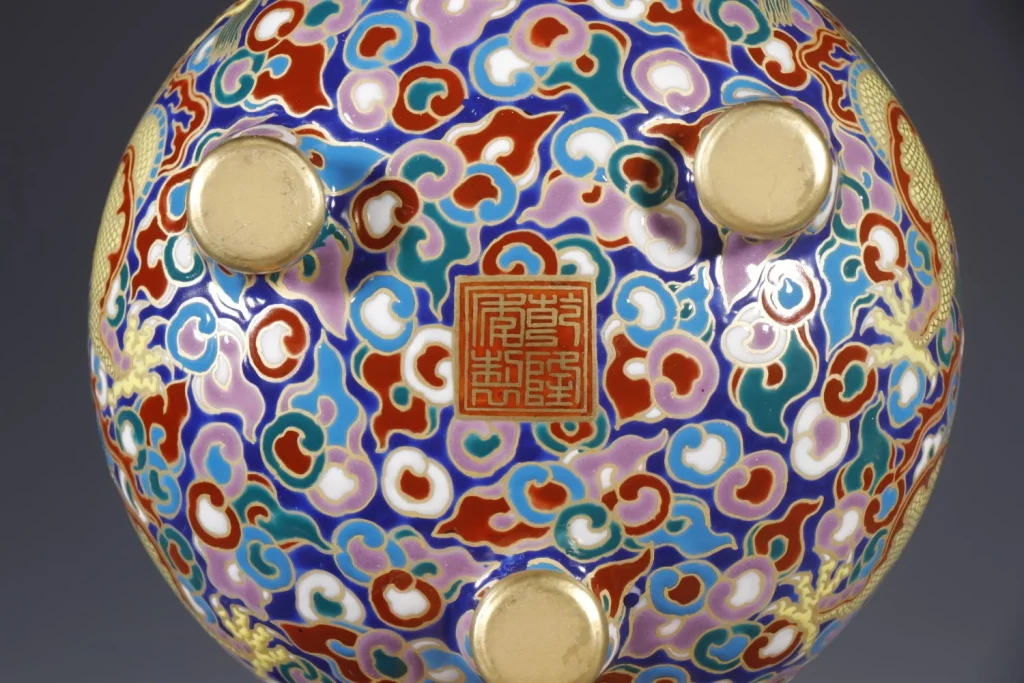
- Decoration: gilt five-clawed dragons among multicolored cloud scrolls, floral and ruyi-head borders, gilt rims, handle, spout and foot edges
- Height: 13 cm
- Mouth diameter: 9 cm
- Base diameter: 9 cm
- Presentation: one lidded tripod porcelain teapot; the lead photograph shows two matching examples
- Production: Jingdezhen, China, 1949-present
- Provenance: made in a family craft workshop
- Certificate: Jingdezhen Heritage certificate included
Origin and Design
This contemporary teapot draws on Qianlong-period court taste for technically elaborate porcelain, archaistic tripod forms and densely layered dragon-and-cloud decoration. “Qianlong-style” describes the historical inspiration of the design; it does not establish eighteenth-century manufacture, imperial ownership or production in an imperial kiln. The decorative seal-style mark beneath the body does not by itself establish age, authorship or court provenance.
Dragons, Auspicious Clouds and the Stability of the Tripod Form
In Chinese visual culture, the dragon is associated with authority, vitality and auspicious power, while layered cloud scrolls suggest blessings gathering and enduring good fortune. The three-footed form gives the compact vessel a stable, ceremonial presence. Gold accents introduce light across the richly colored ground, reinforcing wishes for dignity, prosperity and a firmly established household.
A Qianlong-Style Gilt Dragon Tripod Teapot
The gold dragons and dense multicolored cloud fields wrap continuously around the rounded body, lid, spout and handle. The teapot measures 13 cm high, with a 9 cm mouth and a 9 cm base. Its compact tripod profile suits a tea-room cabinet, scholar’s desk or close decorative display.
Frequently Asked Questions
Is this an eighteenth-century Qianlong imperial teapot?
No. CQCH-011 is a contemporary Jingdezhen work made in the stated period 1949-present. “Qianlong-style” describes the historical inspiration and visual vocabulary; it does not establish an eighteenth-century date, imperial ownership or imperial-kiln manufacture.
Does this catalogue entry describe one teapot or a pair?
The catalogue record and dimensions describe one lidded tripod teapot. The lead photograph presents two matching examples together for comparison and display.
Is the vessel made of metal cloisonne?
No. The vessel has a fine porcelain body. The term “cloisonne-style” describes the visual effect of colored enamel fields separated by fine gilt outlines on the porcelain surface; it should not be confused with a metal cloisonne vessel.
What are the dimensions?
The teapot measures 13 cm high, with a mouth diameter of 9 cm and a base diameter of 9 cm. A Jingdezhen Heritage certificate accompanies the work.
Explore the Workshop and Collection
Read about the Jingdezhen Heritage family workshop or browse the related product collection. The further reading below provides craft background rather than independent authentication of this work.
Workshop photographs, where shown, illustrate general porcelain-making practice and are not a photographic record of the manufacture of CQCH-011.
Artwork Identification
- Work: Qianlong-Style Famille-Rose and Gilt Dragon Tripod Porcelain Teapot
- Catalogue number: CQCH-011
- Production period: 1949–present
- Place of production: Jingdezhen, Jiangxi, China
- Workshop provenance: Made in a family craft workshop
- Materials: fine kaolin porcelain body, blue and polychrome overglaze enamels, gilt decoration
- Decoration: gilt five-clawed dragons among multicolored cloud scrolls, floral and ruyi-head borders, gilt rims, handle, spout and foot edges
- Height: 13 cm
- Base diameter: 9 cm
- Mouth diameter: 9 cm
- Composition: one lidded tripod porcelain teapot; the lead photograph shows two matching examples
- Style reference: Qianlong-Style
- Certificate: Jingdezhen Heritage certificate included
Dating and Historical-Style Clarification
This is a contemporary handcrafted work made in Jingdezhen, with a stated production period of 1949–present. Historical periods named in its title describe stylistic inspiration and do not establish manufacture during those periods. Historical-style marks, where present, do not establish the date or authorship of the work.
Certificate and Workshop Provenance
This work was made in a family craft workshop in Jingdezhen. The family’s porcelain-making tradition spans more than a century. Every work is accompanied by a Jingdezhen Heritage certificate. Please enquire for the certificate details for this catalogue item. Read about our family workshop and showroom.
References and Further Reading
The following resources explain the broader craft and place. They are background reading and do not authenticate or date this individual work.