
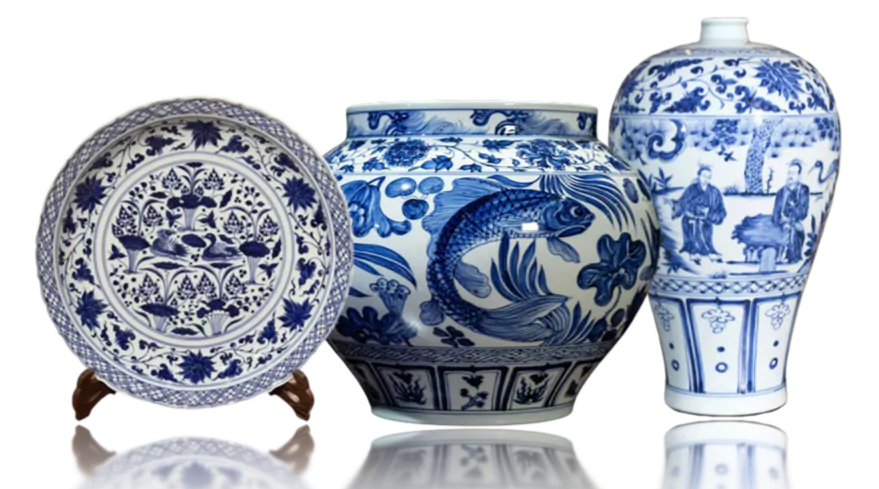
Revival porcelain is contemporary Jingdezhen work made to the forms, glazes and decoration of earlier imperial wares. It is not a counterfeit: potters reproduce historical techniques as a form of research and homage, mark their own work, and sell it openly as modern porcelain of exceptional craftsmanship.
What is revival porcelain?
In Chinese, the category is fanggu ci u2014 porcelain “in the antique manner”. A revival piece is a vessel made in a later period that copies the glaze, the shape, the decoration, or all three, of a famous ware from an earlier dynasty. This is not a marginal activity. It was practised at both official and private kilns, it survives in large numbers, and it forms an unbroken strand in the story of Jingdezhen porcelain from the Song dynasty onwards.
The distinction between a revival piece and a forgery is one of intent and disclosure, not of appearance. A revival potter works in the same spirit as an architect restoring a timber frame by hand, or a musician performing on period instruments: the aim is to understand how an earlier object was made and to keep that knowledge in use. Many pieces are, in effect, study pieces u2014 tests that allow a workshop to establish how a lost glaze was mixed or how a particular cobalt behaved in the kiln.
Reputable studios therefore fire their own seal rather than an imperial reign mark, describe the work as contemporary, and price it as modern craft. When that disclosure is removed and the object is offered as an antique, the same vessel becomes a forgery. The porcelain has not changed; the honesty around it has. For collectors, this makes provenance and the maker’s mark the first things to check, and it is why serious revival work is discussed as a branch of craft history rather than as a problem of authenticity.
When did the tradition begin?
The habit of looking backwards runs through the whole of Chinese ceramic history, but it hardened into a recognised category in stages.
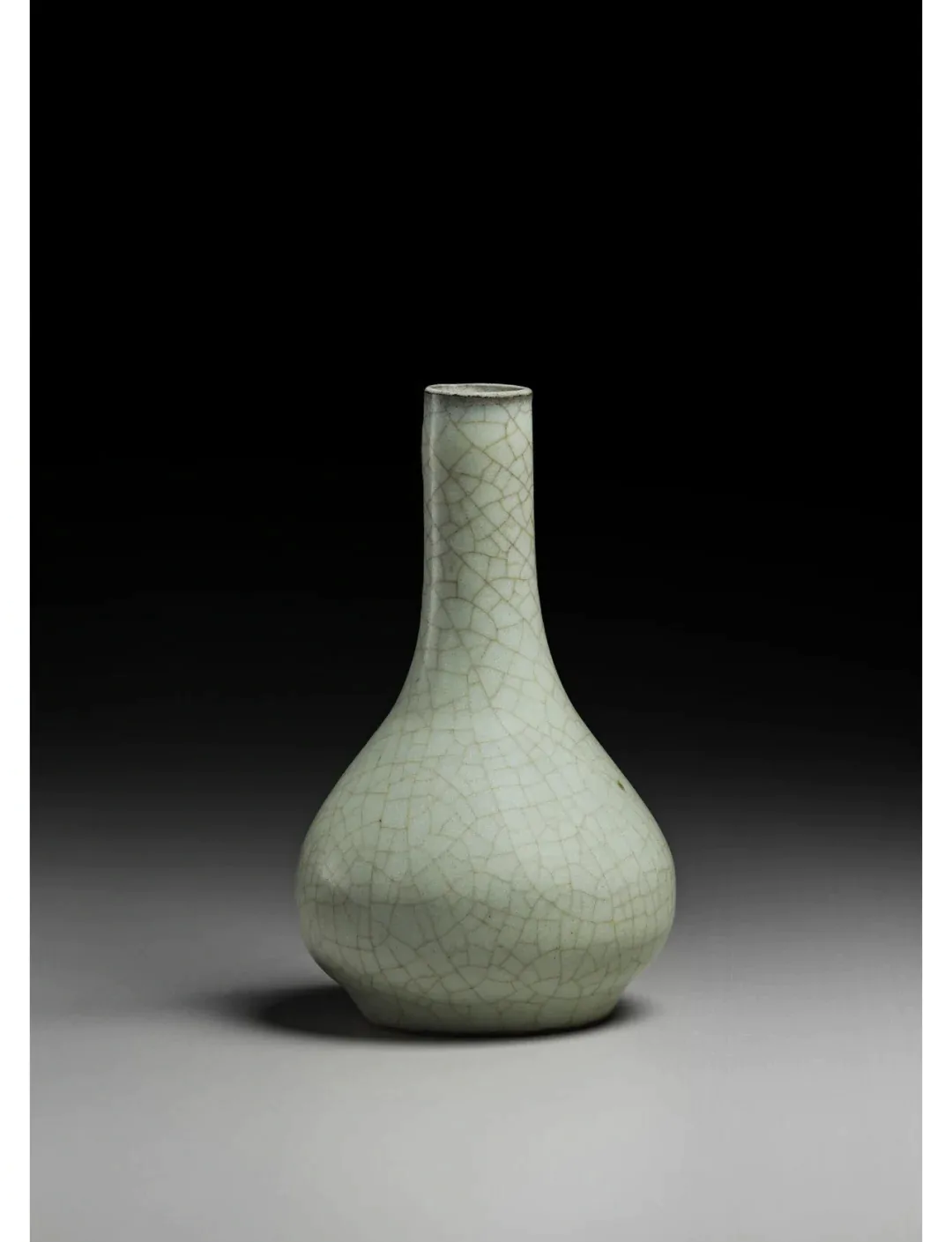
- Song dynasty u2014 the beginning. Potters studied the celadons of earlier centuries and also made ceramic versions of ancient bronze ritual vessels. The intention was already antiquarian: to recover a glaze or a silhouette that had fallen out of use.
- Yuan dynasty u2014 the category takes shape. Blue and white established itself, and later potters would treat Yuan wares as a benchmark in their turn.
- Ming dynasty u2014 maturity. By the middle and late Ming, a fashion for collecting had made reproduction of Song and Yuan pieces a mainstream business, with larger output and steadily better control of materials.
- Qing dynasty, early and high u2014 the peak. Under Kangxi, Yongzheng and Qianlong the imperial kilns led the way. The range was extraordinary: almost every celebrated type in the preceding thousand years was reproduced, and the finest pieces were made with a technical assurance the originals did not always possess.
- Late Qing u2014 decline. Output continued, but standards fell as imperial patronage weakened and workshops turned to commercial quantities.
Three forces drove the whole arc. Collector demand created a market that could absorb a large supply of copies, because genuine pieces of the great periods were already scarce. Court taste supplied the direction: Qing emperors actively commissioned antique-style wares, and an imperial commission legitimised the practice. Technical transmission made it possible, as generations of potters accumulated knowledge of clay bodies, glaze chemistry and kiln control until close reproduction became a realistic ambition rather than a lucky result.
The four great traditions of revival work
Four schools are treated as the high points of the craft. Each asks something different of the maker: one a sense of mass, one a sense of line, one a command of soft colour, and one an almost miniature precision.
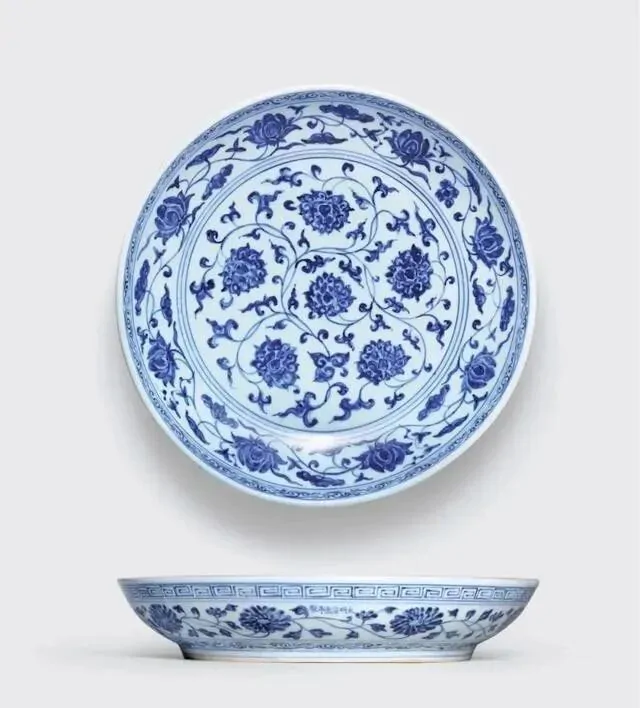
Yuan blue and white
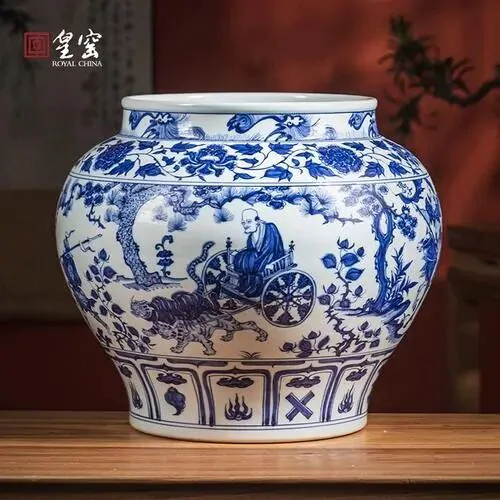
Yuan blue and white is the rarest and most imitated of the early blue and white groups, and its revival is judged on three things. The forms are monumental u2014 the meiping, the yuhuchun bottle and the large jar u2014 with thick walls and a confident, heavy profile. The decoration wraps the whole body: scrolling peony, cloud-and-dragon, and narrative figure scenes that run around the vessel like a painted scroll. The cobalt is the hardest element to reproduce. Yuan potters used imported Sumali cobalt, which fires to a deep, saturated blue with a slight bleed into the surrounding glaze; revival makers adjust their cobalt recipes to imitate that depth and softness rather than the even, controlled blue of later periods. For the wider sequence, see our guide to the history of blue and white porcelain.
Ming doucai
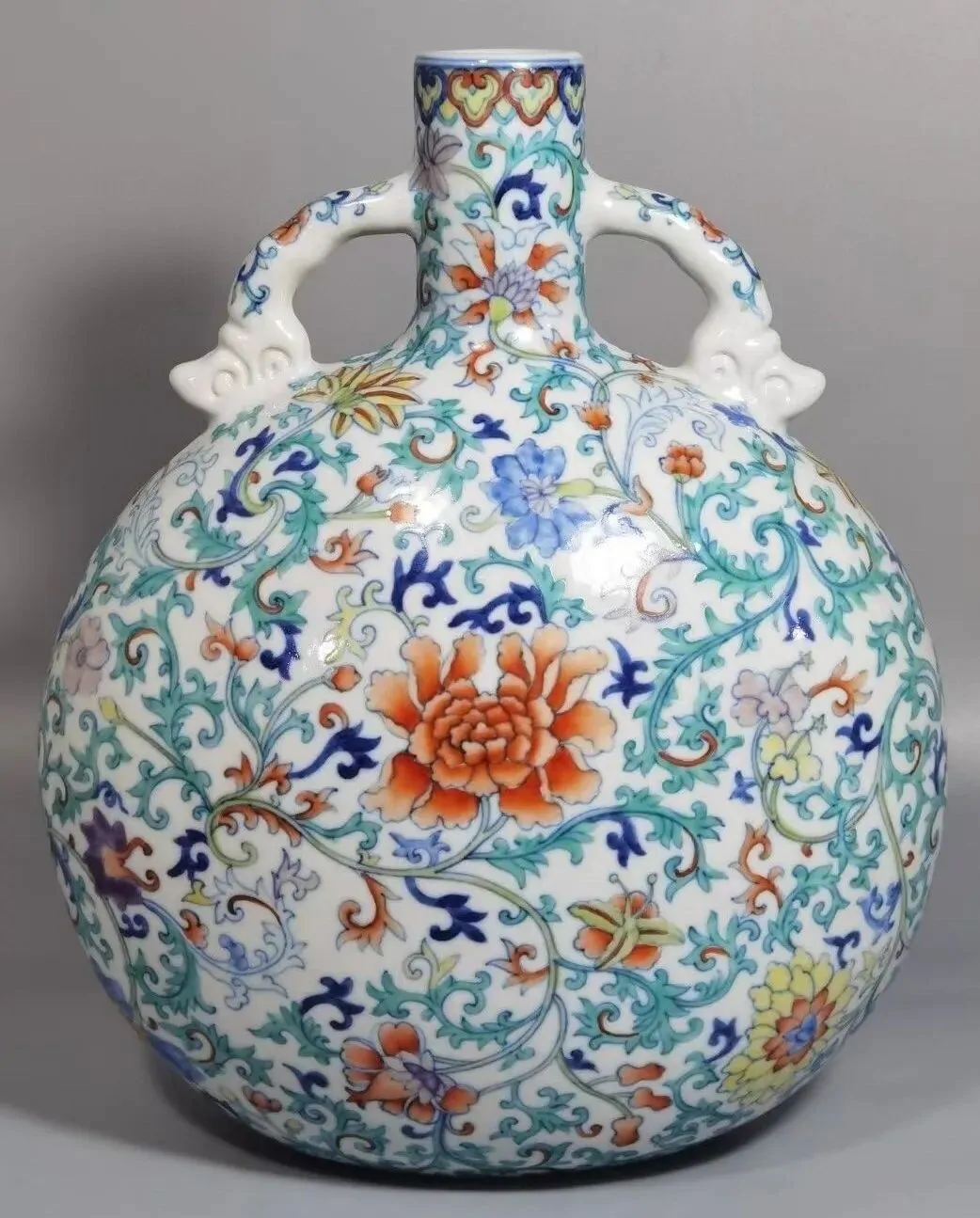
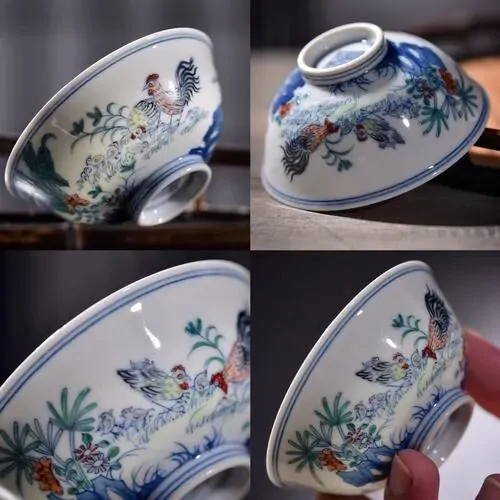
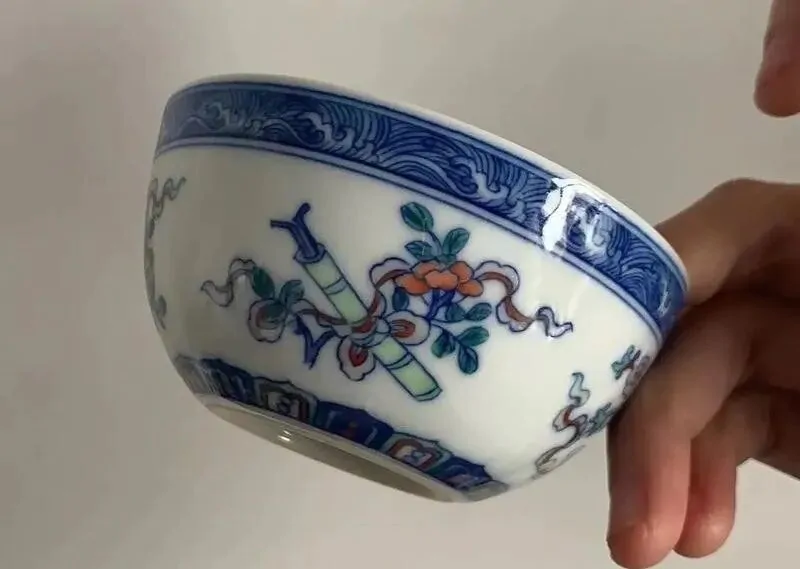
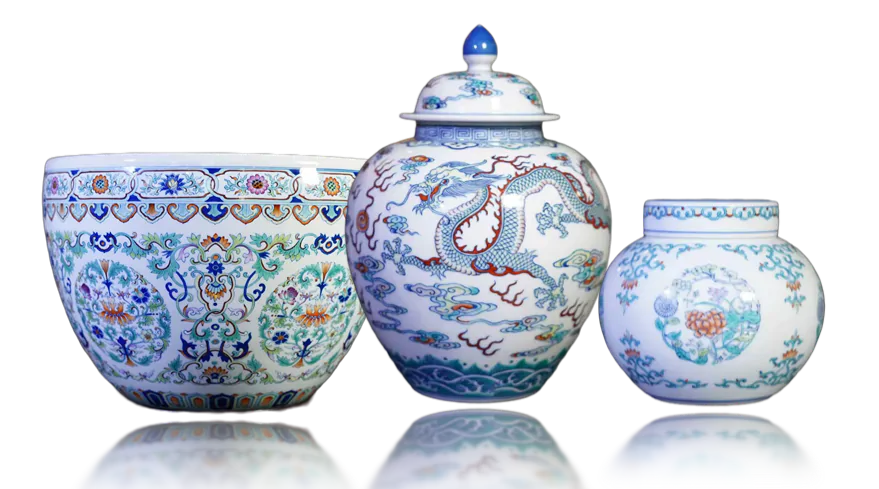
Doucai means “contending colours”, and the name describes the structure of the design rather than its palette. The pattern is first drawn in underglaze blue, fired, and then filled with overglaze enamels and fired again at a lower temperature; the blue supplies the outline and the enamel supplies the colour. The Chenghua period is the benchmark. Chicken cups, the tianzi jar and horse-hoof cups are small, thin-walled and remarkably relaxed in their drawing u2014 bird-and-flower groups, figures and scrolling stems set down with a lightness that is very difficult to fake. Revivals became a speciality of the Kangxi, Yongzheng and Qianlong reigns, and Qing copies sometimes exceed the originals in purity of colour and fineness of application.
Qing famille rose
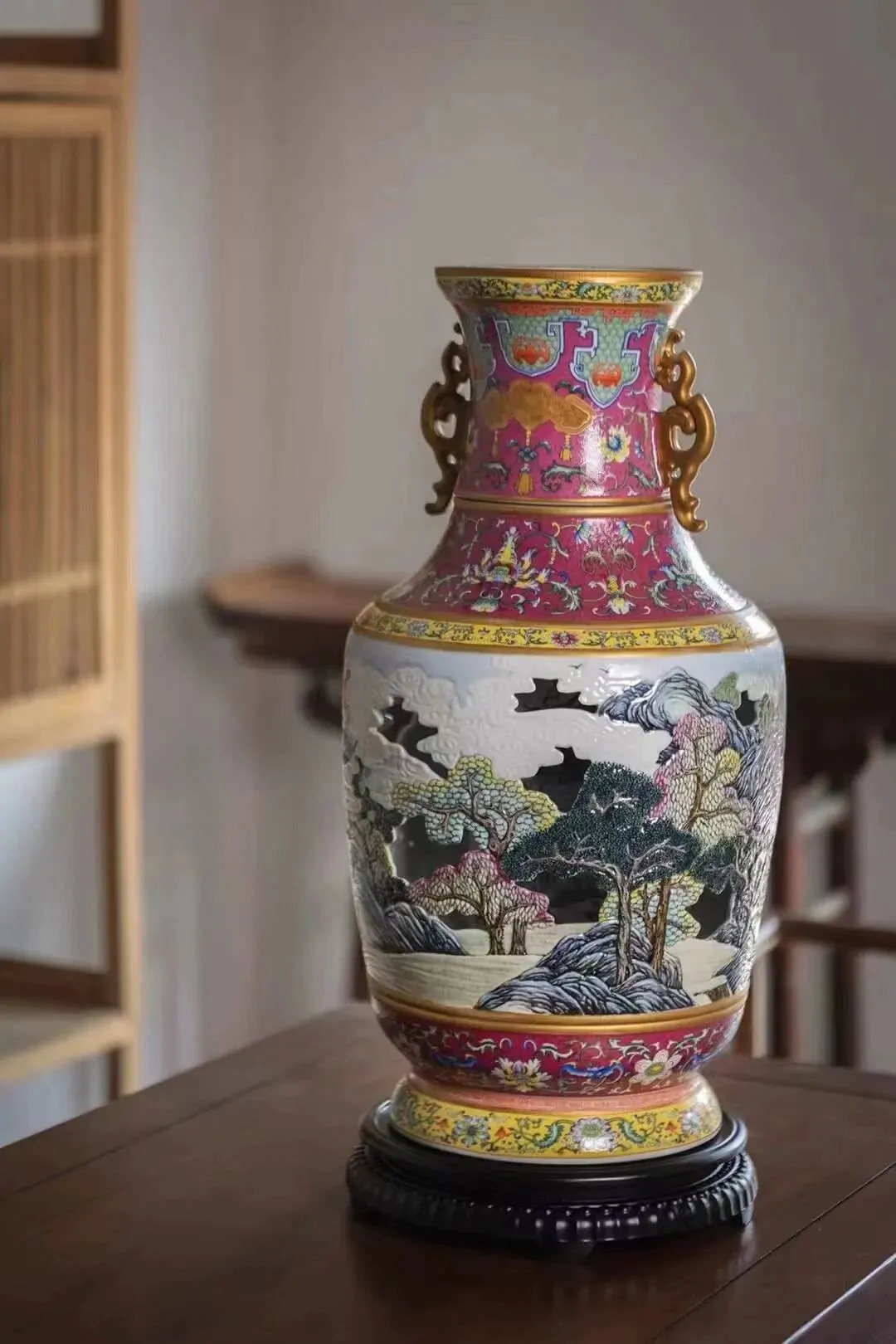
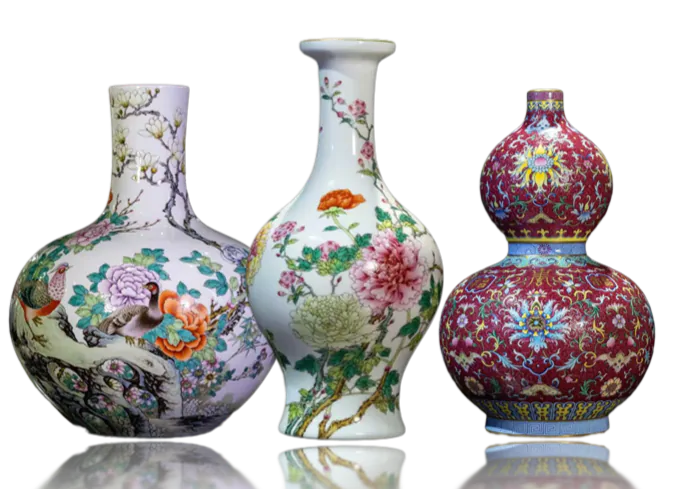
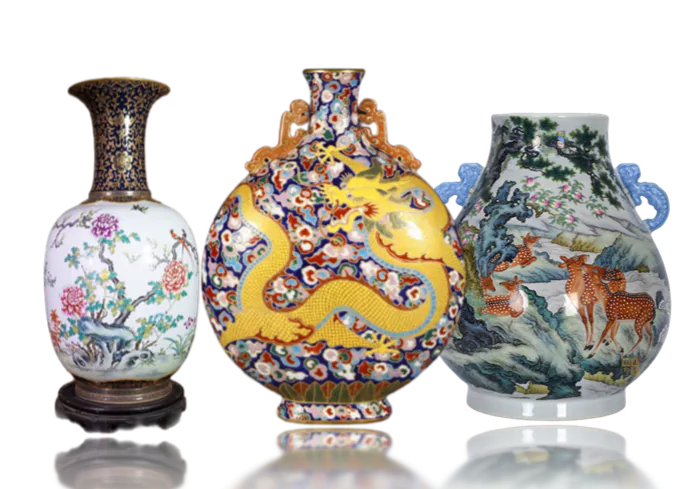
Famille rose is an eighteenth-century palette. The addition of a white, opaque enamel allowed painters to build soft pinks and to grade one colour into another, which produced the powdery, layered look that gives the family its name. Revival work follows the classic repertory u2014 vases, bowls, dishes, brush pots and display pieces u2014 decorated with peony, rose, ladies in gardens or landscape. The difficulty lies in the transitions: the colour must stay soft without turning chalky, and the drawing must remain precise under a pigment that does not forgive hesitation. The best pieces also reproduce the subsidiary techniques of the period, notably gilding and the carved ground known as zhadao, in which a pattern is incised through a coloured enamel to reveal the white body beneath.
Qing falangcai
Falangcai was a palace craft. Enamels were imported, the painting was carried out by court artists, and the output was small: little vases, bowls and cups for imperial use. Its revival therefore concentrates on scale and finish rather than on size. The decoration u2014 bird-and-flower, figures, and occasionally European motifs u2014 is dense, glossy and finely drawn, and the enamel itself has a brightness that ordinary overglaze colours cannot match. The technique is treated in detail in our guide to falangcai enamel craft techniques; what matters here is that its rarity has made it one of the most demanding subjects for revival potters.
Why is revival work so difficult?
The gap between revival work and ordinary hand-painted porcelain is not one of effort but of reference. A decorator painting a new design is free; a revival potter is answering to an object that already exists.
Recovering materials and recipes. Historical clay bodies, glaze recipes and cobalt sources are not the same as their modern equivalents. Makers work backwards from shards, kiln waste and written records, then test until the surface behaves as it should.
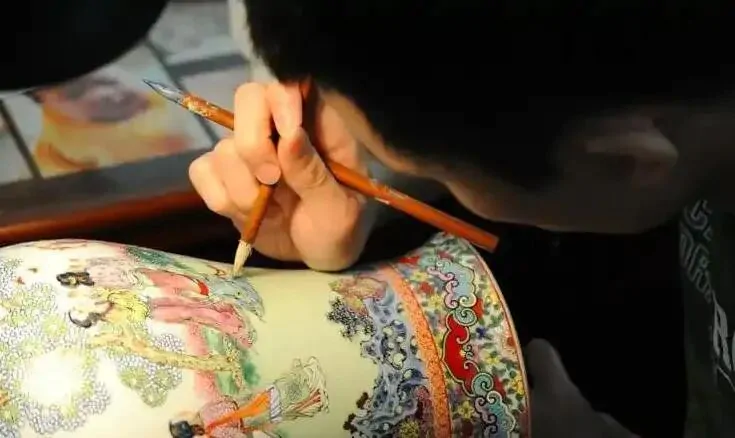
Compounding processes. A single vessel may combine underglaze blue, overglaze enamel, gilding and a carved ground, each requiring its own firing. Every additional pass adds a chance of failure, and the last firing can destroy months of work.
Hand skill and time. Top-level revival pieces take months. The brushwork has a rhythm that cannot be corrected after firing, and the feel for proportion comes from years at the bench rather than from measurement.
Form and spirit. The Chinese standard is xingshen jianbei u2014 form and spirit in equal measure. The question is not whether a vase can be made to the right height, but whether it carries the weight, the line quality and the painted confidence of the original. That is a judgement of eye and hand, and it is the point at which revival work stops being reproduction and becomes interpretation.
Revival porcelain as a collectible
Revival porcelain is often described as a living fossil of Chinese ceramic craft. The phrase is loose, but the idea is sound: each generation’s copies record what that generation understood about the past, and the sequence of those copies is a documentary record of technical progress.
For collectors, the value is contemporary rather than antiquarian. A good revival piece is bought for its making u2014 the accuracy of the glaze, the quality of the drawing, the difficulty of the process u2014 and it should be priced and documented as modern work. Its secondary value is scholarly. Because revival pieces reproduce the taste of a particular reign, they are useful evidence for how later centuries read earlier ones: which shapes were admired, which colours were thought important, and how ideas about porcelain travelled between China and Europe.
That double value is why the category has held its place in the market while remaining distinct from the antique trade. The buyer who understands the difference is protected twice over: from paying antique prices for modern work, and from missing a serious piece of craftsmanship because it is not old.
Who keeps the craft alive today?
The source article for this piece credits four names. Huang Yunpeng is associated with revival work in the Yuan blue and white manner. Tu Xinghua is named for Ming wucai and doucai. Yang Shiqi and Gong Liangbin are associated with Qing famille rose and falangcai. These attributions reflect the source’s account and the specialisms for which the potters are known; they are not a ranking, and Jingdezhen has many other workshops working in the same traditions.
Behind the individual names sits a system. Skills pass through families and through studio apprenticeships, and the study of imperial kiln sites and museum collections gives makers access to the material evidence they need. Conservation work on genuine pieces feeds back into reproduction, because a restorer learns the original’s structure from the inside.
Why does revival porcelain still matter?
Because technique is preserved by use. A glaze that is only written about will eventually be lost; a glaze that is mixed and fired every week survives. Revival work keeps the full chain u2014 clay preparation, throwing, painting, glazing, kiln control u2014 in continuous practice, and it gives museums, scholars and collectors a physical reference for objects that are too rare or too fragile to handle. It is heritage maintained as a living craft rather than as a label.
Explore Jingdezhen craftsmanship
Our porcelain collection brings together hand-thrown, hand-painted vessels made in Jingdezhen by studios that still work in these traditions. Browse the current pieces to see how historical references are carried into contemporary work.
Contact Jingdezhen Heritage
For commissions, trade enquiries, or help identifying a piece, contact us directly: Email Jingdezhen Heritage u00b7 Message us on WhatsApp
Image and text source: the WeChat public account Zhen Ci Fang. This article is an independent English rewrite.